
Opera Colorado’s gorgeous production, anchored by Eri Nakamura, reframes Puccini’s warhorse as a story of survival.
Chances are that if you’ve seen only one opera in your life it’s Madama Butterfly, Giacomo Puccini’s masterpiece. Although the first performance at La Scala in 1904 was not well received, Puccini revised it a few months later and since then it has become a blockbuster at opera companies around the world.
There are several reasons for Butterfly’s success. First and foremost, there is the transcendent music, which includes one of the most famous arias in the operatic canon, Butterfly’s heartbreaking “Un bel dì,” and the haunting “Humming Chorus.” But there are other reasons as well – an easy-to-follow tragic love story, relatively few characters enabling even small companies to mount a satisfying production, and an exoticism that has continued to appeal to audiences.
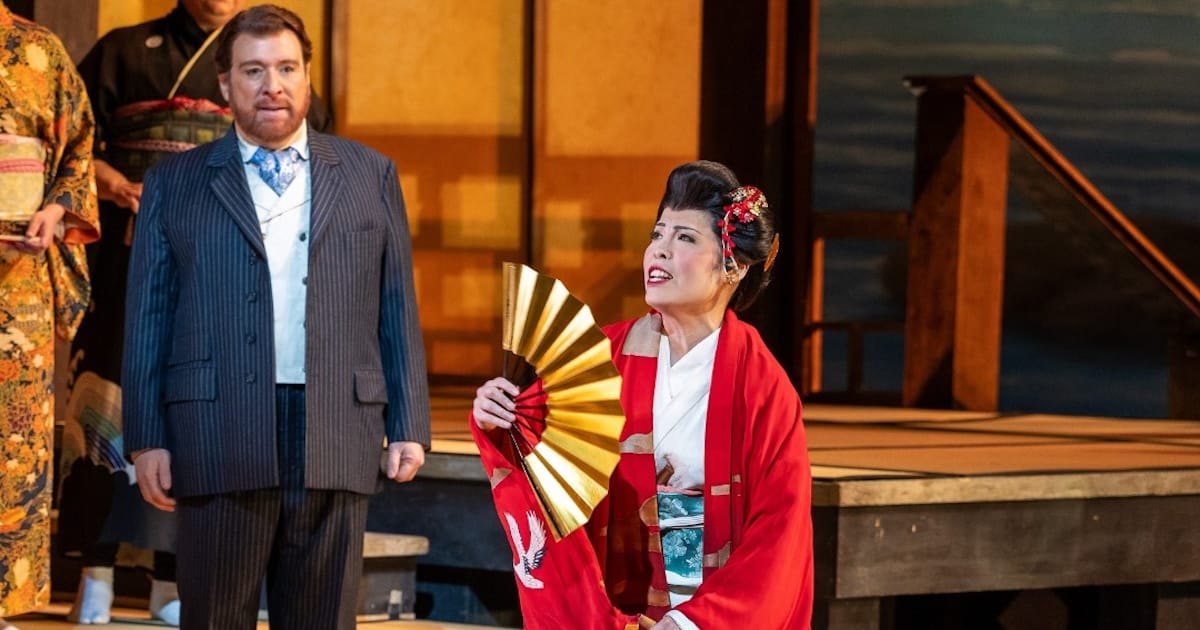
At the same time Butterfly poses major issues for contemporary opera companies, and for today’s audiences. Opera Colorado’s gorgeous production, starring Eri Nakamura, one of opera’s most preeminent Butterflies, attempts to address the issues. To my mind it succeeds as far as possible given the core story.
The challenges are complex. Different productions set the time in different eras in Japan but Opera Colorado’s takes place in Nagasaki during the Rokumeikan era (1883-87). This was a time when the Japanese government undertook a campaign to prove the nation “civilized” enough to be treated as an equal by the West. In this telling, a U.S. Navy lieutenant, B.F. Pinkerton, is visiting Japanand becomes infatuated with a 15-year-old geisha, Cio-Cio-San, and she with him. Pinkerton marries her, which brings prosperity to her family, but admits (clearly not to her) that at heart he wants an American wife.
Cio-Cio-San falls deeply in love with Pinkerton, even giving up her traditional Japanese values, and they live together happily for a while until Pinkerton leaves, promising to return in a few months. As the months turn to years, Cio-Cio-San continues to wait faithfully for him even rejecting an offer of marriage from a Japanese prince. (Under Japanese law at the time an abandoned woman was considered unmarried.)
Pinkerton returns three years later, but this time with an American wife and no apparent intent to see Cio-Cio-San. But when he learns that they have a son together he wants to take the boy back to America. Cio-Cio-San agrees if Pinkerton will visit her but before he arrives she bids farewell to her son and commits suicide.
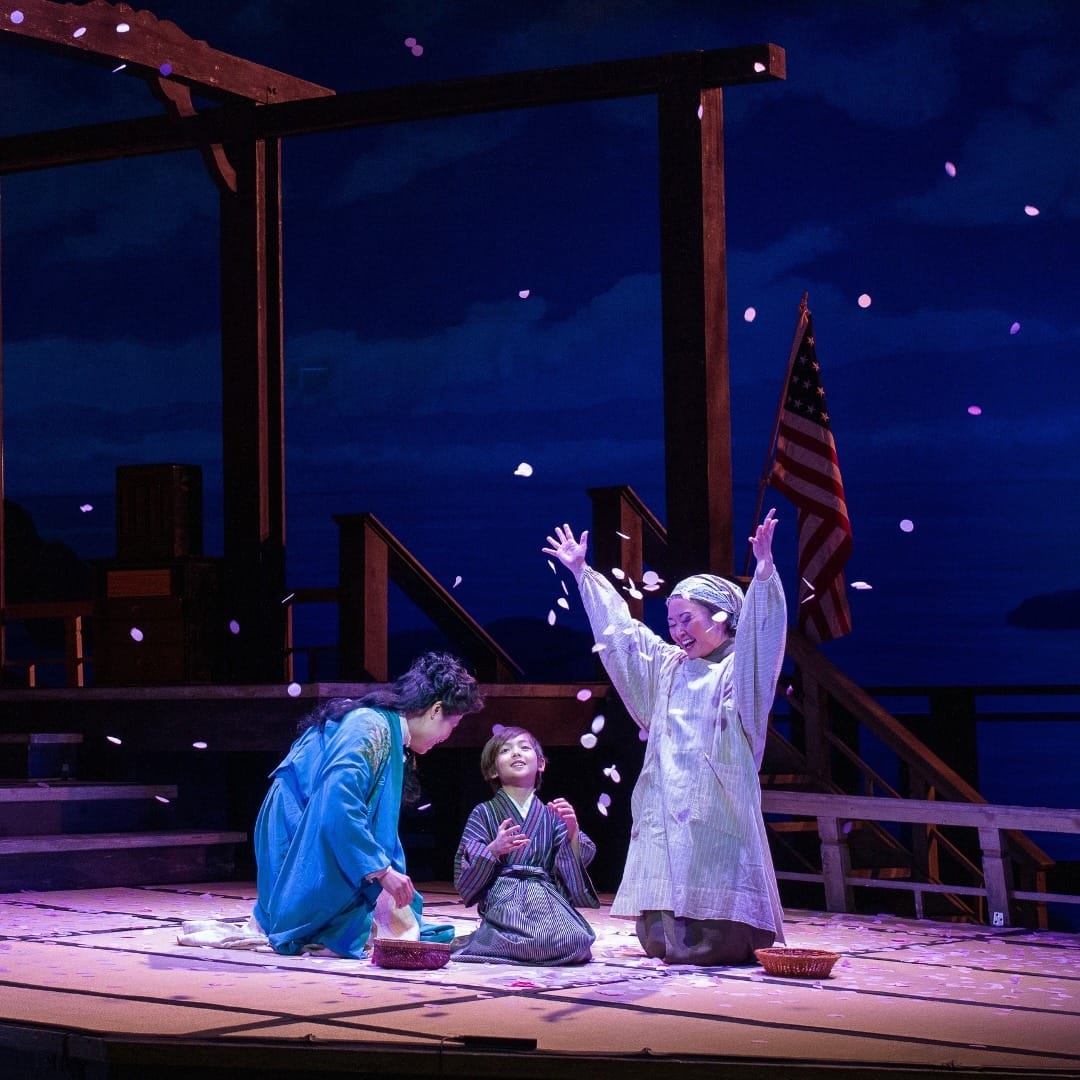
Photo: Matthew Staver
A survival story
In the program notes, Director Mo Zhou writes that as an Asian woman Madama Butterfly has long been difficult for her because of what she calls the hyper sexualization of Asian women and their portrayal as passive, tragic figures. Instead, she has attempted to regard the opera not as a love story but rather one of survival of the exploitation of a vulnerable culture by a more powerful one.
With this production Zhou has largely succeeded, partly in the way that she directs Butterfly’s upright physical stance (none of the stereotypical bowing here) but also thanks to Nakamura’s powerful acting. In her main love scene with Pinkerton, which concludes Act One, Nakamura portrays Butterfly not as a fragile love-sick teenager but rather a woman struggling to manage her competing feelings of attraction and connection to her native culture. Even in the opera’s final moments, when Butterfly stabs herself hara-kiri style, Nakamura is defiant and self-possessed. Denver is lucky to have such a major international star in this career-defining role, and Nakamura never disappoints.
The other standout in the cast is Kristen Choi as Butterfly’s friend and emotional guardian Suzuki. Opera News has dubbed Choi a “powerhouse in the making.” Based on her performance I would say she has arrived at that status. Her mezzo soprano easily has the power to reach the rafters of the Ellie Caulkins Opera House, and on Tuesday night she deservedly received an ovation almost as loud as that of Nakamura. (Note Opera Colorado’s hiring of Asian women in key roles in this production.)
Levi Hernandez’ rich baritone is well suited to the role of the American consul Sharpless, and as an actor he ably communicates his displeasure with Pinkerton’s behavior.
The only weak link among the lead singers is Joseph Dennis as Pinkerton. Dennis has a melodious tenor voice, but he never projects the intense emotionality of a lust-driven lover nor the deviousness of a deceptive partner. The result is a lack of chemistry between Pinkerton and Butterfly which, in a certain sense, reinforces Zhou’s concept (presumably unintentionally) but undermines some of the dramatic power of their great Act One love scene.
Rich production
The overall production design of this Butterfly is evocative and beautiful to look at. The single set, on loan from LA Opera, enables the multi-tiered structure to serve believably as Cio-Cio-San’s Japanese home with its movable screens and front garden. Marie Yokoyama’s luminous lighting captures the changing times of day and emotional moods as the story progresses; the scene where she, Suzuki and the boy child fall asleep on the floor together as they wait for Pinkerton is especially beautiful and touching.
Anita Yavich’s costumes are both beautiful and perfectly suited to the era in which this is set, from Butterfly’s stunning white wedding dress and flowing red cape to the stiff formal attire of Sharpless and Pinkerton.
As usual, Opera Colorado’s orchestra, sensitively conducted by Music Director Ari Pelto, does a wonderful job of capturing the spirit of whatever score they play. Here Pelto and the musicians capture the full range of sounds and feelings of Puccini’s gentle and deeply emotional score.
This Madam Butterfly is both a wonderful introduction to opera for newcomers to the art form as well as a reminder of the transportive qualities of this operatic masterpiece. Whether you’re seeing it for the first time or the fifteenth, it’s worth the trip.
Alice Kaderlan is a long-time dance and theatre critic and general arts writer. She has written for newspapers and online news sites in Seattle, Washington D.C., Pittsburgh and other cities for more than 40 years. She has also appeared on various public radio stations including WAMU-FM in D.C. and KUOW in Seattle and covered arts for NPR. She currently lives and writes in Denver.

Leave A Comment