
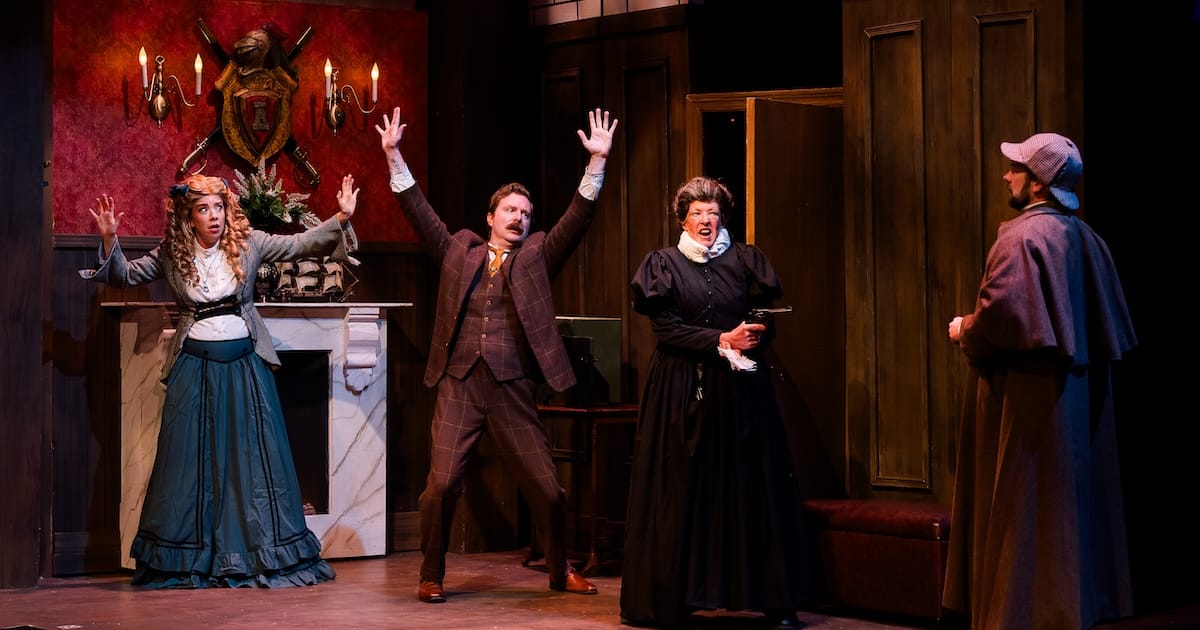
In a bonus episode recorded on location at Creede Repertory Theatre, OnStage Colorado sits down with the company’s artistic director and a returning ensemble member to talk localized theatre, repertory acting and more.
Chapter summary
- 00:01 — Intro: a bonus episode recorded on location in Creede for CRT’s 61st summer season
- 01:18 — Meeting Emily Van Fleet and Noelia Antweiler (and Noelia’s on-the-way baby)
- 04:09 — How the season’s theme, All in a Day’s Work, ties together Working, The 25th Annual Putnam County Spelling Bee, Moriarty and Fully Committed
- 08:26 — Noelia on playing Schwartzy in Spelling Bee and Irene Adler, Mrs. Hudson and Cartwright in Moriarty
- 11:36 — Casting adults as authentic kids, not caricatures
- 16:10 — Emily on her second season, doubling as managing director, and her dad Philip Sneed’s parallel career at the Arvada Center
- 18:35 — How CRT casts nationally: EPAs, 800 video submissions and a monthslong callback process
- 19:45 — Why Noelia wanted to work at Creede for years
- 20:51 — The reward — and the trap — of repertory acting
- 22:26 — Life on Main Street during a Creede summer
- 24:13 — Beyond the mainstage: Boomtown Improv, the Kid Show program and the bilingual Young Audience Outreach Tour
- 27:12 — The Headwaters New Play program
- 28:17 — An update on the Creede USA documentary
- 29:22 — What’s next for Noelia: motherhood, then Liberation at BETC
- 31:01 — Where to eat, hike and explore around Creede
- 34:58 — Alex and Toni’s takeaways on all four shows
- 37:51 — First impressions of the town itself
- 43:05 — Wrap-up and what’s ahead for the podcast

From left: Emily Van Fleet, Noelia Antweiler, Toni Tresca and Alex Miller in Creede. | Photo: Kate Berry
Full transcript
Alex: Hey, hello, and welcome to a bonus episode of the OnStage Colorado podcast for July 21. I’m Alex Miller.
Toni: And I’m Toni Tresca. Today we’ve got an interview we did on location in Creede, Colorado, as part of our coverage of the Creede Repertory Theatre summer stock season. Alex and I made the five-hour trek down to Creede from the Denver metro area this past weekend, and we saw all four mainstage shows in the season.
Alex: Yeah, it’s been a while since we’ve taken the show on the road, but it was a ton of fun to do this interview in person. Creede’s 61st season started in June and runs all the way into September, so there’s still plenty of time to get down there and see some shows in a really beautiful part of Colorado.
Toni: I think it actually started a little earlier — more like the end of May — running all the way through September. So it’s quite a long season, one of the longer summer stock seasons in Colorado. But enough yapping — let’s get to that interview now with Emily and Noelia.
[Interview begins]
Toni: All right, we are here with Emily Van Fleet, artistic director at Creede Repertory Theatre, and special guests Noelia Antweiler and —
Alex: Little Henry. We can talk about that a little later.
Noelia: Yes, it is — his first performance, perhaps.
Alex: So Noelia is pregnant. That’s the news — you’d definitely see that if you were here. Thanks for coming on the OnStage Colorado podcast.
Emily and Noelia: Thank you for having us. We’re so excited.
Alex: We’re here about halfway through the summer repertory season. It’s my first time out here in Creede, and it’s been just lovely — we went on a walk up Main Street this morning to take in the views and check out the local businesses. For you two, what have been the highlights of the summer season so far?
Emily: Well, for me, I just adore these shows. I think they speak so much to where we are right now as a society, but also here in Creede. With the 150th anniversary of Colorado statehood, we have shows that really honor that, and honor everyday Americans. And I could not wish for a better company of performers, production folks and front-of-house folks. We have so many people here in Creede who work here seasonally, and they’re all delightful humans — really talented and great to work with. So I’m very pleased by all of that.
Noelia: On my end, I’m just happy to be here. It’s so beautiful. I’ve been to Creede before, but this is my first time working here, and I’m loving the company. Everyone is so kind — the town is unbelievably kind and generous. Within two weeks, they knew my coffee order at the local coffee shop, and knew I liked salmon on my salad at the restaurant. Everyone is so unbelievably friendly, in the town and in the company. It’s been a dream come true to spend a summer here making great work, while also being in this gorgeous place, so near hiking trails and all the natural stuff.
Toni: We noticed that on our walk this morning — everybody we passed stopped to say hello or good morning. Everyone here is so friendly, in such a good mood and high spirits, which makes it seem like a good place to work for the summer.
Alex: Yes — instead of city traffic affecting your commute, it’s just friendly people on the street who want to get to know you and chat about the plays. It’s really lovely.
Noelia: Everyone who works here becomes family instantly. And very little vehicular traffic, guys — it’s really fun to walk around a town that isn’t bursting with cars.
Alex: So let’s talk a little about the season. The theme this year is All in a Day’s Work. We saw Working the musical last night, so that one definitely fits. How did you arrive at that theme, and how do the other three shows tie in?
Emily: When we were planning the season, we were looking for a title that would honor Colorado’s 150th anniversary, and also the 250th anniversary of the signing of the Declaration of Independence, in a way that felt really authentic — that every single person could get behind. That was a hard challenge, given how divisive things are right now. Our education director, Jenny Harbour, had been pitching Working to various artistic directors throughout her time with us, and she brought it up to me, and it felt like a great fit to honor this year.
What’s great about this production is that we’ve licensed the localized version, which means a lot of the monologues can be swapped out for monologues based on interviews with people in the local community — so you can honor the people who keep it moving forward every day. Because the Creede community is so tight-knit and relies so heavily on each other, it was really special to honor our community that way, and by extension all Americans who participate in society in a meaningful way. So that speaks to Working. The other shows, in their own ways, speak to everyday people trying to get by and do good work.
Spelling Bee is all about awkward middle schoolers and educators navigating difficult emotions and awkward developmental stages in a high-stakes environment. It speaks to American meritocracy and the pressure society puts on all of us to be winners.
For Sherlock Holmes, “all in a day’s work” is a direct quote — but that, too, is about the work of helping people, fulfilling a mission and honoring the work. Holmes isn’t who he is without the work, and neither is Watson, who’s fully committed to Holmes in that way. Fully Committed completely embodies the theme, too, because it’s one man doing the work of a hundred people — literally, and in a meta-theatrical way: one actor plays about 40 characters over the course of one performance. So that’s how all the shows fit the bigger theme. But Working is certainly the anchor piece.
Toni: With Working, it was really interesting to see some evocative Creede stories woven into the piece, which I’ve seen several times before — not always the localized version. Stories like the miner’s, or the fourth-grade teacher sharing about her seven-person class, or the local firefighter. Those are the kind of things you just wouldn’t get in another production of Working, and they felt very true to this Main Street and the people who occupy it year-round.
Emily: That’s right. All of the words from the local interviewees are used in the script — we don’t rewrite anything. It’s their words, their voice. And another great thing about the localized script is that even the pieces that are meant to stay scripted from the original production are flexible. There’s a piece with a retiree that’s scripted, not based on a local interview, but it references local restaurants, because this version lets you customize it for your region.
Alex: So Noelia, can you talk about the two shows you’re in, Spelling Bee and Moriarty? Who are you playing, and what have these experiences been like?
Noelia: In Spelling Bee, I play Logainne Schwartzandgrubenierre — Schwartzy. She’s my absolute favorite. She has a lateral lisp, which just adds to the intensity of the show. She’s an incredibly stressed-out third grader, the youngest competitor, and she has two dads who are very, very pressuring and have high expectations. It’s such a blast to play this kid who’s neurotic and stressed, with the stress seeping out of every pore. What I love about Spelling Bee is that each kid is neurotic and awkward and weird and wonderful, and each is celebrated and also poked fun at, just a little, in the way we all recognize the awkwardness of middle school and elementary school.
In Moriarty, I get to play a couple of different characters — mainly Irene Adler, the woman Sherlock Holmes always loved and loves. But also some fun ones: Mrs. Hudson, the Sherlock Holmes staple, and Cartwright, a little street urchin who’s always my favorite. I played a version of Cartwright in Baskerville last year.
Alex: And I recognized the accent.
Noelia: Yes — Cartwright is forever my favorite. He’s just a disgusting 14-year-old boy, picking at his butt, obsessed with changing bodies, and he’s a delight. But Irene Adler is the main one, and she’s fierce and fun. I love that she gets to go head-to-head with Sherlock and really challenge him — almost bully him a little: “I’m not going to let you get away with this.” It’s such a nice dynamic, especially with Graham, who’s playing Sherlock — we get to go head-to-head throughout the show and develop this wonderful love through mutual respect. It’s almost the enemies-to-lovers pipeline, but not quite, because they’re attracted to each other from the beginning. I love putting on multiple different hats in a show. It’s a lot of fun.
Alex: One thing I love about Ken Ludwig adaptations is that he writes his women in such an empowering way — often a twist on the original work that inspired them. Irene is a great example. She’s so strong, and in so many ways she’s leading the charge, doing the unseen work of solving the mystery and getting to the heart of it.
Toni: For Spelling Bee, it’s often adults cast as children. Have you played a role like that before, and what’s it like playing a kid?
Noelia: I don’t think I’ve played a kid before — I’ve played Cartwright, but not an actual child. It’s a blast. We were lucky — our company manager, Bethany, has two young daughters, and one of them, who’s eight, came to a rehearsal. My character is eight too, and getting to watch this little kid — she’s so bright and warm — fidget, laugh at some things and not others, was so helpful. I was also a nanny for many years, and I went back to New York right before this contract started and spent time with kids I used to nanny who are now this age. You really notice all these little things that matter intensely to them and don’t matter to you at all. Kids are so wonderfully intense about what they want and need, and most times they’re still too young to have the social graces to edit themselves the way adults do. So it’s nice to just go off instinct — this is what I’m supposed to do, but this is what I really feel bursting out of my chest.
Emily: I don’t know — what do you think about kiddos? There were a lot of conversations in casting about how to find adults who can authentically play young people. A lot of productions might comment on the awkwardness, or clown it up a bit, and play these characters from an adult lens in a way that’s meant to be judged, or funny in that way. One of the things I really emphasized in casting was that we were looking for authenticity — we weren’t looking for anyone to try to be young. Alec Steinhorn, our incredible music director, was looking for a very specific straight tone in the way people approached the music. And one thing about Noelia that I adore as a performer is that she’s so vulnerable, and able to access emotions so easily — they’re just right there, and she’s so present. That was really powerful in her audition for Schwartzy, because there are some really vulnerable moments, and we didn’t shy away from those. I think part of what makes these kids so lovable is their authenticity and their vulnerability — you can laugh at them and love them at the same time, laugh with them and also feel for them and cry with them. Every performer in this show really brings that.
Alex: And it deepens the experience so much. What was the documentary you had us watch? What was the name of it?
Toni: Emily had us watch this incredible documentary at the beginning of the rehearsal process — because Emily is directing Spelling Bee. I don’t think we’ve said that on mic, but for our listeners: Emily, our artistic director, is also directing this show. She had us watch an amazing documentary about the Scripps National Spelling Bee, made around 2001. It follows about ten kids, and it was fun to watch and think, “That’s my kid,” or “That kid’s in the cast,” or “I know that kid.” It’s a really high-pressure situation for these little guys. It’s called Spellbound, released in 2002.
Emily: Our dramaturg found it and turned me on to it. I think a lot of our Spelling Bee students were inspired by this film. I’m so grateful for that — it was a really excellent glimpse into the high pressure of the Scripps National Spelling Bee, and these very young people navigating so many challenges.
Toni: So Emily, this is your second season at Creede. What’s your experience been like so far? I know you’re also currently acting as managing director. How’s that going?
Emily: It’s good. When I joined the staff as artistic director in 2024, that’s exactly what I stepped into: the role of artistic director — leading the programming, the artistic vision, casting and choosing shows. Then about a year in, I also took on the managing hat, which is a lot of spreadsheets and operations. I didn’t come in with a ton of skills or education in that area, but I’ve educated myself a great deal, in part through the work, but also I’ve been pursuing a graduate certificate in arts management. My dad, Philip Sneed, ended up doing the same thing — taking on the numbers and operations piece. He just retired from the Arvada Center as president and CEO, and I’ve looked up to him since I was a child. I think some of that love of the puzzle of the numbers, and how everything works together, rubbed off on me somehow, because I’ve actually really enjoyed that piece too. It lets me exercise very different parts of my brain — one minute I’m puzzling over numbers, and the next I’m in a music rehearsal. It’s challenging in a way I didn’t expect, and I’m constantly surprised and delighted by it all.
Alex: Definitely gives you an opportunity to use both sides of the brain. So do you live here full-time?
Emily: I do. I own a home here now. My five-year-old is in school here in Creede, at the Early Learning Center. We’ve planted roots — we build fires in the winter to stay warm, and it’s nice and quiet. I still make it up to Denver pretty frequently, because we have family and friends there, but I’m based in Creede now.
Toni: But it’s absolutely a full-time, year-round job.
Alex: So I wanted to ask about the process of finding actors — the auditions, the rehearsals. You cast nationally, right?
Emily: That’s right. We start season planning around this time, so right now we’re thinking about titles, and once that’s solidified, our season is announced around October or November. We hold EPAs in a couple of different cities — last year we went to Denver and Chicago. We also accept video submissions; last year we received about 800 videos, and we screen all of them in December. All of our initial-round auditions happen before the end of the year, and then starting in January, we solicit callback videos. Hopefully everything’s buttoned up by March, so people can arrive in May to start rehearsals.
Alex: And so for you, Noelia, what attracted you to auditioning for Creede?
Noelia: I’d wanted to work here for quite a while, actually. I really love this theatre, and word travels fast in the acting community about whether a place is a good place to work. This has continually been on my list of “if you get the chance, you have to work at Creede.” It’s a really special place, and now that I’m here, I can say that with my whole heart. So I reached out to Emily and said I’d love to audition, and luckily she knew my work, so she kindly said we didn’t need a pre-screen — she’d just call me back, which was lovely, because I personally hate doing a monologue and a song. That was a nice step to skip. Then they called me back for the track I’m in, gave me some scenes and songs, I sent in a video, and got an offer at some point after that. That was that.
Toni: You’ve done repertory work before, at the Colorado Shakespeare Festival. As an actor, what’s the difference between preparing to take on multiple roles you switch between, versus a one-off show where you’re focused on a single character?
Noelia: Being in repertory is my favorite thing as an actor. It’s the most rewarding, the most giving — you’re working multiple parts of your actor brain, which is a delightful gift. We all want to be the fullest version of whatever we’re passionate about. A lot of people ask, “How do you keep the roles straight?” Really, it’s like — can you watch two TV shows and keep the plots straight at the same time? Can you read two books at once? Yes, plenty of people do this. Once you’re in the room, the circumstances, the world you’ve built, just happen, and the work is never boring. But sometimes, on a long run, there’s a trap of it becoming rote, becoming routine. Doing repertory, and having to switch continuously, never lets that happen — especially with Spelling Bee, because we have audience volunteers, so there’s a surprise element that makes the show vastly different every night. That’s a wonderful gift to those of us living and breathing onstage.
Alex: To the both of you — do you get out much in Creede during the summer season? What’s life like on Main Street?
Emily: I think we’d have very different answers to that. I do my best to get out in the summer, but I spend a lot of time at my desk and in various theatre spaces, and it’s all wonderful — I love everything about it. I’m also meeting with a lot of patrons and donors, and people who are super fans of CRT and are only here in the summer, so I do my best to get those people out of my office and onto the street. I’ve gotten to try a couple of great restaurants — there are some new places in town, some great shops — but I never get out as much as I want to in the summer, and that’s the prime time, because everything’s open and bumping.
Noelia: My main thing has been hiking — I’m hiking three or four times a week. It’s a huge passion of mine anyway, so getting to be out and hike so much is wonderful. When we were rehearsing, I didn’t get out so much, because it was about learning lines and music. But now that everything’s open — well, obviously I’m pregnant, so I’m not going out with the 20-year-olds, but I did hear them singing karaoke from my window last night, which brought me joy. I heard a version of “Zombie” and “My Heart Will Go On.” Pretty great. I’m a very social person, though — I love being out and about, whether that’s hiking or going for coffee or a meal. I also like to eat, so — being out, eating, drinking non-alcoholic beverages.
Alex: Emily, we talked about the four mainstage shows — can you talk about some of the other programs that go on here in Creede?
Emily: Yes — this is our 20th year of Boomtown, our improv comedy show. It’s a long-form improv show that our former artistic director Jessica Jackson started, and it’s on Sundays at 7 p.m. It’s musical improv, so our music director, Alec, provides all the musical stylings, and Clark Jones is in that as well, along with a lot of our musical theatre friends, Julian and Maya. There’s a lot of fun music and great energy this year, some returning Boomtown veterans and some new folks. It’s always really popular among our local audiences, because in the past it’s either been late at night or on a Sunday night, when a lot of local businesses are closed — so it’s become a real favorite among our local community and our visiting patrons.
We also have incredible education programming here at CRT. This is our 24th year of our Kid Show program — they’re actually going into tech next week. It’s a fully supported CRT production, but with students, a lot of them local, and it provides theatrical programming and education for folks — especially in Creede — who don’t often get that kind of opportunity. This year they’re doing a puppet show, partnering with the Dragon Seal Puppet Troupe; the folks at Dragon Seal are helping the students devise, create and build their original puppet shows. That runs next week, July 24-26.
We also have our Young Audience Outreach Tour, a new musical every year — bilingual, English and Spanish — that tours across the Southwest in the fall. That starts rehearsals in a few weeks. This year it’s called ¡Dale, Dale, Dale!, about a boy celebrating his birthday who’s getting a piñata, and the piñata comes to life. It’s about facing your fears, because the piñata doesn’t really understand what his purpose is. It’s really cute, and it travels to a lot of rural, underserved communities that don’t otherwise get theatre programming. That’s a really exciting program. We finished camps in June — gosh, we have so much going on, it’s hard to keep track of it all, but I think that covers most of it. Some years we’ll have special events and concerts too, but that’s the gist of what we’ve got going this year.
Alex: What about the new play festival?
Emily: Our Headwaters New Play program encompasses a lot of the new work we do throughout the season — often that’s the Kid Show, or the Young Audience Outreach Tour, which is a new play. Last year we commissioned a piece from the Dragon Seal Puppet Troupe, an all-ages puppet show that was actually a play with live actors and storytellers, with three different puppet shows within that framework, which was really incredible — we had a reading of it last year. We’ve migrated Headwaters from a submission-based program to a commission-based one, so the process of finding a commission is ongoing. This year we don’t have a commission for a reading, but we are premiering our Young Audience Outreach Tour at the Headwaters weekend. So we’re always committed to new play development, in all its various forms.
Toni: You may not know the answer to this, but one of the last times I saw you in the metro area was at the screening of Creede USA, that excellent documentary that takes people inside this town. Do you have any information on when that’s going to be released to a wider audience? I’d love more people to be able to see it.
Emily: I have no idea, honestly — I wish I could tell you. It’s definitely made the festival circuit and continues to be screened at festivals. I know the filmmakers are working toward distribution, particularly in schools, because I think they’d really like to see it screened for young people and educators, since some of the subject matter relates to the Creede school. But beyond that, I don’t really know. I know a lot of folks are asking, and we just aren’t sure — our fingers are crossed. We don’t know yet, but we’ll definitely publicize it when it comes out.
Alex: So, Noelia — one of the questions we usually ask actors at the end of these interviews is, what’s next? But your baby is due in November, so that throws a bit of a wrinkle into things. What’s next?
Noelia: Actually, I do know what’s next, which is pretty crazy. This is my last project before the baby comes, which is great. Then I’m taking a couple months off, but I’ll be back at BETC in March doing Liberation, which I’m very excited about — I saw that show on Broadway, and it was amazing. I’m so delighted to get to do that Pulitzer Prize-winning show. Fun fact about Liberation: a CRT alum, Charlie Thurston, was in the Broadway production.
Toni: I saw him!
Noelia: Yes — he was an actor in our company years and years ago. He and his wife, Becky Gibble, met here and got married here. He’s also an excellent playwright — he writes a lot of plays for Trinity Rep now, but he wrote a play for us, I think it was called The History Room, back in 2016, starring Christy Brandt.
Toni: Very cool — it’s a small world. There are CRT alums everywhere.
Alex: Very true. Just randomly — a guy I did a show with in New York about ten years ago was a company member here back in the ’60s. He happened to be up here visiting friends, and I ran into him. He played my dad in that show ten years ago, this wonderful guy, John Ingle. It’s really incredible.
Toni: The network extends far and wide, it seems. So for folks like us who’ve traveled here to Creede, what are some of the key things you’d recommend, in addition to obviously seeing Creede Rep, that people should check out around town?
Emily and Noelia: Hiking, for sure.
Emily: There are a couple things I adore. There’s a rail biking adventure — kind of new, or at least new to me. It starts in South Fork, a town about 23 miles from here, and you get on an old rail bike on the old railroad that used to run between South Fork and Creede, and pedal your way up the canyon. It’s gorgeous — I’ve driven that canyon road thousands of times, and this is a completely different view. I did it with my family earlier this year; it’s super fun, and there’s a “ride the rails” partnership with CRT where you can do a ride and then come see a show. Also, the Creede Hotel and Restaurant, right next door to us, has excellent cuisine — I adore it so much. It’s a great place to grab dinner before the show and then come next door and see it. They have great outdoor seating, too, with a really cool sculpture.
Toni: I’d also add, if you have a vehicle that can handle it — you need higher clearance — driving the Bachelor Loop is really gorgeous. And obviously the hiking is fantastic. I think the mining museum is really fun, too — the Underground Mining Museum.
Emily: It’s also our community center — they’ve sponsored a lot of our productions this year, including Working and Boomtown, because of the local connection. We poked our heads in there this morning; it’s built into the side of a mountain, which is pretty cool.
Noelia: And — I’m not a fly fisher, but if you are, the fly fishing here is amazing. The coffee shop in town is also a fly shop — Coffee on the Fly. We love Coffee on the Fly.
Emily: And I just want to say, Creede Repertory Theatre is a very well-established arts organization here, but there are other arts organizations that bring so much culture and vibrancy to this town — the Creede Musical Arts Collective, the Creede Arts Center, Steve Quiller, if you’ve ever been into his gallery — it’s gorgeous work. He’s a world-renowned watercolorist, and his daughter, Ali Quiller, is leading programming for the Creede Arts Center, offering courses for adults and kids. It’s really special to be in a town this small and remote and have this much arts programming available. It’s a real blessing.
Toni: That’s great. Well, Emily Van Fleet, Noelia Antweiler, thanks so much for being on the OnStage Colorado podcast.
Noelia: Thank you for having me again.
Alex: Emily, great to see you as well.
Emily: You too, thanks so much.
Alex: I think this is the first — I don’t know — remote pod we’ve done. The first pod on the road.
Toni: Something we’ve been talking about for months now, since the New Play Summit, when I saw you there, Emily. We chatted about doing this, and now it’s a reality. We’re honored to be the first road pod.
Emily: Heck yes.
Alex: All right — break legs out there.
Emily and Noelia: Thanks. Enjoy.
[Interview ends]
Toni: Well, that was just an absolute treat, getting to chat with Emily and Noelia in our Airbnb in Creede.
Alex: Yeah, absolutely.
Toni: So what did you think, Alex, of the 61st Creede summer season overall?
Alex: Well, we saw four shows — we didn’t stick around for the Boomtown improv show on Sunday night — but we saw Moriarty, Fully Committed, The 25th Annual Putnam County Spelling Bee and Working: A Musical. I’d say Spelling Bee and Fully Committed were both really fun, funny shows, and of course they start out with great scripts. I felt like Moriarty wasn’t maybe Ken Ludwig’s greatest script, although it was done perfectly fine.
Toni: Yeah — certainly not his best mystery script. Murder on the Orient Express, his adaptation of that, or even Baskerville, his other Sherlock mystery, are stronger, funnier mysteries. But this one succeeds as being a very fun piece of summer entertainment.
Alex: And then we were a little mixed on Working. It had a lot of really cool elements — it didn’t hit me quite as well as it did you, and my son Andy, who was also there, wasn’t a huge fan either — but it did have a lot of cool things in it, particularly the local elements of the Creede community built into the show.
Toni: Yeah, Emily talked a bit about that localized adaptation in our interview, and that really was probably the coolest part of this production — hearing those stories from Creede workers. However, the musical itself leaves a lot to be desired. It’s about 95 minutes of narrative, going through stories mixed with some songs, and it’s not the most compelling dramatic arc. But the stories they’re telling, and the appreciation it’s trying to foster for local community members and service workers who live and work in Creede, is really important, and I understand why it’s part of this season.
Alex: One of the cool things about seeing a couple shows in repertory is you’ll see one actor in one show and think, “I don’t know how well that person did there,” and then you’ll see them in another show and think, “That’s definitely a better role in a better show” — you can really see the stark difference.
Toni: Absolutely. It was also fun, since Creede is such a small town — you’d be walking to and from the restaurants and bump into the actors you’d just seen onstage earlier that day.
Alex: So speaking of Creede — what was your overall take on your first trip down there, Toni? How did you like it, and what were your takeaways?
Toni: It’s in a very rural location, but absolutely scenic — nestled in these beautiful, edgy, spiky cliffs at the top. What was the word you used to describe it? You had such a lovely word when we were there.
Alex: Craggy. A box canyon, yeah — very craggy.
Toni: Very craggy-looking cliffs. And everybody in Creede, as we said in the interview, was just so nice. It took a little longer to get around town, because as you’re walking, you really do have to stop and say hello to everybody. It was funny to see a lot of the Creede locals just camped out on their porches all day — you’d pass the same people sitting out there. We did a little porch-sitting ourselves. I’d say that was one of the highlights — it’s a very fun spot to do some people-watching.
Alex: Yeah, we were fortunate to have an Airbnb right on Main Street, so we did some of that too. And of course there’s lots of hiking, and if you’re into fishing — there’s also a lot of motorsports going on, which, in my view, are a little obnoxious, but that’s part of the scene in a lot of mountain towns: jeeps and OHVs and all that.
Toni: One thing that did surprise me was how limited the options were. There really are only a couple of things in town — I wasn’t quite prepared for how small Creede was. There’s one coffee shop that also sells fishing equipment right next door — Coffee on the Fly — and a couple of local restaurants, and some cute little shops. But it really is just that one Main Street, maybe two or three blocks populated with businesses. And apparently, from talking with some company members who’ve been with Creede for over 50 years, this is actually a lot more populated than it’s ever been — this is busy Creede, this is Creede that’s booming. We were talking with a woman named Kathy — I don’t remember her last name — who’d been a company member for over 50 years, and I asked her how much the town had changed. She said it doesn’t even look anything like it did when the theatre was first getting started. It’s grown up a lot around here, but still — I probably should have been prepared. It’s a town of just under 300 people, so really not big at all, and Main Street reflects that.
Alex: Yep — that’s the year-round population; there’s certainly a lot more in the summertime. It’s a hopping little place. We had a mixed experience with the restaurants — we were both a little disappointed in some of the local IPAs. Toni and I are both IPA fans, so if you get the chance, maybe go for something in a can rather than the local draft. But hey, could be your thing if you like weird-tasting IPAs.
Toni: One thing I do want to shout out — they had popcorn sold at every performance. Freshly popped, and you could bring it in. As a popcorn aficionado and someone who loves eating salty things while watching a show, I really enjoyed being able to have that, and it tasted delicious.
Alex: And I think you said it was only four dollars, right?
Toni: Four dollars, and a very generous portion — that’s for the small. They also had a massive large option; I figured that was too much for me, so I took the small.
Alex: The other thing — if you’re coming down from the Denver area like we did — it’s just a beautiful drive, mostly on Highway 285. You see a lot of fourteeners along the way, and a lot of other really nice parts of Colorado, and some old rail lines along the river by Creede and South Fork. There’s more activity happening on those now, like the rail bike Emily mentioned.
Toni: Yeah, Emily mentioned that in the interview — the pedal cars you can ride around the canyon. That’s definitely on my bucket list; I’d like to do that when I come back to see more shows at Creede. I’d overall recommend the experience — it’s a really scenic location to check out some theatre, and the locals are very happy to have folks around. It’s not like some tourist towns where they’re like, “Get out of here, you dirty summer folk.” They’re very welcoming and accommodating, and happy to see people populating the streets. The theatre itself is a little broader, I’d say, in terms of its sensibility — they’re programming for a general audience — but the shows they’re doing, and the level they’re producing at, particularly at nine thousand feet — they kept saying “theatre at nine thousand feet” — it’s quite impressive.
Alex: Yeah. All right — well, we’ll be back next month, in August, for our regular monthly show. But since we were down at Creede, we thought it’d be fun to talk with Emily and Noelia while we were there, so I think it worked out well.
Toni: Yeah, absolutely. In the meantime, we’re going to be out at a lot of different theatres seeing a bunch of different stuff. If you want to keep up with what we’re doing before our next podcast episode, head over to onstagecolorado.com, where you can check out all our latest reviews and news. But until then, we’ll see you at the show.
Alex: All right.




News about live shows in Colorado, press releases 'n' such

Leave A Comment