
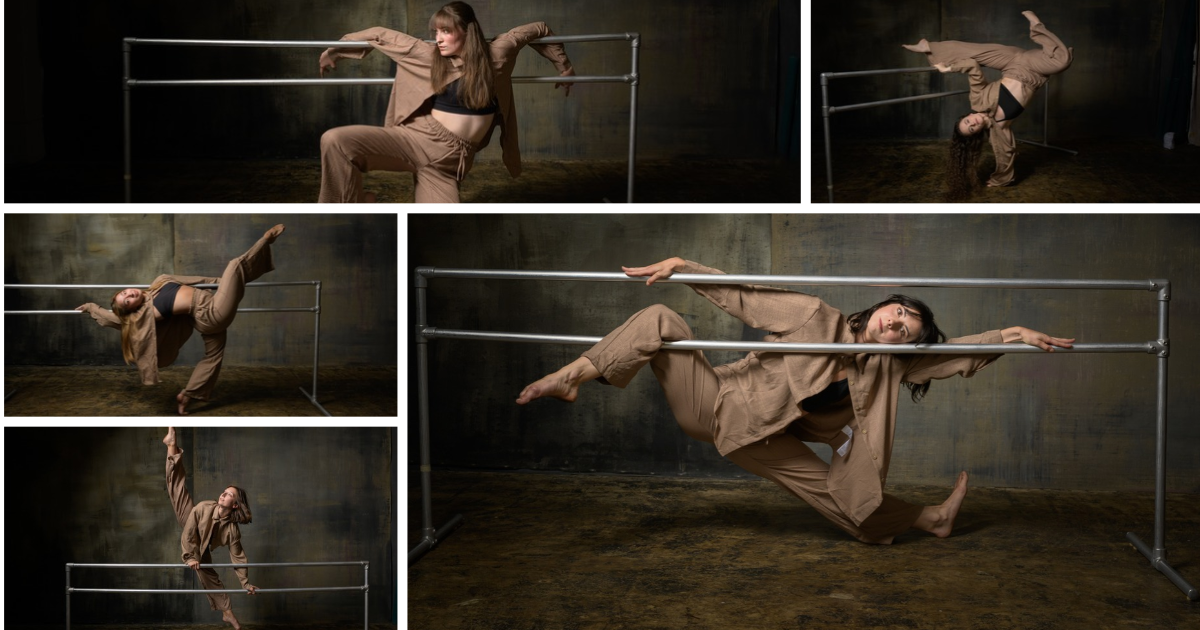
A ballet barre becomes a path through life in a full-length work from choreographers Rebecca Allen and Larah Pamplin.
Life’s experiences rarely unfold as predictably as a morning ballet barre routine, and that’s exactly the point choreographers Rebecca Allen and Larah Pamplin make in their new work Semitae: Where We Pass.
Semitae: Where We Pass is an ambitious full-length contemporary piece reflecting on life’s journey. A ballet barre represents the metaphorical path one walks along during their time on Earth. Sometimes the path is straightforward, sometimes the dancers make a wrong turn and sometimes they are stuck in a thumping tunnel with nowhere to go. In the final section, “The Worn Path,” dancers trudge, shoulders slumped toward the ground. Just as with life’s many paths, the sections reflect a range of experiences and emotional states.
Choreographer and dancer Rebecca Allen began Animus Movement in New York City at the height of the pandemic and expanded the project to Colorado in 2022. Here, Allen and her assistant director, Pamplin, create works for a small company on a production-by-production basis. The company features dancers who trained in Colorado dance schools, including Mackenzie Kellogg, Brianna Smith, Faith Brock and Madison Hard.
Paths and patterns
Semitae: Where We Pass, performed by an all-female cast, oscillates between large corps work and more intimate pieces — duos, trios and quartets. There are some notable solo and partnering moments, but Semitae‘s undulating group work is where it shines. As soon as the audience catches a glimpse of a solo and has a moment to reflect on that dancer’s artistry, the dancer is swallowed back into the group, where their movements once again become part of the collective. This effect is amplified by the uniformity of costume, hair and makeup.
The set is simple: the stage at Cleo Parker Robinson Dance Center for Healing Arts houses only portable metal ballet barres and spotlights. The barres transform with each section and are useful tools for adding depth to the choreography. In particular, a few playful suspensions and trust falls make the work more animated. Using the barres as pathways for each of life’s seasons is effective, but at times the transitions feel choppy.
Music and mood
The piece is set to an original score composed by Hymns for Wild Nature (Matt Arendse). The music is sometimes hopeful, sometimes contemplative and sometimes driving, but always pushing the piece forward. This is a score that doesn’t just provide a structure for dance but holds intrigue in its own right. The shifts in music (and therefore movement) make the performance more dynamic. As in life, from one moment to the next we don’t know whether the dance will be intense and dystopian or light and collaborative.
Semitae: Where We Pass follows two other works choreographed by Allen and Pamplin. The first, Change, was created for students at Metropolitan Dance Academy as part of the Animus Iuventus kids program. These students delight audiences with their fresh interpretation of the choreography. The other, Kinetic, is performed by Animus Movement’s second company, Animus II. Watching the choreographers’ work performed by progressively more seasoned groups of dancers is a unique opportunity to become more familiar with their style.
Final curtain bows usually don’t hold much excitement, but as Semitae: Where We Pass concludes, the audience gets a glimpse of how delighted these dancers are to be here — and as the old adage goes, “the dancer having the most fun is the best dancer.”

Jacqui Somen is a Denver-based culture reporter, covering dance, performance, and emerging artists. Also a poet, her work has appeared in Ballast Journal, Deep Wild Journal, and Humana Obscura, among other publications.

Leave A Comment