
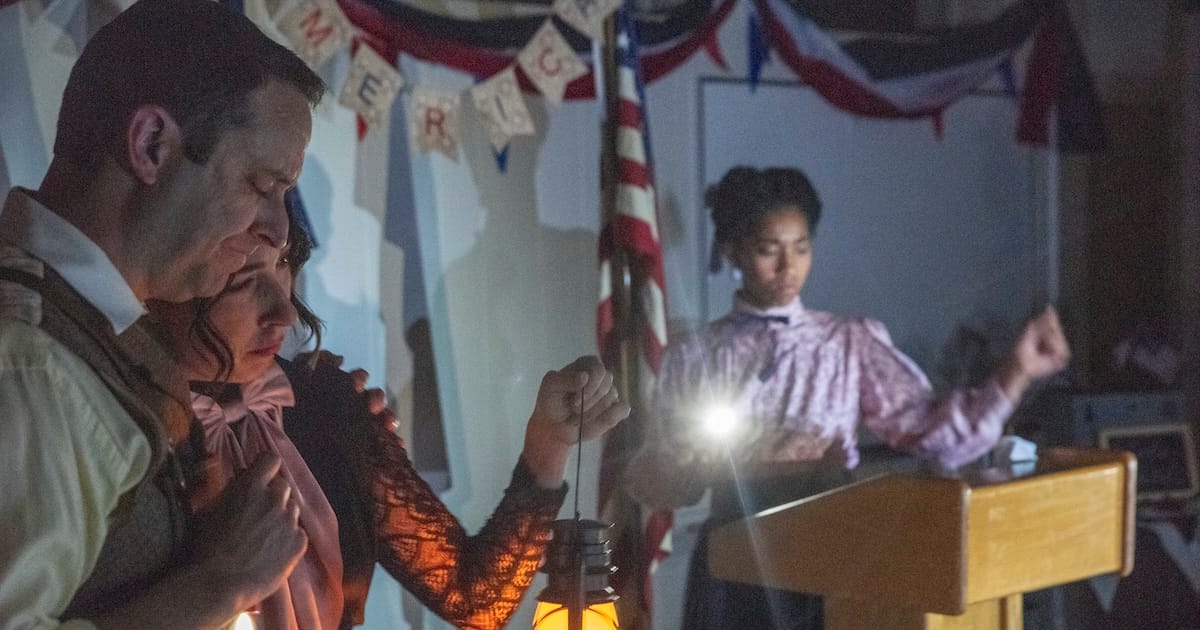
The Catamounts’ witty, site-specific performance mixes local history with ghostly fun at DeSpain Schoolhouse.
History doesn’t just sit in a display case at A Town Called Harris. It creaks across the floorboards, flickers in the lights and whispers from around the corners of Westminster’s DeSpain Schoolhouse, where the Catamounts’ latest immersive adventure turns a civic lesson into a comic ghost story.
On opening weekend, I found myself wandering from classrooms to bathrooms to secret back rooms, following characters on a roaming tour through the schoolhouse. Each stop came alive with glowing ghostly messages and eerie technical elements that made the building feel animated by its own history.
The experience was less about jump scares and more about being swept into a spirited mash-up of local lore and meta-theatrical comedy, with The Catamounts inviting the audience to play detective alongside their characters.
For Denver audiences who have wondered about the future of immersive performance after DCPA Off-Center announced it would stop developing original works, A Town Called Harris feels like a timely answer. It proves that adventurous, site-specific theatre isn’t disappearing; it’s thriving in the hands of smaller, nimbler companies like The Catamounts, who know how to turn a historic building into both a stage and a co-conspirator.

Audience members take part in the investigation in ‘A Town Called Harris.’ | Photo: Michael Ensminger

A play within a play goes awry
The performance doesn’t wait for a curtain to rise. The moment I stepped inside the DeSpain Schoolhouse, I was handed a nametag and asked to choose an old-fashioned profession — blacksmith, seamstress, innkeeper, haberdasher or even a cheesemonger — so I could join the fictional town of Harris.
The gesture was mostly symbolic, as these jobs don’t play into the experience in any way, but it set the tone: We weren’t just spectators but part of the community whose story was about to unravel. Actors in character mingled with us in the lobby, chatting about the town’s history and pointing out displays from the real Westminster Historical Society that lined the walls, such as maps, timelines, portraits and artifacts.
From there, the premise emerged: The Westminster Junior Historical Society, comprised of two overeager teens and their adult helpers, is staging a pageant about the town’s 1911 name change from Harris to Westminster.
We were ushered into a classroom transformed into their makeshift stage, where patriotic signs and displays about irrigation dressed the space, but it doesn’t take long for the reenactment to unravel. The lights snapped off, static crackled on the TV and ghostly messages were heard through the vents, suggesting that Westminster’s history was more haunted than its junior historians realized.
Rather than letting the haunting stay confined to a single room, writer Jessica Austgen and director Adeline Mann structure the evening so that every audience member cycles through five investigation sites around the building before regrouping. One group goes ghost hunting inside the classroom, another sneaks into the restroom, while others are led into the lobby, a makeshift green room and a hidden side chamber.
In each location, the DeSpain Schoolhouse itself became a character, with its historical quirks amplified by Riley Nicole’s sly lighting cues and Max Silverman’s ghostly sound effects, giving the impression that the space was playing along with the performers.
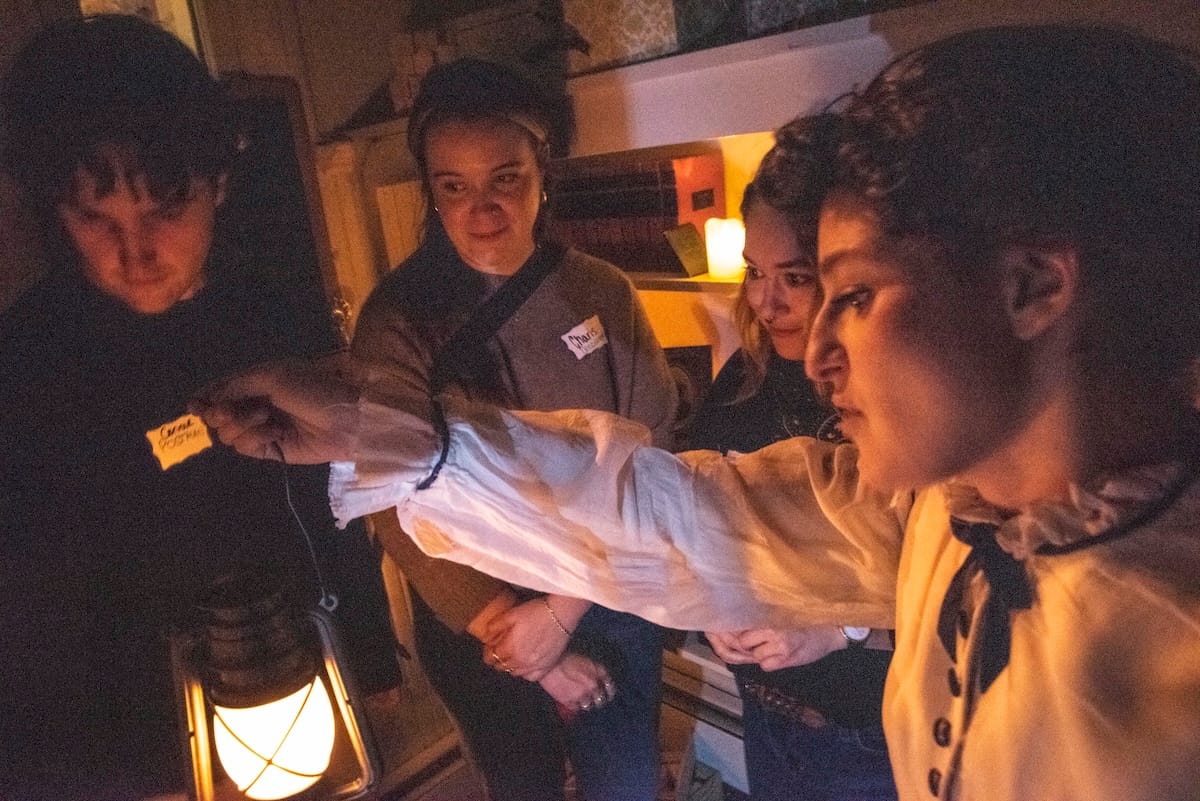
Mel Schaffer with audience members in ‘A Town Called Harris.’ | Photo: Michael Ensminger
Ensemble energy
The ensemble embraces the silliness of Austgen’s script with gusto. Jason Maxwell, as faculty supervisor Elliott Harris-Witt, is all puffed-up authority, desperate to control a performance that spirals out of his grasp. Shannon Altner sparkles as his Broadway-burnished wife, Maggie, who treats the whole affair with diva-like disdain, mining laughs from her inflated resume of Phantom and Les Misérables.
As BJ, the reluctant tech sponsor roped into playing Farmer Joe, Peter Trinh plays the characters with good-natured dry humor. Zeah Loren, as Junior Society president Niamh Smith, provides an earnest counterpoint, determined to soldier on despite the absurdity. Gabriel Hannah Smothers brings a likable energy to Fox Jones, the society’s vice president, though the role feels less developed than others.
And then there’s Mel Schaffer, drifting through the space as a ghostly member of the DeSpain family. They’re rarely acknowledged by the others, which makes their silent watchfulness deliciously eerie. Schaffer’s presence also gives the play a slight emotional edge: amid the jokes, here is a spectral reminder that real families and histories risk being forgotten.
Lighthearted haunts
A Town Called Harris doesn’t aim to terrify. Unlike immersive productions that dive into grief or psychological trauma, this show offers something breezier. The scares are mild, the mystery is solvable and the overall tone is closer to a Halloween romp than a horror story.
But that lightness is also its strength. The audience felt comfortable leaning in, asking questions and even joking with the characters. It was the kind of interactivity that felt organic rather than forced.
Under Mann’s direction, the audience cycles briskly through all five investigation sites, never lingering long enough to lose momentum. Even the transitions, from a classroom to a hallway bathroom to a hidden chamber, feel energized, sustaining a rhythm that keeps curiosity high.
Costumes and props, designed by Gleason Bauer, add another layer of meta-comedy. The pageant outfits and makeshift historical trappings look just shabby enough to remind us we’re watching a fictional “Junior Historical Society” muddle through a performance. That slightly homespun aesthetic contrasts cleverly with the professional precision of the technical design, making the production both funny and immersive.
If there’s a drawback, it comes in the plotting. The mystery is intriguing but rarely enigmatic, with some clues practically begging to be discovered. A lipstick tube framed by a lit-up makeup mirror near a smudged vent, for example, made it impossible not to connect the dots.
Once you realize many of the “hauntings” have human explanations, the structure starts to repeat itself. But the show saves its best for last with a finale that tips into the truly ghostly, leaving just enough lingering doubt to satisfy the haunted schoolhouse premise.

Shannon Altner and Jason Maxwell. | Photo: Michael Ensminger
Superb interactive adventure
The Catamounts’ 15th season begins with a wink and a ghostly nudge. A Town Called Harris may not provide the most complex mystery or chilling scares, but it succeeds on its own terms: as a quirky, meta-theatrical, immersive ghost-hunting romp that makes history feel alive.
It doesn’t attempt to reinvent immersive theater or deliver harrowing scares, but it doesn’t need to. The brisk pacing, smart staging and witty use of the DeSpain Schoolhouse create a light but satisfying evening that leaves audiences laughing as much as shivering.
The Catamounts once again demonstrate the power of working site-specifically. Using the DeSpain Schoolhouse gives the production a texture no warehouse build-out could match. The building’s real history mingles with Austgen’s fictionalized one, making the experience both educational and oddly moving. I walked away knowing more about Westminster’s past but also with the sense that I had helped “uncover” it.
By embracing the site’s unique history and folding it into a playful mystery, The Catamounts have crafted a production that is both theatrically engaging and distinctly local. The result is an experience that underscores why site-specific immersive theater remains such a vital form.
A Town Called Harris demonstrates how a small company can transform a historic space into an inventive performance environment, reminding us that live theatre’s greatest asset is its ability to animate the world around us in unexpected ways.


An award-winning Colorado arts and culture reporter originally from Mineola, Texas. Tresca is the chief theatre critic for OnStage Colorado and managing editor of OnScreen Colorado. He’s the editor of Bucket List Community News, a contributor to Denver Westword and Estes Valley Voice, a resident storyteller for the Bonfils-Stanton Foundation and the co-host of the OnStage Colorado Podcast.

Leave A Comment