
Stripped-down script and World War II staging don’t quite add up in the Springs.
The story of Romeo and Juliet, those “star-crossed” lovers and their feuding families, is one we’ve heard so much about that we think we know it better than we do. Theatreworks revisits Shakespeare’s work with an imaginative take that attempts to refresh our experience of it.
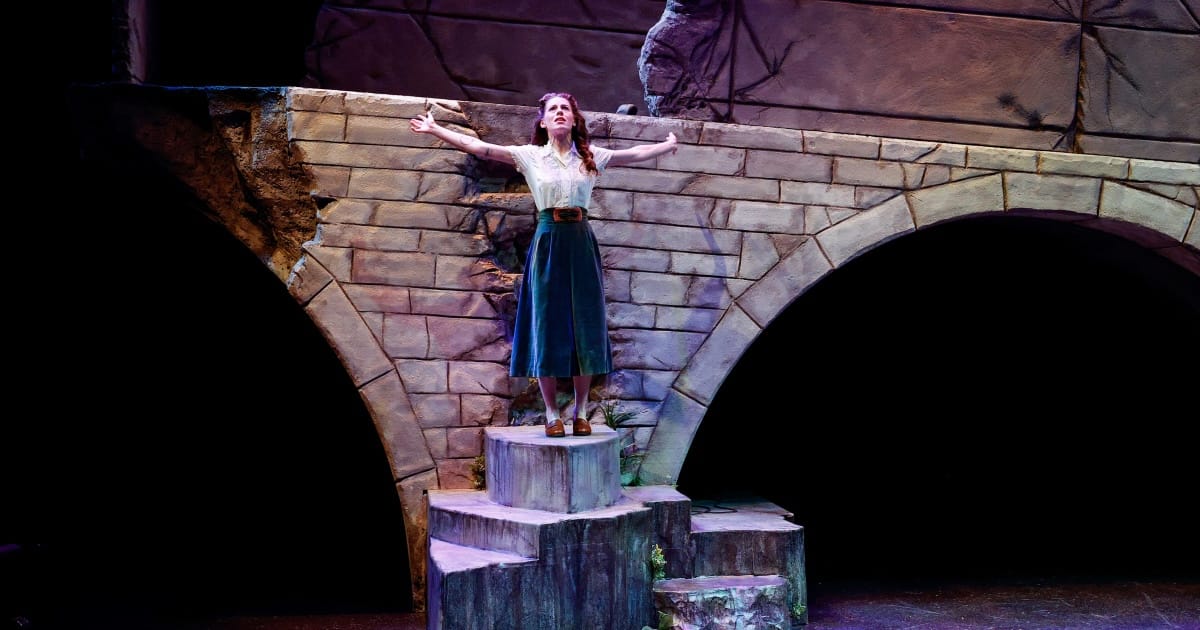
It’s a worthy purpose, but the effort is hit and miss. Theatreworks Artistic Director Max Shulman directs a high-concept production, setting the play in 1943 Verona. The war-torn city is occupied by Nazis, while overhead Allied planes drop bombs.
The setting is vividly staged with the geographically and historically accurate Ponte Pietra bridge serving as the centerpiece. After intermission, the bridge has been partially destroyed, as it was in World War II, reflecting the disruption of Romeo and Juliet’s romance amid the wider civic destruction.
It’s a great image, but other than fine set design, the concept doesn’t carry over into the play’s action. None of the characters are in the military or in any resistance, for example. The program notes tell us that Mercutio is about to be drafted, but there’s no reference to this in the play’s action or dialogue. The setting comes to seem happenstance, and planes occasionally roaring overhead seem random.
This matters because it’s the enemies within that visit destruction on each other, the poisoned civic institutions that destroy Romeo and Juliet, not invading armies.

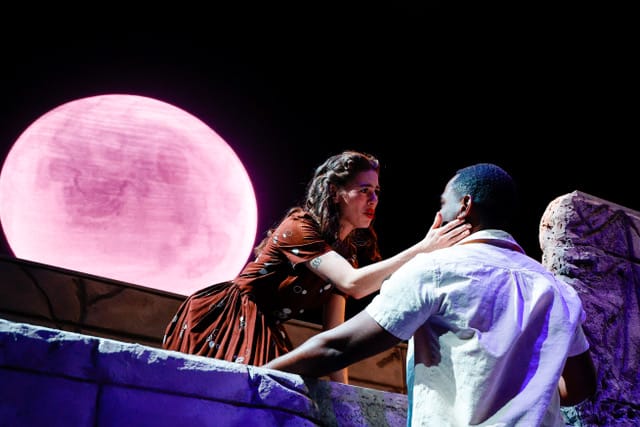
Rachel Schmeling as Juliet and Rakeem Lawrence as Romeo. | Photo: Isaiah Downing
Slow start
The production starts sluggishly, Sarah Duttlinger’s dynamic Nurse providing the only spark in the early scenes. The text itself is exposition-heavy, laboring through the backstory of expectations that girls will marry young, the fraught history of the Capulets and Montagues, and the fatuous Paris (Josh White), smug suitor to the massively uninterested Juliet.
The entry of Mercutio (Colton Pratt) jolts the production to life. Mercutio is a much-coveted role among actors and Pratt makes the most of it. He is alternately funny, furious and bawdy, commanding the stage and verse with ease. He manages to wring humor from a cup of water.
Another high point is the mini-musical Shulman makes of the Capulet party. As Lady Capulet, Jennifer DeDominici’s nails a soaring soprano solo in the style of a 1940s big band. The cast dances with brio in one of the few moments that reinforces the World War II setting. The jazzy, world-weary pop music provides a suitable soundtrack for thwarted lovers.
One of the most successful directorial choices is the pairing of scenes originally written to be played sequentially. Act 3, Scenes 2 and 3, alternate on either side of the stage as Juliet and Romeo each learn of Romeo’s banishment. This immediacy works beautifully to heighten the impact of events on the characters.
In the final scene, most of Friar Lawrence’s lines are redistributed among the remaining characters who encircle Romeo and Juliet’s tomb. This dramatizes the responsibility of the community for the tragedy that has taken place and gives great solemnity to the conclusion.
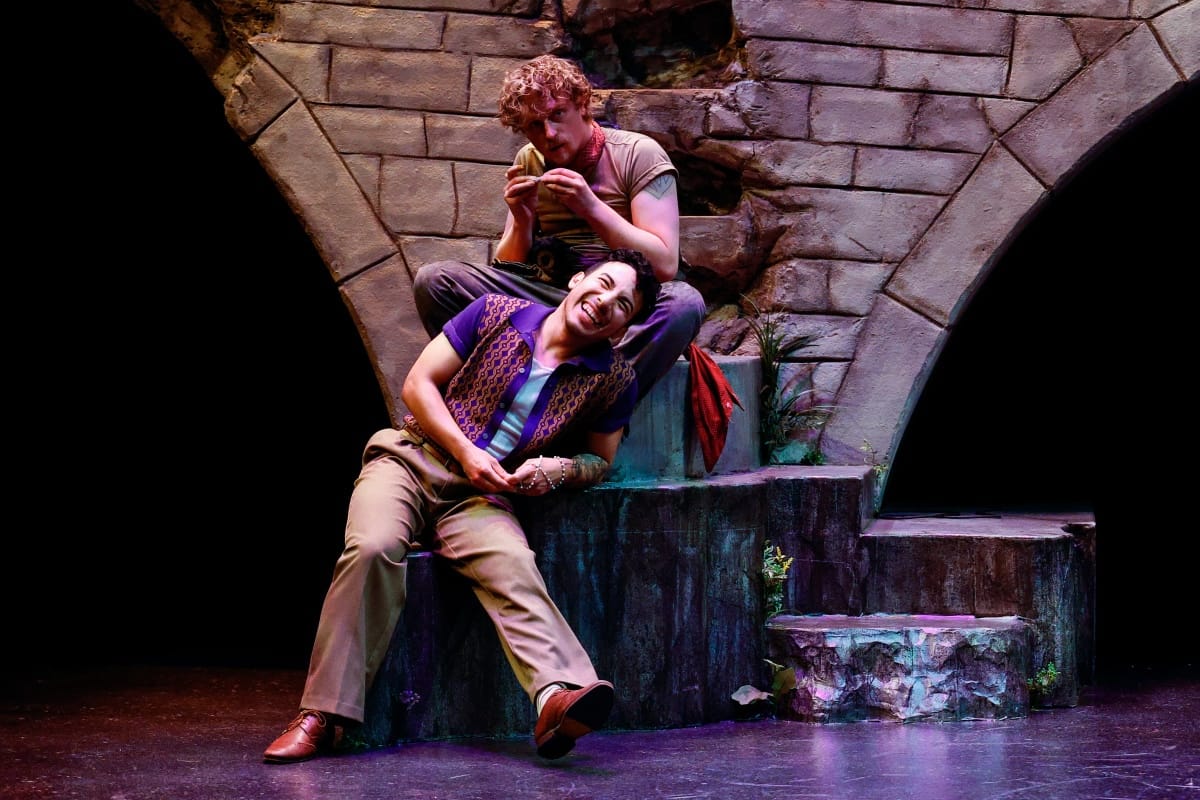
Photo: Isaiah Downing
Tech
The play’s fighting is pivotal to the drama, and the cast carries out Samantha Egle’s choreography in a highly effective manner. The fights feel both stylized and real.
Vance McKenzie’s magical lighting design enhances the production in every scene, whether ethereally surrounding Romeo and Juliet’s wedding or with the haunting setting of Juliet’s tomb — which rises from beneath the stage. These moments evoke an awe in keeping with the awful price that Romeo and Juliet pay.
Nevertheless, this Romeo (Rakeem Lawrence) and Juliet (Rachel Schmeling), both of whom have impressive training and experience, never seem to be under a spell. Substantial cuts have been made to the script, making for an even more truncated courtship than the original text. The result felt like marking plot points rather than watching impetuous young love.
As Juliet, Schmeling is sulky and defiant, apparently to suggest her independence of societal expectations. The character’s passion comes through, but little of Juliet’s giddy rhapsody. Lawrence’s Romeo seems more like a collection of well-delivered lines than a rounded person with an animating drive.
This production has many well-executed pieces that make an impact and linger in memory. In the end, the lack of consistent high quality made for an interesting, not essential effort.

Judith Sears has had a 25-year career in marketing and corporate communications. Over the last several years, she has pursued playwriting, and several of her short plays have received staged readings at Colorado theatres.

Leave A Comment