
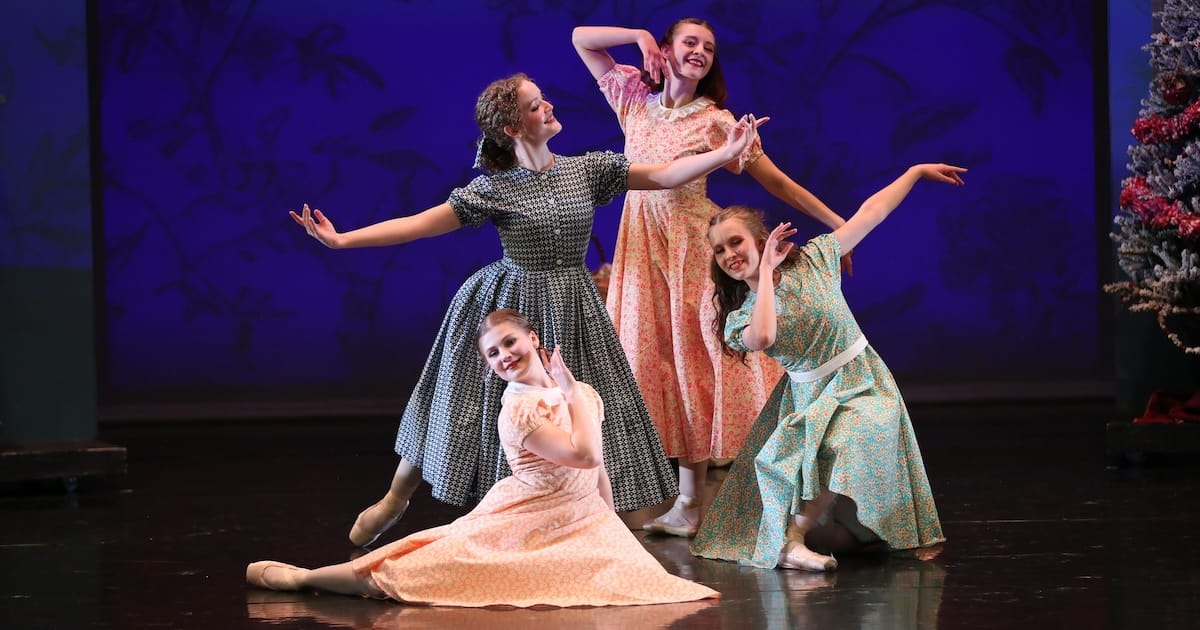
A split holiday bill from Ballet Ariel delivers a moving Little Women and a less-polished Nutcracker Suite.
Holiday dance programming often promises comfort and familiarity, but Ballet Ariel’s latest seasonal offering is more curious than cozy. Little Women, also presenting A Nutcracker Suite (as it’s billed on the program), pairs a brand-new narrative ballet with one of the most overperformed classics of the season, producing an evening whose ambitions feel unevenly matched.
The Denver-based company, led by Artistic and Executive Director Ilena Norton, is presenting the dual bill at the Lakewood Cultural Center and later at the Parsons Theatre at the Northglenn Recreation Center. The program opens with A Nutcracker Suite, a condensed selection of Act II dances set to recorded music, before pivoting to Little Women, an original adaptation of Louisa May Alcott’s novel performed with live accompaniment by the Gossamer Winds.
Both works are choreographed by Norton, but they operate on strikingly different artistic wavelengths. Little Women is thoughtful, musically rich and grounded in character-driven storytelling, even as it struggles at times with narrative clarity. A Nutcracker Suite, by contrast, feels underdeveloped and oddly perfunctory, particularly when placed front and center.
What emerges is not a cohesive holiday pairing but a clear reminder that Ballet Ariel is most compelling when it trusts its original voice rather than chasing seasonal expectations.
A Nutcracker that never quite finds its footing
The production opens with A Nutcracker Suite, a condensed sampling of Act II divertissements from Tchaikovsky’s ballet, performed to recorded music. While the suite hits familiar beats quickly, it rarely settles into the level of polish those dances require. Candy-colored projections wash the back wall, but their soft focus and visual sameness make it difficult to distinguish one setting from the next, flattening what should be a series of sharply contrasted worlds.
Choreographically, the suite moves efficiently through the expected national dances, yet persistent spacing issues and spotty synchronization undermine its momentum. Early on, ensemble timing feels loose, with entrances and final poses landing a beat late often enough to draw attention. Group sections read as busy rather than precise, and the lack of live music only heightens the sense that this portion of the evening is operating at a lower resolution.
There are stronger moments. Yoshiko Brunson’s Sugar Plum Fairy brings authority and composure, her solo marked by crisp footwork and an assured presence that cuts through the visual haze. Antonio Houck’s Cavalier, while heavier in his jumps early on, settles into a stronger partnership with Brunson by the time they dance together. Annika Grace Weidemann and Echo Sweet dance the Arabian section with fluidity and control, while Samantha Harmon’s Lead Russian performs energetically with striking spins.
Even so, the suite never coheres. Costumes are colorful and well-matched to each section, but design elements and execution do not align in a way that elevates the material. Placed at the very start of the evening, A Nutcracker Suite feels less like a festive overture and more like something to get through before the main event arrives.
Little Women finds Ballet Ariel’s true voice
After a brief pause, the evening shifts dramatically with Little Women, Ballet Ariel’s original adaptation of Louisa May Alcott’s novel. Accompanied live by the five-piece Gossamer Winds, the ballet immediately feels more intentional. The ensemble’s playing adds texture, transforming familiar holiday melodies and classical selections into a cohesive dramatic score.
Norton’s adaptation introduces the four March sisters through distinct movement styles that clearly establish character. Meg’s dancing is lyrical and poised, Jo’s energetic and impulsive, Beth’s gentle and restrained and Amy’s buoyant and expressive.
Costume design reinforces those identities through consistent color palettes (Meg in pink, Jo in blue, Beth in green and Amy in orange), while Sean Mallary’s lighting subtly mirrors those hues, giving each solo its own emotional frame. Scenic design further supports the storytelling. Rotating platforms transform a fireplace and Christmas tree into multiple locations, while projections establish shifts in time and place.
Early scenes unfold with storybook sharpness, from Christmas morning to the visit with the impoverished Hummels and the blossoming friendship between Jo (Echo Sweet) and Laurie (Antonio Houck). Sweet and Houck share an easy, engaging chemistry that brings humor and warmth to their scenes together, while the duet between Beth (Charlotte Meilaender) and Mrs. Hummel (Bean Shindell) stands out for its quiet emotional weight.
As the story expands beyond Act I, ambition begins to outpace definition. Without narration or projected text, the ballet assumes a working knowledge of Alcott’s novel that not all audience members will have.
Major plot developments arrive quickly, particularly in the second act, which compresses years of emotional growth into a series of brief vignettes. Meg’s wedding, Beth’s death and multiple romantic resolutions unfold in rapid succession, beautifully danced but not always clearly contextualized for viewers unfamiliar with the source material.
Still, individual sequences stand out, including the physical storytelling of Jo’s rejection of Laurie and the lively ensemble work set in Paris and New York. The ballet remains engaging even when it becomes narratively dense, carried by committed performances and a cohesive design sensibility.
A holiday bill at cross purposes
Little Women affirms what Ballet Ariel does best: original narrative ballet that prioritizes character, musicality and ensemble storytelling. It is not a flawless adaptation, but it is a sincere and thoughtfully constructed one, and it reflects the company’s long-standing commitment to developing new classical work.
Placed alongside it, A Nutcracker Suite feels more like a strategic add-on than an artistic companion. While its inclusion may help draw audiences during the holiday season, it ultimately dilutes the impact of the stronger ballet that follows.
Ballet Ariel does not need to compete with Colorado’s many large-scale Nutcracker productions to justify its place on the calendar. When the company trusts its original voice, as it does in Little Women, the results are far more memorable.

A Colorado-based arts reporter originally from Mineola, Texas, who writes about the changing world of theater and culture, with a focus on the financial realities of art production, emerging forms and arts leadership. He’s the Managing Editor of Bucket List Community Cafe, a contributor to Denver Westword and Estes Valley Voice, resident storyteller for the Bonfils-Stanton Foundation and co-host of the OnStage Colorado Podcast. He holds an MBA and an MA in Theatre & Performance Studies from CU Boulder, and his reporting and reviews combine business and artistic expertise.

Leave A Comment