
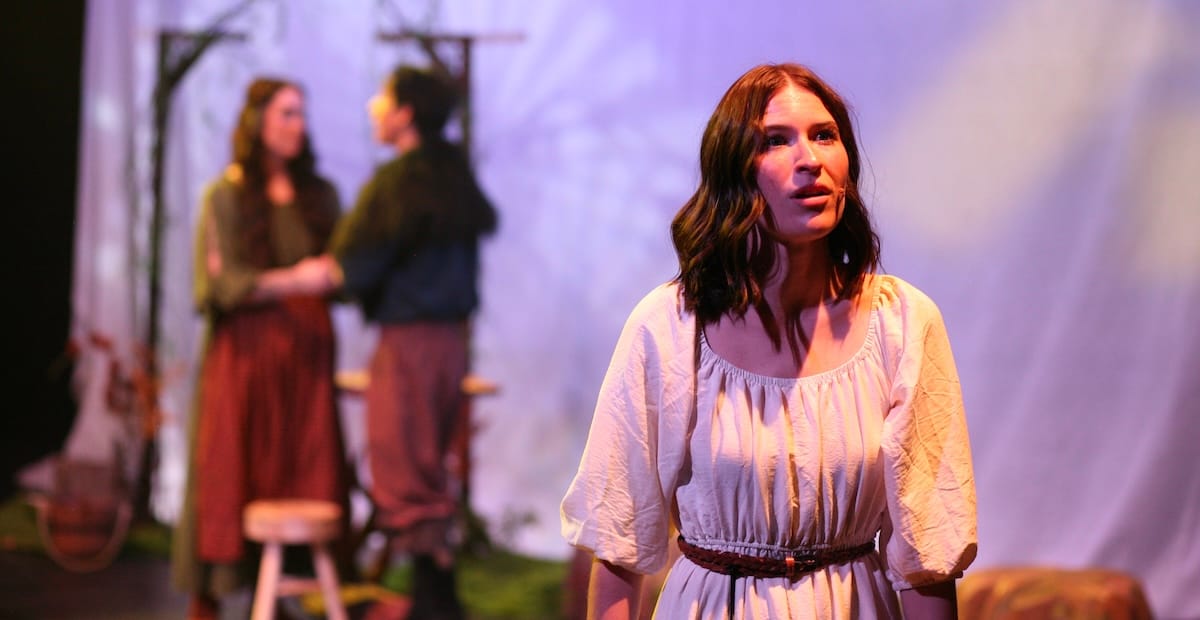
Ryan Glaser’s Brindlewood is a charming folk musical that proves small-scale theatre can cast a big spell.
Practical Magic 2, starring Sandra Bullock and Nicole Kidman, arrives in movie theaters next week. But in Aurora, practical magic has already arrived.
It comes in the form of Brindlewood, Ryan Glaser’s new 60-minute folk musical about a young girl who wanders too far into an ancient forest and discovers that every gift, shortcut and tempting offer comes with a price.
Third Side Theatre Company stages the world premiere of this spooky morality tale with gleeful simplicity at The People’s Building. Under Andy Seracuse’s tactile direction, five actors, a band, puppets, a white curtain and a handful of theatrical tricks become an entire woodland universe.
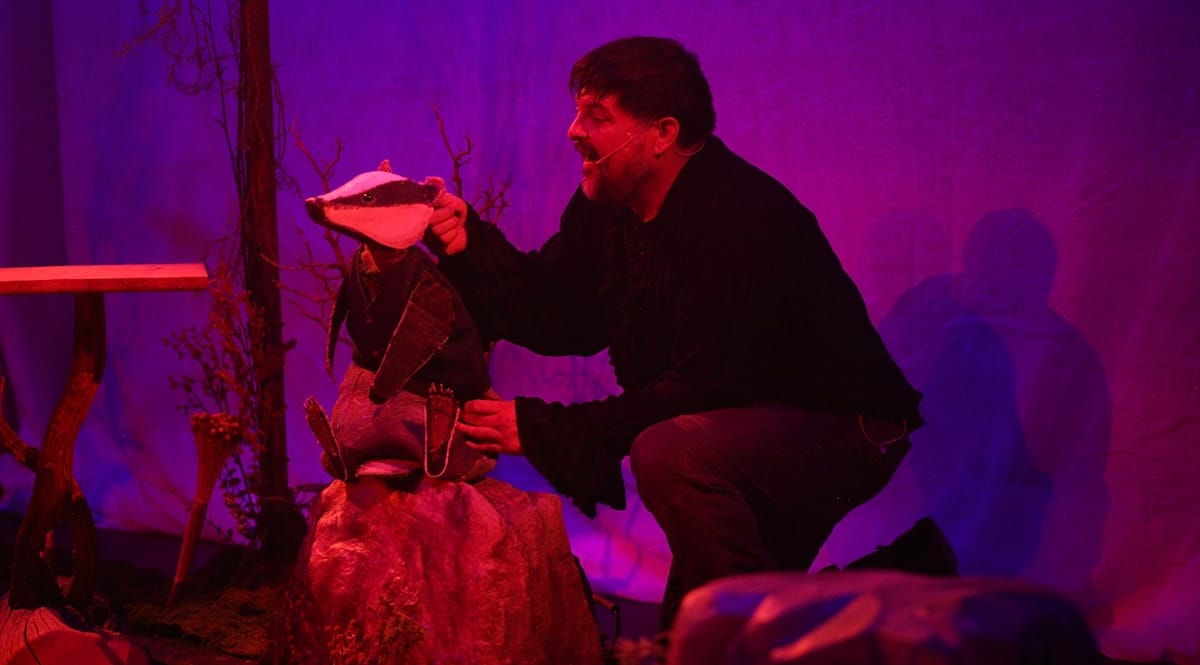
Jeremiah Martinez in The Third Side Theatre Company’s production of Brindlewood. | Photo: Kellie Fox and Matt Fox
Don’t take the gift
Glaser, who wrote the book, music and lyrics, establishes the rules and stakes of the forest before Elara (Alex Seracuse) ever enters Brindlewood.
“Never give your name,” her mother warns. “Never take a gift. Never eat what’s offered without asking the cost.” Despite how friendly and inviting Brindlewood’s creatures appear, things aren’t always what they seem in the woods, and if you break the forest’s rules, “you may not come home.”
Naturally, Elara winds up breaking the most important rule of all by entering the forest.
What follows has the paratactic structure of a Grimm fairy tale, with echoes of Pinocchio and The Wizard of Oz. Elara meets creatures who seem to reflect pieces of the people she left behind: a forgetful willow, partying woodland animals called the Flickerfolk, a familiar-looking crone, three chaotic crows, a giant riddling owl and, eventually, a bear who knows more about her family than he initially lets on.
Glaser’s book is fundamentally a story about temptation and identity. What are you willing to forget to get what you want? Give away too much of yourself, and Brindlewood may keep you forever.
That morality is deliberately straightforward, and Brindlewood is stronger for recognizing the kind of story it wants to tell. Glaser gives Elara enough room to mess up: the Flickerfolk get her dancing and laughing until she loses track of why she entered the woods, then convince her to surrender her flute.
“We’ll remember for you!” one promises. “But songs aren’t always free.”
The forest could become darker or morally murkier, but that would likely turn Brindlewood into a different musical. At an hour, Glaser gets in, tells his story and gets out before its episodic structure grows repetitive.
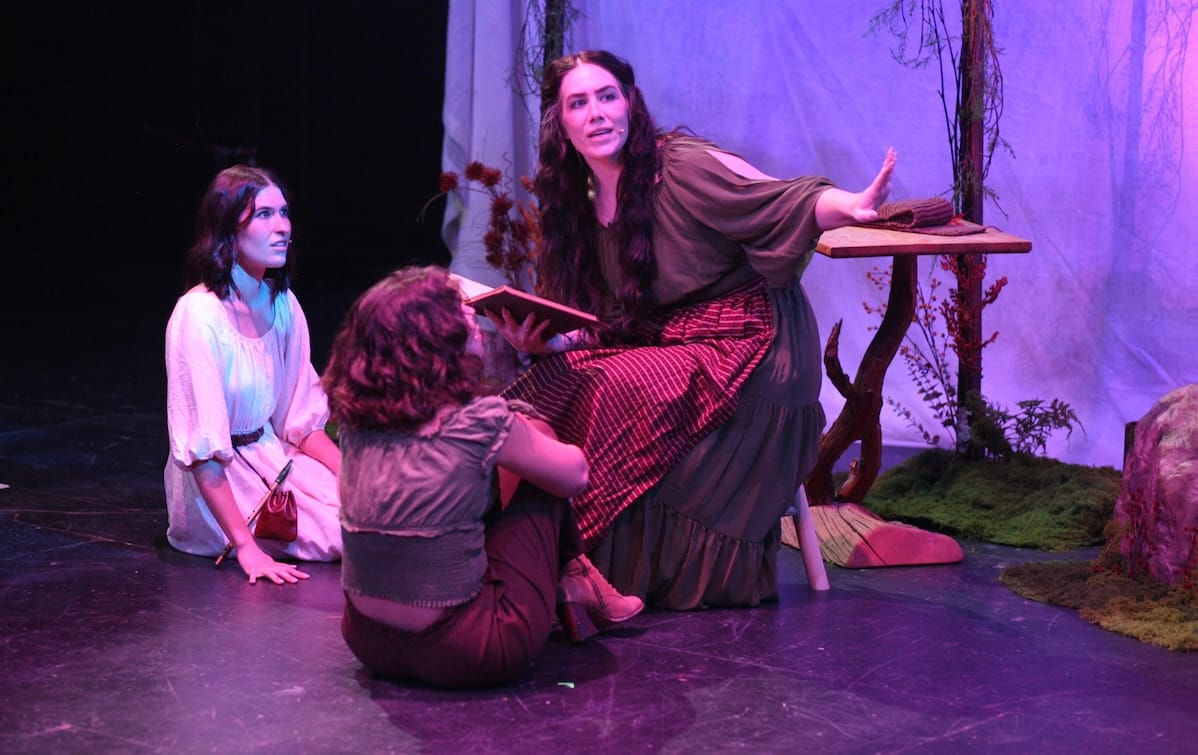
Alex Seracuse, Kayla Curneen and Leann Ritter in Brindlewood. | Photo: Kellie Fox and Matt Fox
The woods come alive up close
Kellie Fox’s delightful puppetry gives the woods much of their personality.
Kayla Curneen disappears beneath a striking willow rig, branches arching over her head and extending through her arms. Handheld Flickerfolk scamper around Elara, three crows flap overhead and Jeremiah Martinez’s enormous Owl becomes genuinely imposing once a playful series of riddles turns into a chase.
Seracuse’s thrust staging makes all of this especially effective because there is nowhere for the mechanisms to hide. The audience sits close enough to see puppeteers working levers, actors shifting between roles and musicians helping create some of the forest’s sound effects in real time. Alex Hana’s lighting gives those simple ingredients depth, while Russ Kirby’s crisp sound keeps every lyric and whispered warning intelligible.
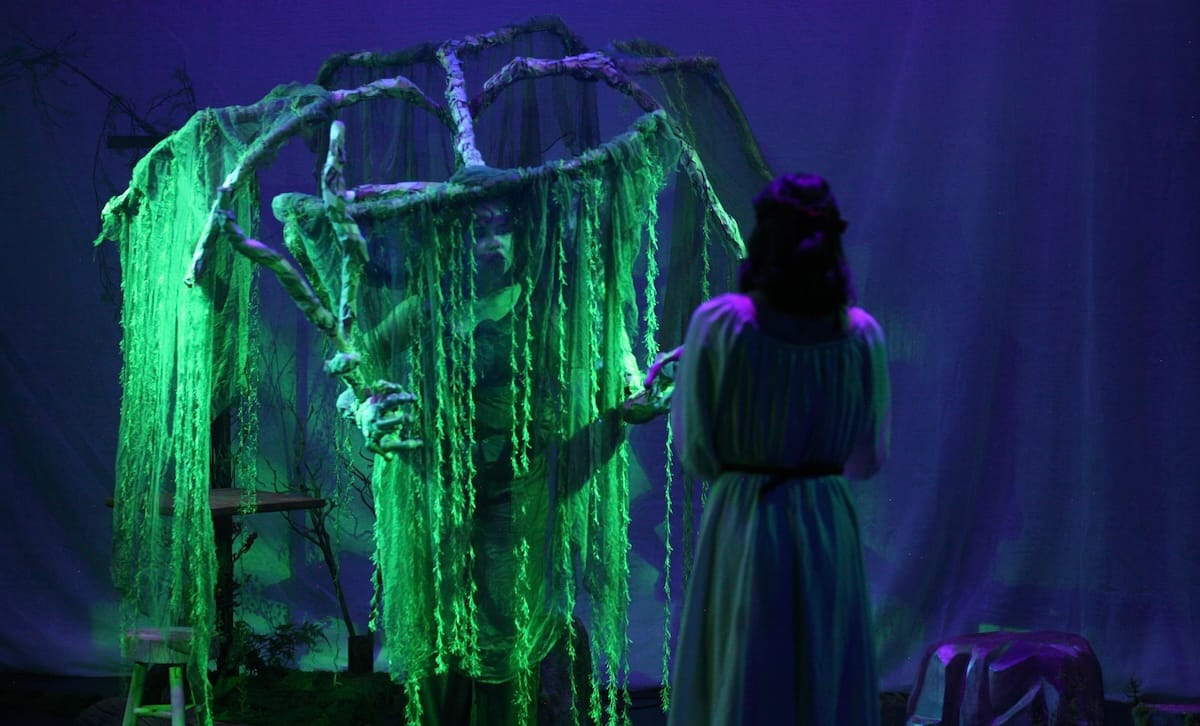
Kayla Curneen and Alex Seracuse in Brindlewood. | Photo: Kellie Fox and Matt Fox
Folk music keeps the story moving
Glaser’s score keeps the forest shifting between invitation and threat.
‘The Tale of Brindlewood” introduces the woodland legends as something Elara can laugh off, then returns with new weight after those warnings have taken physical form around her. The “Flickerfolk” number bounces along with a loose, playful energy — including a particularly fun soft-shoe moment from Brian Dowling’s Fox — while “The Choir of Crows” is a jaunty villain number that revels in vaudevillian chaos.
The cast handles that tonal movement well. Leann Ritter, Curneen, Dowling and Martinez rapidly cycle through Elara’s family members and the figures she meets in the forest, and the doubling reinforces one of Glaser’s better ideas: “The woods wear the faces you’ve lost.”
Alex Seracuse keeps Elara grounded amid all that theatrical invention. Her performance has an appealing openness early on, then grows more physically guarded as each encounter chips away at Elara’s confidence. By the time she is running from the Owl and pleading for her mother to call her name, Seracuse has made the possibility of forgetting who she is feel like a genuine threat.
Brindlewood also seems well positioned for a life beyond this premiere.
Glaser’s script explicitly invites future companies to stage the nonhuman characters with puppets, masks, costumes or whatever else they can devise, and the five-performer structure can be expanded or condensed depending on a company’s resources. With its hourlong runtime, family-friendly story and modest technical demands, the musical could travel easily to schools, community theatres and other small spaces.
Third Side’s production demonstrates how much those companies could accomplish without needing much more than a few good performers and a willingness to make the forest themselves.

An award-winning Colorado arts and culture reporter originally from Mineola, Texas. Tresca is the chief theatre critic for OnStage Colorado and managing editor of OnScreen Colorado. He’s the editor of Bucket List Community News, a contributor to Denver Westword and Estes Valley Voice, a resident storyteller for the Bonfils-Stanton Foundation and the co-host of the OnStage Colorado Podcast.

Leave A Comment