
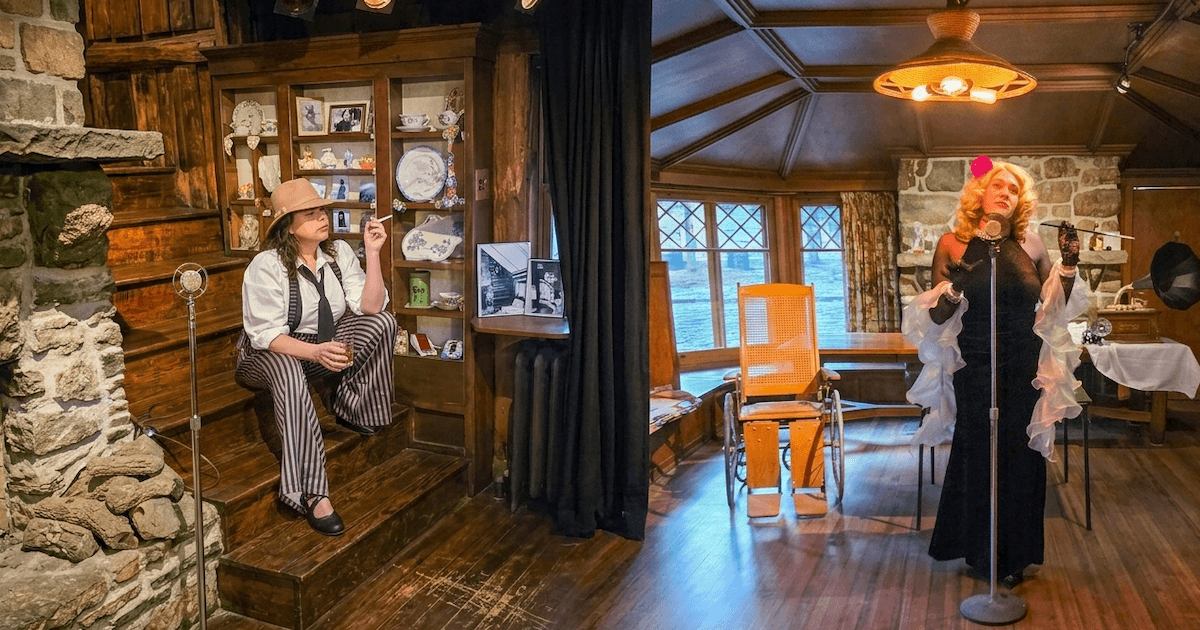
Evergreen Players’ interactive mystery at Hiwan Heritage Park blends immersive theater, comedy and collaborative sleuthing
This prohibition era murder mystery from the Evergreen Players is staged at the Hiwan Heritage Park inside of the historic Hiwan Homestead Museum in Evergreen. On the National Register of Historic Places since 1974, the property was first the residence of one of Colorado’s earliest female doctors and a summer camp, and was later turned into a working Hiwan Hereford cattle ranch, hence the name.
With a total of 25 rooms, including two octagonal towers, a chapel and formal dining room, we only get to see a portion of the mansion during the show, but it serves as the perfect backdrop for an illicit, underground club in the 1930s. It also has ample parking, always a plus.
A speakeasy comes to life in the Hiwan Homestead Museum
I hang my coat, select my alias from a list of punny mobster names (like Mindya Business and Robyn Banks), and grab a premixed mocktail from the table. Rounding the corner, the grand hall of the main floor is bustling with activity as guests arrive and take their seats.
Although a few audience members have worn costumes for the occasion, it’s easy to spot the characters who will soon be in the show because they’re dressed to the nines in flapper dresses and mobster suits, and wielding Transatlantic accents. Already, they are dropping clues, allowing astute audience members to overhear their conversations and observe their overt behaviors.
In addition to audience and cast members, there is also a conspicuous number of Jefferson County volunteers present, identifiable by their professional nametags. They are all friendly and helpful as they keep a watchful eye over the proceedings and, more specifically, the protected building and its contents.
A block of seats sits before the cased opening of the next room over where a makeshift bar has been established with a microphone standing in front of it and additional seating along the walls. The show formally begins when Ruby LaRue (Nealy Drew) steps to the mic to do a few numbers for us. While she sings, it’s hard not to notice Betty Moretti (Alexandra Wagner) pacing back and forth to the bar, tipping her drink back as she does, and rolling her eyes in annoyance when the audience claps for Ruby.
Murder at the bar
Next, Victor Moretti, the owner, approaches the mic to thank everyone in attendance for their support and patronage of his speakeasy. When he asks for a round of applause for Ruby, Betty rolls her eyes again and walks away in disgust. Before Vic has a chance to get too far with his thank-yous, Salvatore, a sketchy looking guy who’s been roaming around the audience, interrupts with an outburst.
“What happened to my booze, Moretti?!” he shouts while shaking a piece of paper in his face.
Vic is enraged at the humiliation of this unfounded public accusation in front of his guests and immediately reacts in kind. The women try to break it up, and even the bartender gets in the middle of it, but it’s too late. Vic staggers backwards and collapses into a conveniently placed wheelchair. Betty, Vic’s wife, is struck with instant grief as he is pronounced dead.
How he died, I can’t exactly tell. No guns are pulled in the altercation that leads to his death; only a few punches thrown. It feels a little anticlimactic for the “murder” in a “murder mystery” and is the only part of the show that leaves me feeling shortchanged. Eventually, though, I learn more about the cause of death.
A conveniently placed (and named) investigator, Iva Gunn (Michal McDowell) also happens to be in the audience tonight and she elbows her way through the crowd to get control of the situation. She’s in character — complete with a fake cigarette between her fingers, notepad in hands and thick New York accent — but she’s also giving us instructions for what’s going to happen next.
We’ll be separated into three groups and escorted to one of three “interrogation rooms” where we’ll have 15 minutes to inspect the evidence and question the suspects. When time is up, we’ll rotate to a new room and repeat until we’ve questioned everyone and seen all the evidence.
Murder is serious business and we have important jobs to do, but not without first pausing for selfies with the deceased. Yes, you read that right. Before our investigations begin, Vic is wheeled to the center of the room for guests to pose for photos and visually inspect him for any clues. When I notice Vic’s wife standing next to me, looking on with a tissue held to her mouth, I comment on the morbidity of it all and she agrees, storming off in tears.
Questioning suspects room by room
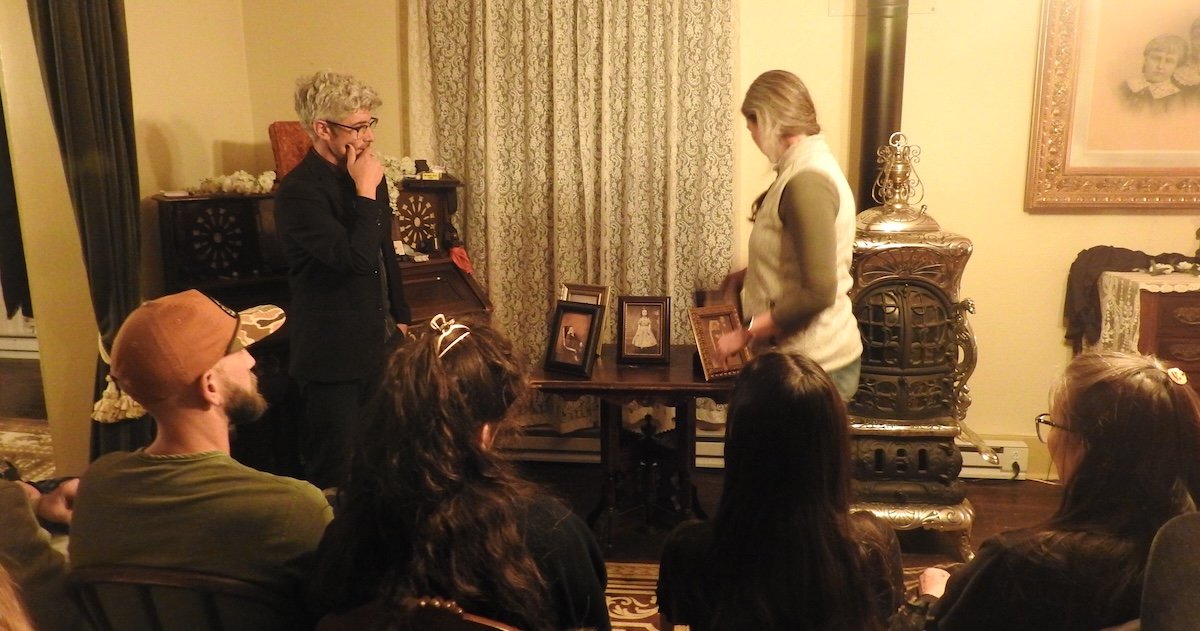
When we finally move on to begin our investigations, my group of 10 (plus one of those helpful JeffCo volunteers, who stays with us for the rotations and ultimately acts as a sort of puzzlemaster, pointing out things we might want to take a closer look at) start in the kitchen with Betty. Here, the novelty of the non-traditional venue really shines. It’s an actual kitchen that was actually built in the early 1900s and the dated appliances and colors add tremendously to the historical vibe of the evening.
There is no need to hunt for the evidence; it’s all been neatly laid out for us. In this room, it’s Vic’s life insurance policy and some newspaper clippings. Some of us look those over while others begin questioning Betty, then we swap to take turns reading and questioning. Mrs. Moretti never falters and always has a plausible answer for every question we ask. She divulges information that is relevant to the situation and provides a lot of clarity on the relationships between the suspects, as well as other people who aren’t present, like Vic’s mother, the beneficiary of his life insurance policy.
When we rotate rooms, we enter the study to find Ruby and Mickey Stubbs, the bartender. Appropriate for a study, this room is darker and more warmly lit. And when some of us inevitably have trouble reading small print in the low light, that JeffCo volunteer is at the ready with a flashlight and a magnifying glass.
Both suspects in this room are cooperative as we probe them on their relationships with Vic. It’s established that Vic had wandering eyes for Ruby, but she confirms she had no interest; she simply tolerated his advances for the sake of her job. We learn through more newspaper clippings that Mickey’s dad is said to have been in the mob, and it’s believed that Vic arranged for the hit that ultimately killed Mickey’s father. There’s lots of motivation floating around in this room (mainly revenge), but we still can’t make any definitive conclusions.
The final rotation brings my group up a tight, twisting staircase to the octagonal chapel where we spend our remaining 15 minutes with Salvatore Marconi, the mobster who attacked Vic at the beginning of the evening. Again, the venue choice shines, except that I find it difficult to stay focused on the task at hand and just want to take in the beautiful, wildly unique, historic architecture.
Sal seems cool as a cucumber considering he appears to be the one that provoked Vic’s death, but he stands by his alibi that the only reason he’s there is because someone told him to be. That’s what the paper is that he shakes in Vic’s face — a message in ransom note lettering that tells him his stolen booze can be found here.
Pieces of evidence from this room include Vic’s cardiac medicine bottle (the prescription is just recently filled, yet the bottle is empty) and a report confirming receipt of a recent shipment of booze, signed off on by Mickey the bartender. Just like Betty does, Sal provides a lot of personal observations that give us a clearer picture of how all these characters relate to one another.
Putting the clues together
By the time we return to the scene of the crime, we have a lot more information than when we started, but as my group discusses our theories, the answer of whodunnit is still not immediately clear.
We take our seats for the reveal of the murderer and Iva Gunn, the investigator, again steps to the front of the room to walk us through her findings. This is immensely satisfying because nearly everything she reads from her notebook we have also figured out during the course of our own investigation.
She connects the final dots, proclaims who the murderer is, and places them in handcuffs to end the show. The actors all take their bows, and then Vic is wheeled out and, suddenly revived, hops up to join them.
An immersive mystery built for collaboration
A traditional murder mystery game usually consists of 10-12 people total, and most if not all of those people have a script or role to play. So the challenge of “too many cooks in the kitchen” presents itself when the game is scaled to an audience of 30. Murder Prohibited solves that challenge by dividing the audience into small groups and containing their investigation to a single room in 15-minute blocks of time.
They effectively control for the chaos and unpredictability of humans by giving us structure and directing our attention where it needs to be directed. They also give us the satisfaction of letting us figure it all out on our own, then drive it home with a dramatic reveal of the murderer.
An evening worth investigating
By the end of the night, I had collaborated with strangers, felt reasonably successful as an amateur gumshoe, and got to experience a piece of Colorado history that I might not have otherwise ever learned about. Murder Prohibited was funny, interactive, and offered just enough structure to keep us on the rails, while giving enough leniency to make the investigation feel like our own.

Danielle Riha is a digital marketer by trade and a lifelong writer. She is an active member of the Denver theatre community as a regular contributor for No Proscenium and a marketing volunteer with Immersive Denver. When she's not taking in local theatre, Danielle hikes and attends jam band concerts with her husband.

Well done. Looks fun!