
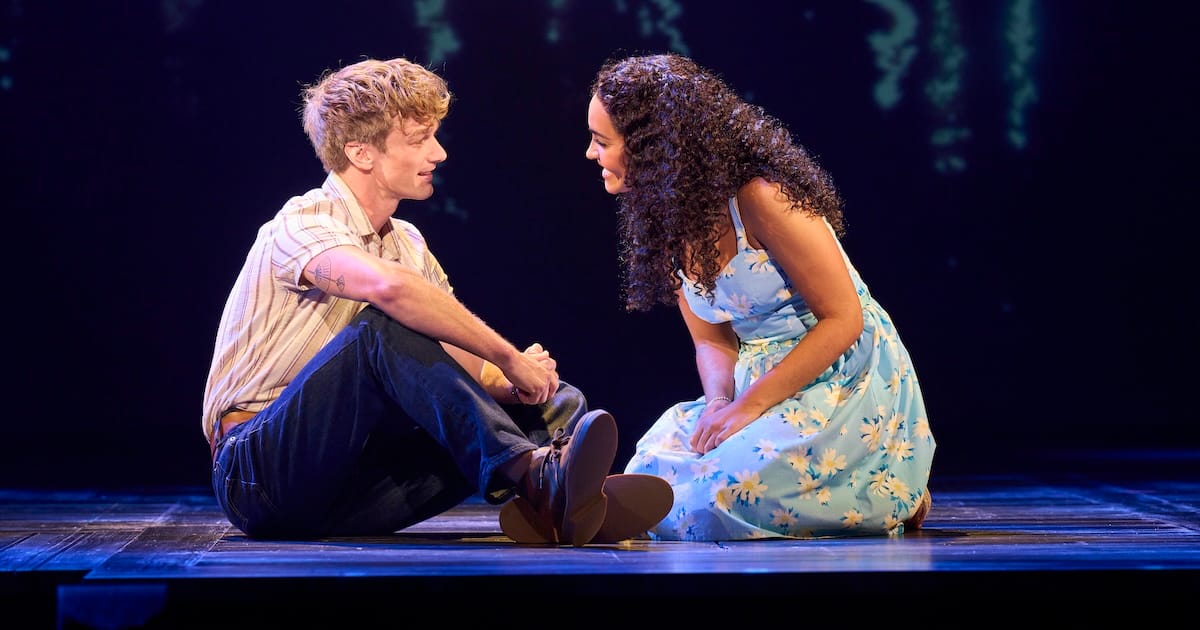
The touring Broadway production of The Notebook – The Musical delivers spectacle without substance, flattening a complex love story into hollow sentimentality.
There is a version of The Notebook that could work as a musical. A story stretched across decades, shaped by longing, separation and memory, seems like a natural fit for heightened theatrical storytelling. However, the touring Broadway production currently playing at the Denver Center Buell Theatre serves as a cautionary tale of how prestige adaptations can go wrong: preserving the recognizable outline of a story while removing nearly everything that made this love story compelling in the first place.
The Notebook The Musical adapts Nicholas Sparks’ best-selling novel and the wildly popular 2004 film into a shallow Broadway spectacle that mistakes familiarity for substance. Directed by Michael Greif and Schele Williams, with music and lyrics by Ingrid Michaelson and a book by Bekah Brunstetter, the show attempts to capture a lifetime of love by telling Noah and Allie’s story across three stages of their lives.
Structurally, the musical divides the couple into three versions: Young Allie (Chloë Cheers) and Noah (Kyle Mangold) falling in love, Middle Allie (Alysha Deslorieux) and Noah (Ken Wulf Clark) reckoning with choices and Older Allie (Sharon Catherine Brown) and Noah (Beau Gravitte) living in a care facility, where Noah reads their shared history aloud as Allie’s memory fades. The ensemble doubles as figures from Allie’s past and present, including parents, friends and hospital staff, suggesting how memory blurs identities as the story unfolds.
The musical concludes in a similar way to the original source material. After Noah suffers a stroke, he escapes his ward to find Allie one final time. Allie then remembers that the story Noah has been reading is their own. They lie down together, hold hands and die peacefully as the company gathers to sing of their enduring love.
On paper, it’s a mostly faithful adaptation, but in execution, it’s bafflingly empty.
An adaptation that replaces experience with exposition
The fundamental flaw with The Notebook The Musical is that it hollows out the story and refuses to dramatize the very experiences that give Noah and Allie’s relationship meaning. The novel and film earn their final moments through accumulation: years of separation, unanswered letters, Allie building another life and Noah restoring a house plank by plank.
These long stretches of waiting and separation give weight to the final reunion and, ultimately, to the inevitability of loss. The Notebook The Musical removes or rushes through nearly all of this.
Major life events are compressed into brief scenes or tossed off in clunky exposition. We are told Allie and Noah have broken up rather than watching the rupture unfold. Noah’s time in the war is barely acknowledged. The long, lonely labor of restoring the house — a central metaphor in the story — is flattened into passing references. Even pivotal emotional turns occur abruptly: Middle Allie’s engagement lacks the dramatic foundation required to make it register, and Noah’s friend Finn’s death is revealed casually, thrown off in dialogue like an inconvenient scheduling update.
The result is a musical that tells rather than shows, leaning heavily on exposition while paradoxically remaining difficult to follow, especially for viewers without deep familiarity with the source material, as time jumps occur unexpectedly, characters appear and disappear before they can register and years pass between lines of dialogue.
And for those who do know the novel or film, the musical feels like a highlight reel stripped of connective tissue. Key emotional beats are recognizable, but they land without force because the experiences that should support them have been removed.
This structural thinness is why the ending, despite mirroring the source material, fails to resonate. The show wants the audience to feel the full force of Noah and Allie’s reunion and shared death, but it hasn’t built the emotional architecture required to support that payoff. We are told, repeatedly, that their love is deep and lifelong, but we are rarely shown why.
What should feel devastating instead lands as vaguely pretty and emotionally inert.
Songs that circle feelings without deepening them
That lack of specificity extends into the score. Michaelson’s music leans heavily into contemporary Broadway-pop stylings that are pleasant enough in isolation but dramatically thin. The songs rarely advance the plot or reveal new dimensions of character. Instead, they circle broad emotional states, repeating simple phrases until they lose any real meaning.
“Sadness and Joy,” sung by the young couple, is emblematic of this problem. The song reiterates its central idea so often that the words begin to feel abstract rather than insightful. Across the score, there is not a single number that lodges in the memory for its melody or its insight into who these people are.
“If This Is Love” is another prime offender, cycling through variations of the same question — If this is love, why does it hurt? If this is love, how do I know — without ever arriving at insight. By the end, the repetition has drained the song of meaning, leaving behind a hollow refrain that feels less like emotional confusion and more like writerly indecision.
“I Wanna Go Back,” sung by Middle and Younger Allie, gestures toward something more interesting, including aging and the terror of forgetting, but again settles for repetition over development. Lines like “I am still in here” and “Is it time for dinner? Is it time for forever?” are repeated until their poignancy evaporates.
Choreography by Katie Spelman offers little counterbalance. Movement is limited, with most numbers staged with no dancing and actors standing in place, emphasizing how thin and unengaging the music is. Greif and Williams occasionally hint at a more theatrical approach, most notably when the three couples take the stage at the same time, acting out parallel memories, but these moments are fleeting and unsupported by the material.
Performances are vocally solid across the board, particularly from Chloë Cheers and Alysha Deslorieux as the younger and middle versions of Allie. But the acting style across the production skews broad and overstated, as if emotional volume is being used to compensate for thin writing.
Chemistry between the middle-aged couple is notably lacking, draining the much-anticipated rain scene of tension or romance. Beau Gravitte, tasked with anchoring the show as Older Noah, is saddled with relentless exposition and limp humor about aging. His interactions with Connor Richardson’s Johnny, a peppy physical therapist, are meant to provide levity but instead underline how schematic the characters are.
The performers do what they can, but the material gives them little to play beyond earnestness.
Spectacle, malfunctions and a familiar Buell problem
If The Notebook has one undeniable asset, it’s money. Scenic designers David Zinn and Brett J. Banakis create a large-scale, constantly shifting set with moveable set pieces that fly in and out, sliding walls and a massive projection surface.
Ben Stanton’s lighting design is often the most expressive element onstage, using shadow and warm tones to suggest emotional shifts the script does not. Paloma Young’s costumes clearly delineate time and class, grounding the characters visually even as the storytelling wavers.
But the production’s scale also exposes its fragility. On opening night in Denver, the rain machine, which is central to recreating the show’s most iconic image in the rain, malfunctioned mid-song in Act I, forcing a nearly 20-minute stoppage while crew members mopped water from the stage.
The pause felt like an apt visual metaphor for the overall production: a dozen technicians scrambling to clean up a mess caused by an indulgent effect the production never needed, just as the musical keeps throwing labor and money at a story it never bothered to build.
The technical stoppage also appeared to fracture the evening’s momentum. A noticeable number of patrons left during the cleanup, with additional departures at intermission, suggesting that for many, the production had already exhausted their patience.
Sound issues compound the problem. Act I dialogue was frequently difficult to understand due to muddy mixing, a recurring complaint at the Buell Theatre that has become less an anomaly than an expectation. For a show that is so reliant already on exposition, losing basic clarity is fatal.
A love story without texture
In its final stretch, The Notebook reveals its most troubling impulse: a desire to sand down the hardest truths of its own story in service of a cleaner emotional payoff. Dementia, which in the novel and film is portrayed as erratic, cruel and ultimately inescapable, is reshaped here into a narrative problem that love can intermittently solve.
This misunderstanding is crystallized in the show’s handling of the nurse character, played by Anne Tolpegin. When she explains, calmly and accurately, that dementia cannot be reversed, that progress is not linear and that hope must be reframed around comfort rather than recovery, the musical positions her as an obstacle to be overcome. Her realism is treated as coldness. Meanwhile, Johnny, the physical therapist who believes he can “fix” Allie by reading to her, is framed as the moral center of the scene.
That framing bleeds into scenes involving Allie’s family, who arrive with loud urgency and emotional need, demanding recognition and clarity from a woman whose reality is already fragile. Rather than emphasizing the central truth of dementia care — that the work is about meeting the person where they are and making them comfortable — the musical turns these moments into sentimental spectacles about the pain of the people around her.
What’s striking is how unnecessary this distortion is. The film includes family visits, but it does not portray them as clueless or self-centered, nor does it pretend that love alone can stabilize memory. The musical’s version flattens this complexity into a feel-good fantasy, one that treats dementia less as a condition to be lived with than as a dramatic device to be temporarily conquered before the curtain falls.
This impulse mirrors the show’s broader approach to adaptation. Time is not something to be endured here; it’s something to be skipped. Years of separation, quiet labor and emotional accumulation are replaced by tired clichés in clumsy exposition and lame lyrics that expect the audience to fill in the meaning for themselves.
The ending remains intact, of Noah and Allie dying, but it lands without gravity because the journey toward it has been hollowed out. What remains is a lavish, handsomely packaged production that wants the reward of deep feelings without committing to the work required to earn it.
The Notebook The Musical repeatedly reminds us that time is precious. Unfortunately, this adaptation is a waste of time, and your evening (and money) would be better spent elsewhere.

A Colorado-based arts reporter originally from Mineola, Texas, who writes about the changing world of theater and culture, with a focus on the financial realities of art production, emerging forms and arts leadership. He’s the Managing Editor of Bucket List Community Cafe, a contributor to Denver Westword and Estes Valley Voice, resident storyteller for the Bonfils-Stanton Foundation and co-host of the OnStage Colorado Podcast. He holds an MBA and an MA in Theatre & Performance Studies from CU Boulder, and his reporting and reviews combine business and artistic expertise.

I cry every time I watch it. Idk what put you in a bad mood before the performance. I love live theatre and the experiences with it.
This review sums up exactly how I felt. I was really looking forward to a powerful and tear-jerking romance, but I ended up feeling more bored than moved. I know it resonated deeply with some people, and to each their own, but it just didn’t land for me. #wasted time and money
Our entire family genuinely enjoyed the show, we thought the performances were amazing, and the audience gave the extremely talented cast an extended standing ovation.