
The Tony-winning production storms the Buell with bruising movement, while a bland score keeps its emotions at arm’s length.
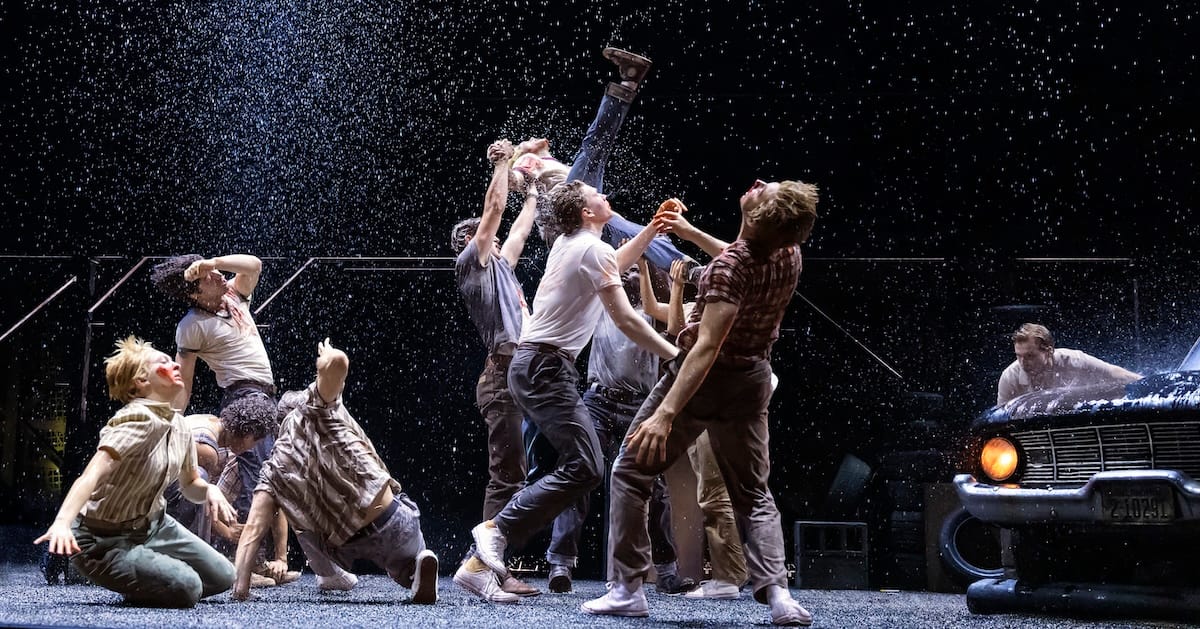
About midway through Act II of The Outsiders, the rain starts falling and the bodies start flying.
Greasers and Socs charge, collide and pound one another into the ground during the rumble, Rick and Jeff Kuperman’s extraordinary piece of fight choreography. Bodies skid across the wet floor. Fists seem to land with bone-crunching force. Water explodes around performers as they fall, grapple and spring back into the fight.
For three breathless minutes, director Danya Taymor’s production feels dangerous and unlike much else in contemporary musical theatre.
If the entire evening were as thrilling as the Rumble, its 2024 Tony Award for Best Musical would make perfect sense. The problem is that the rest of the show rarely reaches that level.
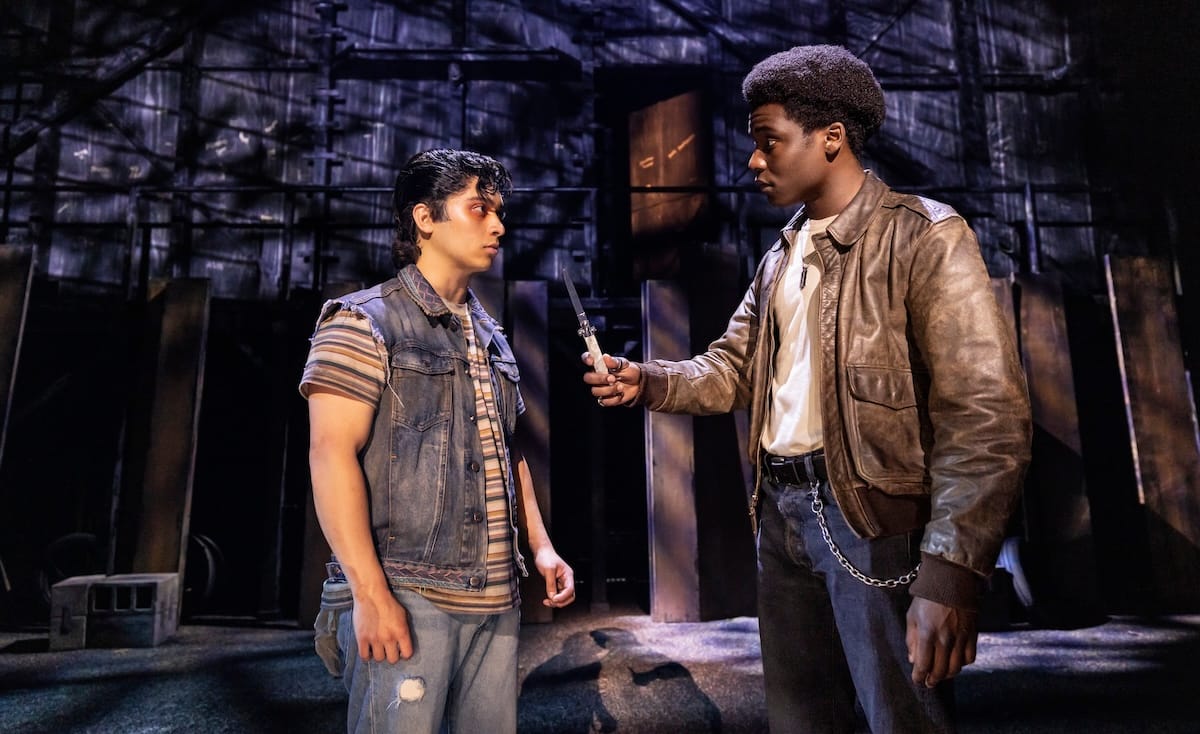
Bonale Fambrini and Tyler Jordan Wesley in The Outsiders North American Tour. | Photo: Matthew Murphy
Knockout visual language
Adapted from S.E. Hinton’s 1967 novel and Francis Ford Coppola’s film, the musical follows Ponyboy Curtis (Christian Arredondo at Denver’s opening performance), a working-class Tulsa teenager being raised by his older brothers after their parents’ deaths. Ponyboy and fellow Greasers Johnny Cade (Bonale Fambrini) and Dallas Winston (Tyler Jordan Wesley) live in perpetual conflict with the wealthier Socs, a rivalry that turns deadly.
Adam Rapp and Justin Levine’s book wants to examine how class, grief and masculine pride trap these boys in cycles of violence. Taymor and the Kupermans communicate those ideas most effectively through bodies.
The young men crouch, stalk, scramble over cars and hurl themselves around scenographer Tatiana Kahvegian’s industrial playground of wood, tires and dirt-like EPDM synthetic rubber granules. Their physicality suggests boys permanently braced for impact.
The committed touring cast looks terrific executing this demanding movement. Yet when everyone stops moving, the musical becomes far more conventional.
Jamestown Revival and Levine’s country-tinged pop-rock score rarely develops the same distinct personality as the staging. “Great Expectations” gives Ponyboy some welcome interiority, even as its extended book metaphors become labored, but many numbers announce their meaning rather than deepen it. “Hopeless War” boils the show’s complicated social divide down to “It’s only black and white, but never gray,” while “Throwing in the Towel” reaches for anguish with the repetitive “the darkest hour of the darkest night.”
The melodies are similarly polished but rarely surprising. Songs keep reaching toward enormous emotions that the music itself seldom generates.
Cherry (Emma Hearn) suffers particularly from that bluntness. Although “I Could Talk to You All Night” and “Hopeless War” position her as Ponyboy’s connection to the other side of Tulsa, the book mostly uses her to explain that Socs have problems, too, without giving those problems much dimension.
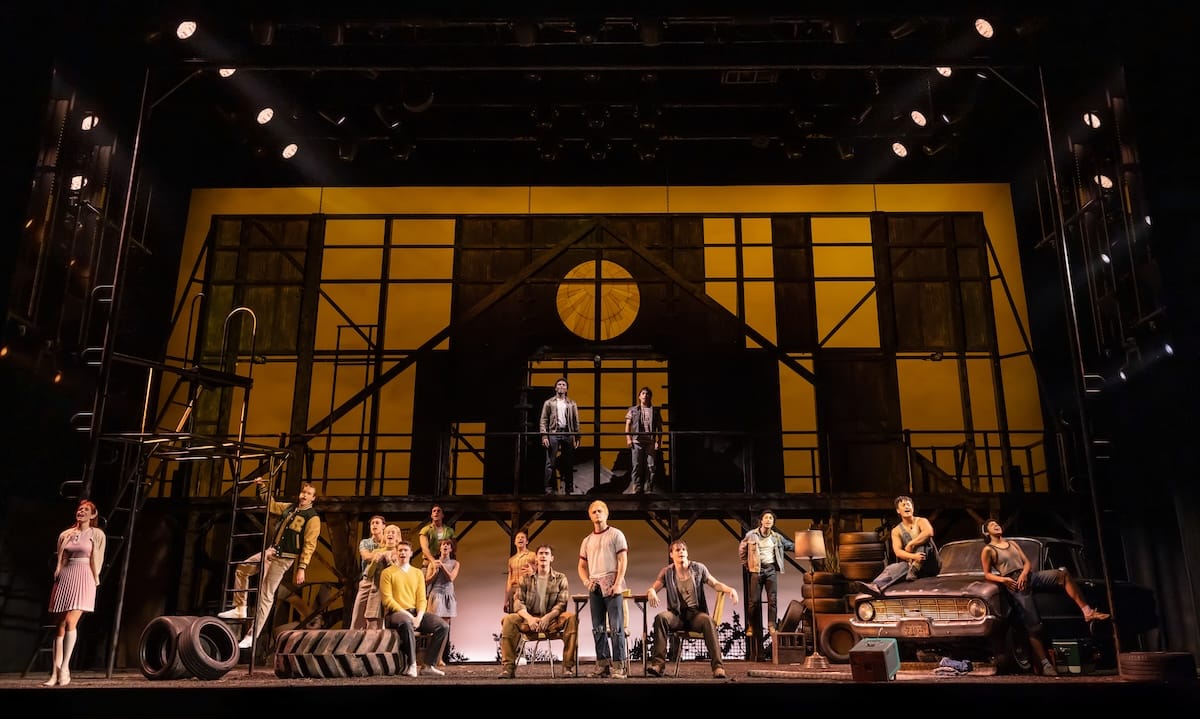
The Outsiders North American Tour Company. | Photo: Matthew Murphy
When the rain comes
Then comes “Trouble” and the rumble, and nearly every limitation briefly disappears.
As the confrontation erupts, actual rain pours across the stage, soaking the actors and turning the floor into a slick battlefield. The choreography initially resembles a recognizable street fight before becoming increasingly expressionistic: punches stretch into slow motion, bodies recoil in unison and MacDevitt’s flashes isolate fragments of brutality. Cody Spencer’s sound design makes each collision land harder as water sprays from stomping feet and falling bodies.
The sequence is a gritty theatrical spectacle with astonishing control underneath its apparent chaos. It is also a curious triumph for a story arguing that violence leaves everybody diminished.
Taymor makes violence so seductive that the production struggles to persuade us away from it. The quieter consequences — Johnny’s fate, Dallas’ unraveling and the repeated instruction to “stay gold” — are far less compelling than witnessing these boys’ bombastic brutality.
That contradiction makes The Outsiders more interesting than its sometimes thin book and score might suggest, though perhaps not in the way its creators intended.
This is certainly not a bad musical. Taymor’s direction is visually assured, the technical production is formidable and the Kupermans’ choreography alone makes the tour worth seeing. Still, for a Best Musical winner, there is surprisingly little beneath all that rain, dirt and motion.
The Outsiders knows exactly how to make these boys fight. It is less convincing when it asks us to understand why they should stop.

An award-winning Colorado arts and culture reporter originally from Mineola, Texas. Tresca is the chief theatre critic for OnStage Colorado and managing editor of OnScreen Colorado. He’s the editor of Bucket List Community News, a contributor to Denver Westword and Estes Valley Voice, a resident storyteller for the Bonfils-Stanton Foundation and the co-host of the OnStage Colorado Podcast.

Leave A Comment