
Curious Theatre closes out its current space with a layered, beautifully directed two-hander.
FAurlough’s Paradise, by a.k. payne, is yet another play about identity, grief and how choices made in the past play out. Yet payne’s play is novel in how it melds together these standard themes, paying tribute to plays of the past, but expanding upon them. Furlough’s Paradise is a thoughtful, engrossing and meditative production, strongly directed by Curious Theatre’s Artistic Director Jada Suzanne Dixon.
This two-hander starts out in the manner of Sam Shepard’s True West. But then, it changes to abstract sequences reliant upon choreography, sound, lighting and mime. Next, it adopts the choreopoem forms of Ntozake Shange’s for colored girls who have considered suicide/when the rainbow is enuf. Shange’s work is even explicitly referenced in Furlough’s Paradise. But, payne uses these prior texts (and others) to build their own approach to exploring the themes of identity, grief and choices. Dixon expertly guides her cast through these differing layers and approaches.
The past is the present
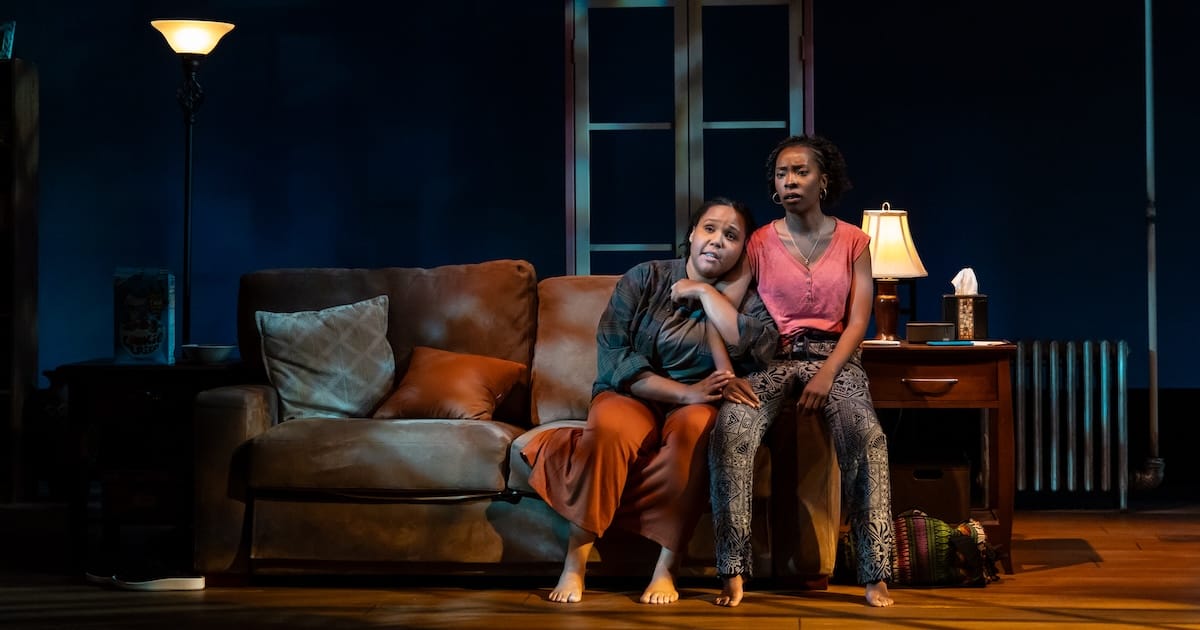
As the play opens, we meet Mina (Tresha Farris) and Sade (Alex Campbell) on the day of the funeral of Sade’s mother, who is Mina’s aunt. They haven’t seen each other in a while and their words and thoughts come guarded.
We then learn that Sade is on a three-day furlough from prison to attend her mother’s funeral and staying at Mina’s apartment. The play is written so that this is a surprise, but descriptions of the play reveal this plot development.
Growing up, Mina and Sade lived close together and interacted constantly. Yet, they were raised differently. Sade complains her single mother never had time for her and didn’t encourage her. Mina’s dad, on the other hand, pushed Mina and supported her constantly even after Mina’s mom left.

Mina is the one who “got out,” attended an Ivy League college and works for Google in San Francisco with a partner she lives with in Los Angeles. Sade has a daughter who, it appears, was taken away from her when Sade was sentenced to jail. They have traveled different roads to get to this place in time.
Over the three days, Mina and Sade relive aspects of their childhood, discuss their current relationship, but most importantly, reveal each other’s dreams and plans for the future. For each, though, the future is far from certain. Both women are driven by a fear of being alone and they yearn for the simpler times of the past.
Sade has bonded with several other prisoners and has a plan to create a utopia where they will all live together in their own community — the first Black girl nation. None of them would be alone.
Mina is contemplating having children with her partner, but she is staying in her relationship more out of a fear of being alone than love. In one of the strongest segments, each speaks about being alone in a choreopoem that would make the late Ms. Shange proud.
The apartment where the play takes place is back in the neighborhood Sade and Mina grew up in. Mina uses the apartment as a place to escape to — and to keep her connection to the past alive. She too uses it as a furlough from her California life.
While race is a major element of the play and is a basis for some humor, it is not the dominant theme. That Mina and Sade are Black is a defining characteristic that affects and informs their views. But ultimately Furlough’s Paradise is about two people confronting their lives. Each chafes at being treated as an object or at being considered exceptional. They want to be able to be honest about who they are but fear the result. And they each are hopeful of finding a paradise for themselves.
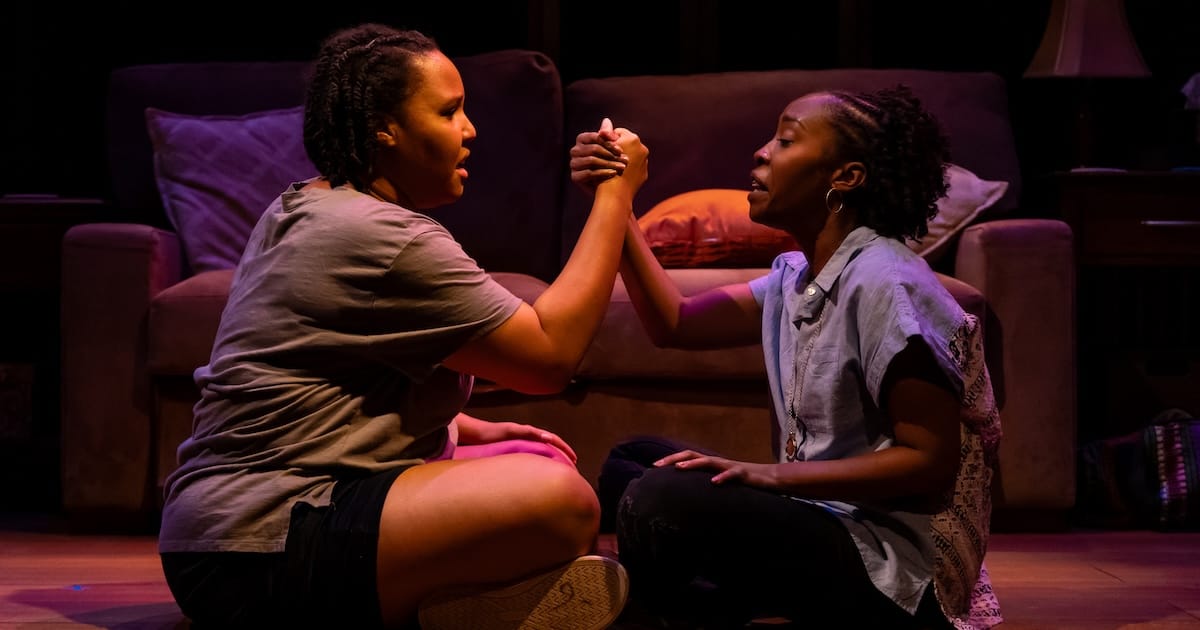
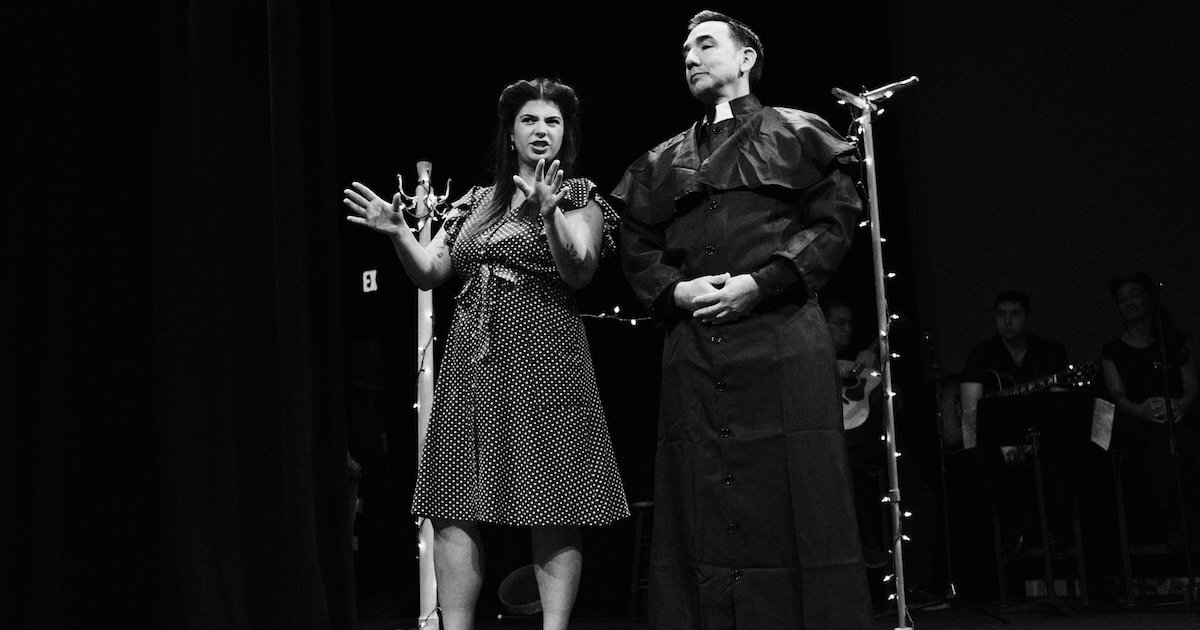
Photo: RDGPhotography
Strong direction amplifies the themes
Dixon’s direction is commendable. The physical connections the actors make are purposeful, meaningful and true to the script. Dixon has added many little touches and given the actors gestures, looks and silences that communicate character without words. That Farris and Campbell can switch between the differing presentation styles reflects a strong and deliberate guiding hand.
The changes in performance styles do not feel awkward or off-putting to the audience. Dixon brings the audience along where all feels natural, even the choreopoems and lengthy monologues directed to the audience. Finally, Dixon creates a pitch-perfect ending to the play.
Farris and Campbell mostly have an easy chemistry and play off each other well. They act as you expect cousins who grew up together would. They have terrific moments with callbacks to hand games, word games and television shows they watched when young. Campbell and Farris let the audience know and feel what made those childhood moments special to them.
Campbell is electric as Sade. She dominates the stage and has her own clear understanding of Sade beyond the words in the script. Her highs, lows, anger and caring all flow naturally. While Sade made choices that led her to prison, Campbell depicts her as smart, insightful and philosophical. Campbell’s movements are genuine and communicative. She handles the first dream sequence masterfully.
I wanted to like Farris more than I did. While Sade is the one to ask, “Who am I?” and dreams of a future where “these Black kids will know themselves,” it is Mina who is unsure whether she is herself or is living to others’ expectations and standards. Farris lets Mina’s uncertainties overwhelm her performance. She hits most of the beats but doesn’t let us get a sense of where and who Mina is or wants to be. There are times where Mina’s emotions feel forced.
Farris need not be as dynamic as Campbell, but while Mina may wonder about who she is, Farris should have a set idea of how to build upon those uncertainties. I expect that Farris will gain and project her insight as the run progresses.
Light, sound, set and props help define the story
Haley Hartmann was called upon to create lighting elements that are crucial to several scenes. Hartmann delivers lighting that establishes and guides abstract dream sequences, quick montages and the passage of time. You feel and are affected by the lighting as much as any line of dialogue.
The play calls for defining sounds, whether music or clips from television shows as well as a thunderstorm. Jason Ducat handles these technical challenges, nicely balancing out the background television sounds where they are recognizable but do not detract from the actors.
Credit also is due to Matthew Crane’s set design and props design by Wayne Breyer — especially for creating elements for Sade and Mina to build a child’s fort of blankets, sheets and pillows for a critical scene.
Like every show I’ve seen at Curious Theatre, this is an admirable production that challenges its cast, crew and audience. The differing styles create a memorable and provocative experience. It succeeds in that you leave hoping that Mina and Sade get closer to finding their own paradise. Furlough’s Paradise is a fitting send-off as the final play in Curious Theatre’s current space before it is renovated — reflective of the past and anticipation for the future.

Garth Gersten is an attorney and lifelong theatre lover. In Champaign, Illinois, he directed shows with Champaign-Urbana Theatre Company, Rantoul Theatre Company, Bright Lights Theatre Company and Twin City Theatre Company, which he founded. He now lives in Boulder with his wife who is a professor at CU.

Leave A Comment