
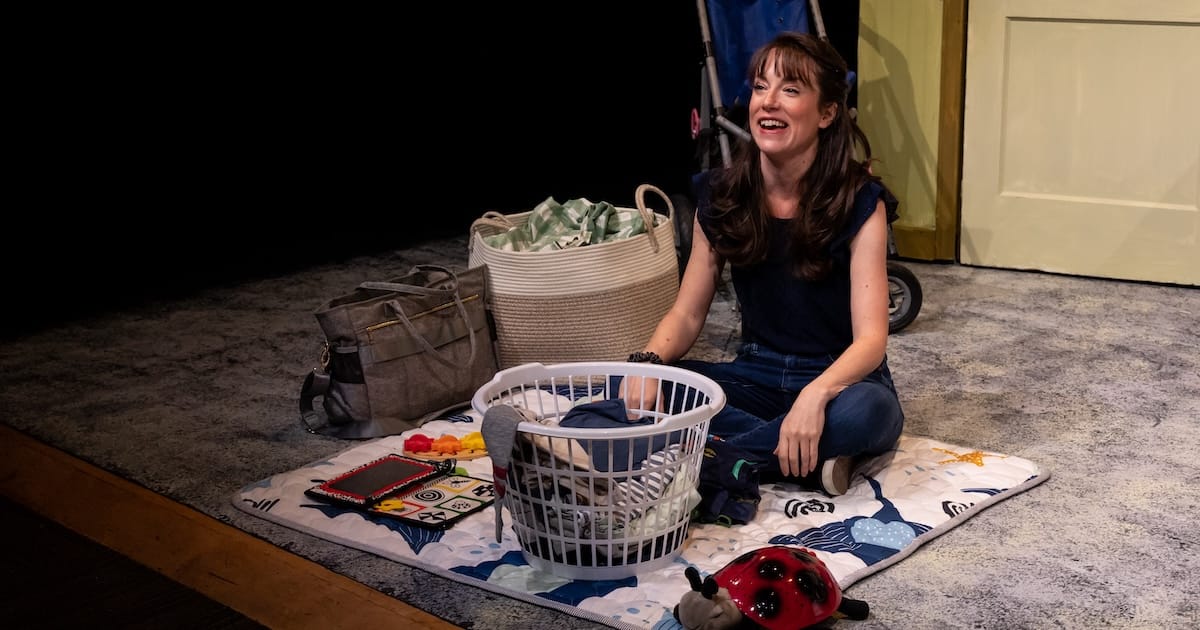
BETC’s production highlights hope and community.
Writers are told to “write what you know.” Amy Herzog used her personal experience tending to a child sick from birth as the origin for her 2017 play Mary Jane. But, Mary Jane is not Herzog’s personal story. Instead, Herzog expands it to comment on issues of faith, empathy, community and the U.S. health care system.
BETC Managing Director Mark Ragan says he fell in love with the show during its recent Broadway run starring Rachel McAdams and directs it here in Boulder. While I didn’t see that Broadway production, Ragan’s version feels fresh and consistent with what can be accomplished at the Grace Gamm Theatre at the Dairy Arts Center.
With a tight and accomplished cast of five women, Mary Jane hits the emotional highs, lows and turmoil emphasizing that people need community to carry on in the face of trauma and trying times.
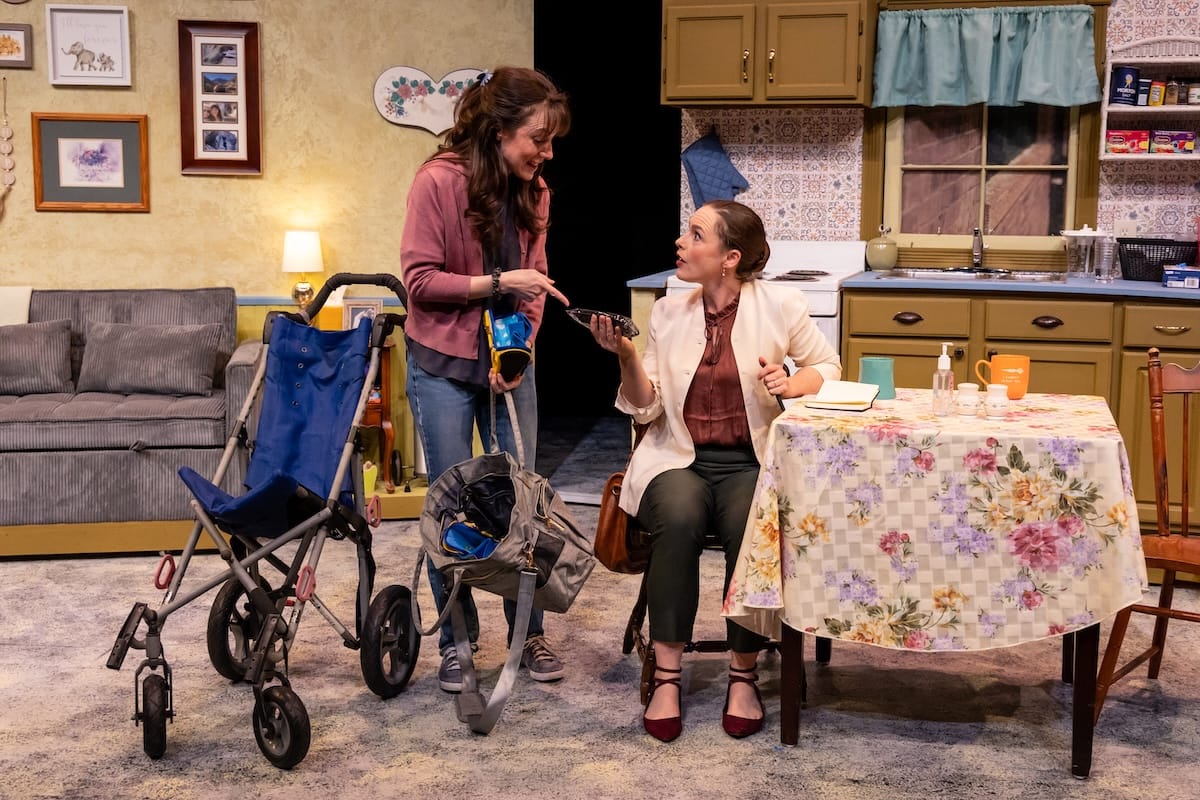
Candace Orrino, left, with Colleen Lee in ‘Mary Jane.’ | Photo: RDGPhotography
A mother under stress
The title character, Mary Jane, embodied wholly and fully by Candace Orrino, is a single mother. Her husband left following the premature birth of their son, Alex, now 2. Alex was born with a brain bleed and now has a myriad of medical issues requiring 24/7 care — including breathing and eating issues and suffering seizures.

Although there is no intermission, there is a clear demarcation between the apartment in which Mary Jane and Alex live in the first half of the play and the hospital in the second half where Alex is taken after a severe seizure. The two halves reflect each other with each actor — other than Orrino — playing thematically connected roles.
While Alex’s medical condition drives the plot, this is Mary Jane’s story. Orrino is a stalwart and devoted Mary Jane — her maternal instinct dominating her life. There is nothing Mary Jane will not do and nothing she will not sacrifice for Alex.
Amidst trauma and setbacks, Orrino’s Mary Jane holds onto any positive development and is ever hopeful. She does not question whether her efforts are the right thing to do. She never voices hope that one day Alex will be cured or that his condition will be controlled enough for him to have a meaningful life. But Orrino lets us see that she does have that hope in every phrase she utters and every movement she makes.
Community and faith
While Mary Jane could be focused solely on herself, as played by Orrino she is kind and giving. She offers insights to a mother in each half of the play, each dealing with a seriously ill child (both played by Colleen Lee). Mary Jane is concerned for her building’s superintendent, Ruthie, (Tammy Meneghini) and for one of the home-care nurses, Sherry, (Madelyn J. Smith). These interactions reveal Mary Jane as a good person forming and relying on community with others, which makes her easy to like and to root for.
Discussions of faith and whether suffering has a purpose are central to the second half of the play. Orrino’s interplay with Lee’s Chaya, the second mother with a seriously ill child in the hospital, offers Mary Jane a different way to live. Chaya is a woman at peace with herself, and Lee’s embodiment of inner contentment helps us to understand Mary Jane better.
Mary Jane also discusses her situation with Meneghini’s Tenkai, a Buddhist nun acting as the hospital chaplain. Combined with the scenes with Chaya, these further discussions of faith shape and answer some of the questions the audience may have of Mary Jane.
Madelyn J. Smith delivers a strong performance as both Sherry — the sensitive and capable home care nurse in the first half — and as Dr. Toros, trying to be sensitive but honest with Mary Jane in the second. Smith takes the words in the script and creates two wholly formed characters, each of whom we feel sympathy for.
Lucinda Lazo has smaller roles as Amelia, a new nurse, in the first half and as Kat, the overworked music therapist in the second half. Lazo bears the brunt of Orrino’s anger when Mary Jane has finally been pushed too far by the inadequacies of the American health system.
Lastly, the program does not identify the name of the goldfish who plays an important part in the final hospital scene.
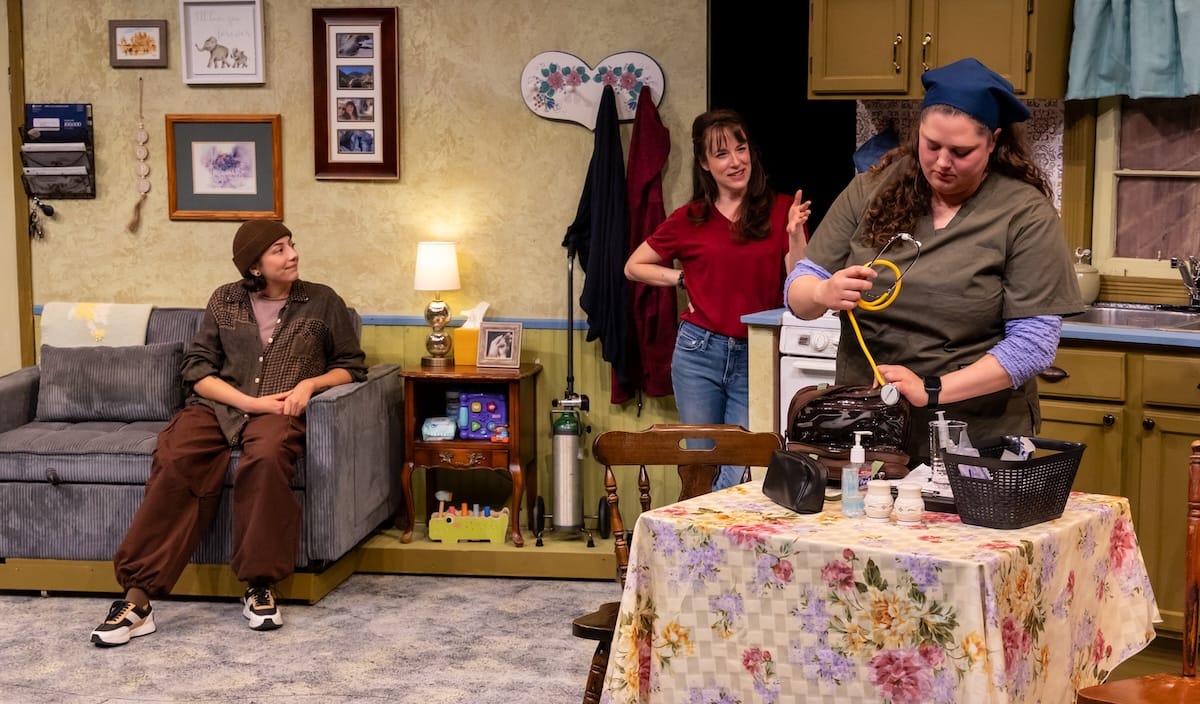
Lucinda Lazo, Candace Orrino and Madelyn Smith in ‘Mary Jane.’ | Photo: RDGPhotography
Impressive set by Tina Anderson
The set, including a revolve used to switch the action from the apartment to the hospital, is the most complicated I’ve seen at BETC in recent years. It’s not just the big pieces, designed by Tina Anderson, but the plethora of little details presumably the work of props designer Katie Hopwood McCleaf. Together, it is a top-tier professional set.
Sound plays an important part in Mary Jane. Rowan Livengood sees to it that we hear and understand small musical bits, the beeping and functioning of medical equipment, words heard through a baby monitor and, importantly, the actors when they are behind set pieces communicating important information.
The lighting design by Erin Thibodaux is simple and direct. The story does not need major effects until the end of the play, when Thibodaux is able to show her design abilities
Trigger warning
Shows about seriously ill children can be tough to watch. Herzog smartly provides bits of humor throughout, so the play is never as dark, foreboding and difficult as it might otherwise be.
It is no accident that all the characters are female. They are supportive of each other, and none are trying to fix Mary Jane or solve her problem. Even Ruthie, the superintendent, in the first scene gives up trying to fix a sink and decides to call a plumber. We feel that empathy and community from every actor and understand how that gives Mary Jane strength to go on.
The play, direction and performances do not directly challenge you to judge Mary Jane or to ask you to consider what you would do if you were in Mary Jane’s place. Rather, the play focuses on the human spirit under immense and continued stress. It asks you to try to ignore pain, open your eyes and see the light in life. You need to survive and advance, just as Mary Jane is committed to doing.

Garth Gersten is an attorney and lifelong theatre lover. In Champaign, Illinois, he directed shows with Champaign-Urbana Theatre Company, Rantoul Theatre Company, Bright Lights Theatre Company and Twin City Theatre Company, which he founded. He now lives in Boulder with his wife who is a professor at CU.


Leave A Comment