
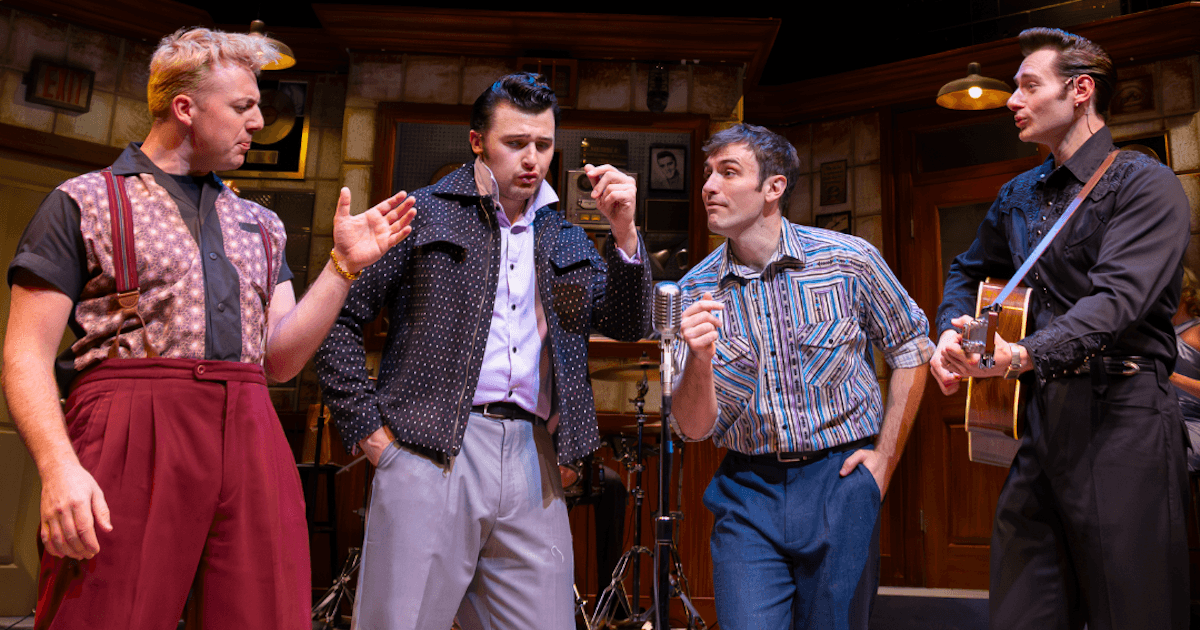
In Silverthorne, it’s a high-energy musical retrospect powered by a cast that nails every note.
Elvis, embodied by Mason Blaine, is in the building — energetically shaking, gyrating and belting out tunes in Million Dollar Quartet at Theatre SilCo.
Blaine and the three other actors who portray Johnny Cash (Tyler Michael Breeding), Jerry Lee Lewis (Brady Wease) and Carl Perkins (Brian Bohlender) all do an amazing job through acting, vocals and playing their respective instruments.
The high-energy, jukebox rockin’ fun begins the moment you step into the lobby of the theatre, with a mini set that anyone can pose within. Don’t be shy — pick up the guitar, take a seat at the drum set, even try on one of the hats or jackets, because these photos are part of the entirely memorable evening at Theatre SilCo in Silverthorne.
Then prepare to be blown away as the cast transports you back to December 1956, when four now-legendary musicians gathered in Memphis, Tennessee to jam at Sun Records. With a book by Colin Escott and Floyd Mutrux, Million Dollar Quartet dramatizes that night under the steady direction of Jessica Hindsley, with musical direction by Neal Dunfee.
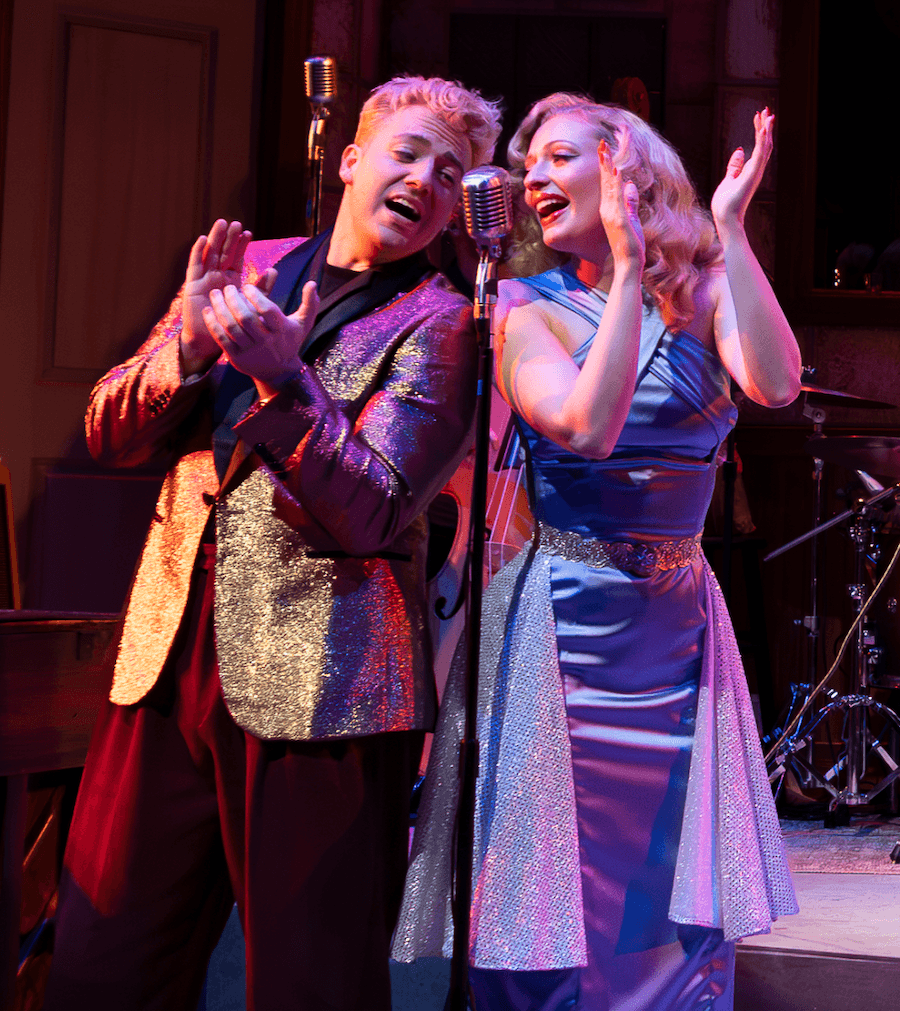
‘Million Dollar Quartet’ plays through Aug. 2 at Theatre SilCo in Silverthorne. | Photo: Graco Hernandez
Rock history
Elvis had already been scooped up by RCA Records after the owner of Sun Records, Sam Phillips (Jake Bell), first recognized his immense talent. Elvis would later perform Perkins’ “Blue Suede Shoes” — inspired by a comment Perkins overheard at a party warning a pesky partner to stay off the suede shoes — on The Ed Sullivan Show before Perkins had a chance to make his own national television debut with the song.
Perkins had to cancel after a near-fatal car accident on his way to New York, so listeners automatically associated the catchy tune with Elvis. This fact, of course, creates some tension in Million Dollar Quartet, which is not only a great musical retrospect of classic rock ‘n’ roll but also a fascinating story about where each musician was in his career trajectory — as well as where he was headed.
Lewis hasn’t released “Great Balls of Fire” yet; he’s just some kid who can’t sit still at the piano and needs lots of attention.
Cash, meanwhile, has already released hit singles like “I Walk the Line” and “Cry, Cry, Cry” with Sun Records.
Though Million Dollar Quartet compresses the timeline — and thus the story — of these four musicians from 1956 to 1957, it makes for a compelling narrative. And the historic moment truly did happen, with Perkins recording his future hit “Matchbox” that night, Lewis (literally) standing his ground on the piano and Cash and Elvis stopping in.
As Elvis enters the studio that night with his girlfriend, he admits he longs for the simpler days at Sun Records, in part due to his confusion stemming from The Colonel (Tom Parker) and other record executives pushing him in various directions.
Meanwhile, Perkins’ ego emerges as he struggles to deliver his signature rockabilly — which merges hillbilly country, blues, gospel and hard-driving electric guitar — to an audience who assumes “Blue Suede Shoes” is an Elvis tune.
As egos clash, Lewis remains right in the thick of it, with overactive enthusiasm bordering on hyperactivity — leading to the exciting piano playing he’s known for.
And then there’s Cash, who somehow must let Phillips know that he’s leaving Sun Records and has signed with Columbia. (In actuality, he became the first Sun Records artist to release a long-playing album in 1957 and didn’t part from the label until 1958. But, again, all of the musicians did converge on that December 1956 evening, and condensing the timeline results in a compelling story full of action, egos and, of course, musical talent.)
Fitting the iconic shoes
While many actors couldn’t fill the shoes of such iconic musicians, Blaine, Breeding, Bohlender and Wease fit the bill to a T.
Yes, Blaine broke character once as he took a minute to catch his breath on opening night after uncannily impersonating Elvis’ unique and challenging moves while simultaneously playing guitar and singing, but he was otherwise spot on — from facial expressions to notes.
Breeding and Wease are also spot on with their depictions. Breeding masters Cash’s nonchalant, polite-bordering-on-outlaw Man in Black persona and hits all the deep notes, while Wease’s piano playing and singing are stunning to witness. Likewise, Bohlender stands out for his mastery.
Kyle Wells also delivers an extremely memorable performance as Brother Jay on the upright bass. He proves that just about anyone — including himself — can actually sit on the instrument while playing it. Sean Case (as Perkins’ percussionist) joins the rest of the actors in showing the audience a great time — while seemingly having a grand old time himself.
A studio that feels real
Scenic Designer Brian Mallgrave — whose usual stomping ground is the Arvada Center — sets a convincing scene to accompany the nostalgic music, from flooring that looks like linoleum to glass-looking tiles reminiscent of the era. Worn wall tiles reflect the historic auto shop turned record studio. Two doors and four levels for musicians to move to and from offer both a sense of spaciousness, where each one shines, and a sense of intimacy. Placing “Sun Records” in lights, which turn on and off, adds to the atmosphere. The built-in mock sound studio, placed behind glass and complete with reels that actually move, allows Bell to run back and forth from the recording stage to the sound booth, employing the set to make the audience feel as though they’re sitting in an authentic studio. Linda Morken’s costumes are simple but effective, with each musician’s look subtly distinguishing his persona.
Bell’s performance, like that of all the others, is also a pleasure to watch, as it easily transports audiences back to that magical night. Of course, no magic is complete without a little tension, and Cash particularly brings it in spades as he prepares to leave his recording nest.
Though Elvis’ girlfriend at the time, Marilyn Evans, is pictured sitting on the piano while Elvis plays, many photos crop her out, and she was only a spectator — not a performer — during the jam session. Nevertheless, Million Dollar Quartet includes her in the mix.
As Evans, Caroline Hanks contributes wonderfully to a couple of songs, especially in Act Two. That said, it’s hard not to get distracted as she so consistently looks at Wease again and again. Granted, a line of dialogue does tell her that Lewis needs attention, but eyeballing Lewis so much seems out of character for Elvis’ girlfriend.
Overall, Million Dollar Quartet offers a delightful, thoroughly entertaining ride into musical history while providing enough story and tension to engross audiences so that two hours fly by.
And the extended encore is a blast — one that gets you on your feet with a whole lotta shakin’ goin’ on.


Kimberly Nicoletti is an award-winning journalist, with accolades from the Colorado Press Association, Warren Miller/The Ski Journal, and Home Instead. Her work has allowed her to: interview international athletes, musicians, artists, chefs and entrepreneurs; write national travel pieces; review art, theater and dance; create he said/she said movie reviews; cover business and politics; and more.

Leave A Comment