
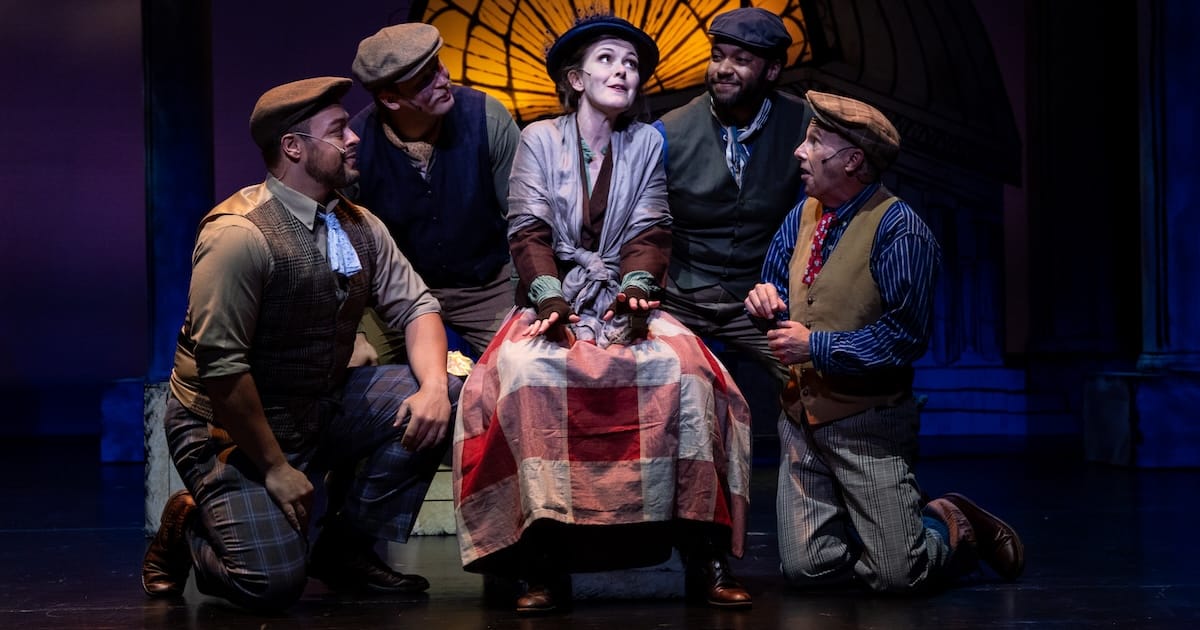
Lakewood production delivers a lush, sharply sung My Fair Lady, though Eliza’s final return still stings.
The woman sitting next to me at Performance Now Theatre Company’s Sunday matinee of My Fair Lady offered a candid critique seconds after the musical ended: “Great musical, bad ending.”
She was not familiar with the show, which made watching her watch it a little heartbreaking. As Eliza Doolittle found her voice in the second act, especially during the scene with Mrs. Higgins where she finally pushes back against Henry Higgins’ condescension, the woman was visibly rooting for her. Then came the final scene, with Eliza returning to Higgins and his gruff request for his slippers. Her face dropped.
That is the trouble with My Fair Lady, Alan Jay Lerner and Frederick Loewe’s glorious, frustrating adaptation of Pygmalion by George Bernard Shaw. The musical remains one of the most stunning scores in the American musical theater canon, with songs like “I Could Have Danced All Night,” “With a Little Bit of Luck” and “I’ve Grown Accustomed to Her Face” that seem engineered to last forever. It also softens Shaw’s ending into something far more romantic, asking audiences to accept Eliza’s return to Higgins as a kind of happy ending.
Performance Now’s production, directed and choreographed by Kelly Van Oosbree, does not try to solve that problem. This is a handsome, traditional staging of an excellent musical with a difficult final note. The production has many highlights, from the magnificent live orchestra to the polished ensemble, but the final scene leaves a bitter taste by folding Eliza’s hard-won independence back into Higgins’ household.
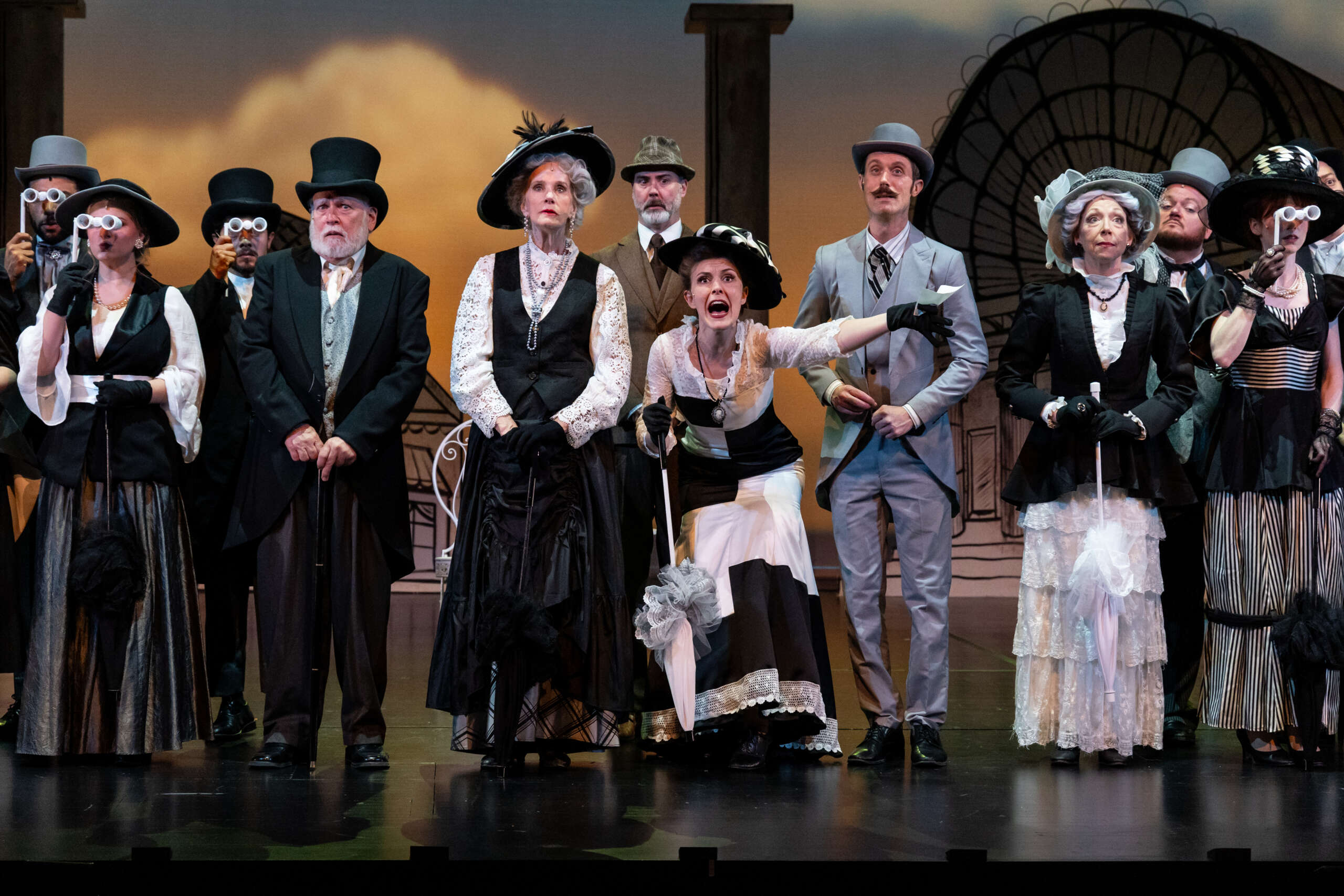
Charlotte Campbell and the cast of My Fair Lady at Performance Now Theatre Company in Lakewood, Colo. | Photo: RDGPhotography
Flower girl to belle of the ball
My Fair Lady follows Henry Higgins (Bill Diggle), a phonetics professor who makes a bet with Colonel Pickering (Wes Munsil) that he can transform Eliza (Charlotte Campbell), a Cockney flower seller, into a woman who can pass in high society. What begins as a linguistic experiment becomes a brutal education in class, gender and power as Eliza learns to speak like a “lady” while realizing that the men around her have given little thought to what kind of life they have prepared her to live.
The ending stings so much in this production because Campbell’s Eliza is so compelling. In the opening scenes, Campbell grounds Eliza in the scrappy practicality of a woman who may be poor but is not helpless. Her “Wouldn’t It Be Loverly?” has a dreamlike warmth without losing sight of the hunger underneath it. Her “Just You Wait” is sharp and comic, fueled by the frustration of someone who has been underestimated for too long.
Campbell also makes the mechanics of Eliza’s transformation clear. “The Rain in Spain,” performed with Diggle’s Higgins and Wes Munsil’s Colonel Pickering, hits with the right amount of triumph, while “I Could Have Danced All Night” becomes a giddy release. Even as Mrs. Pearce (Ashlie Kirkpatrick) and the maids try to put her to bed, Campbell keeps jolting back to life with a joyful, sleepless burst of song. It is one of the production’s funniest and most charming sequences.
Her later scenes are even stronger. At the ball, Campbell carries herself with the poise Higgins has drilled into her, but she never lets the audience forget the cost of that education. When Eliza asks what she is fit for now, after being remade into a lady, Campbell makes the line land with real ache. Eliza had independence before Higgins, even if it came with poverty. After him, she has polish but far fewer clear choices.
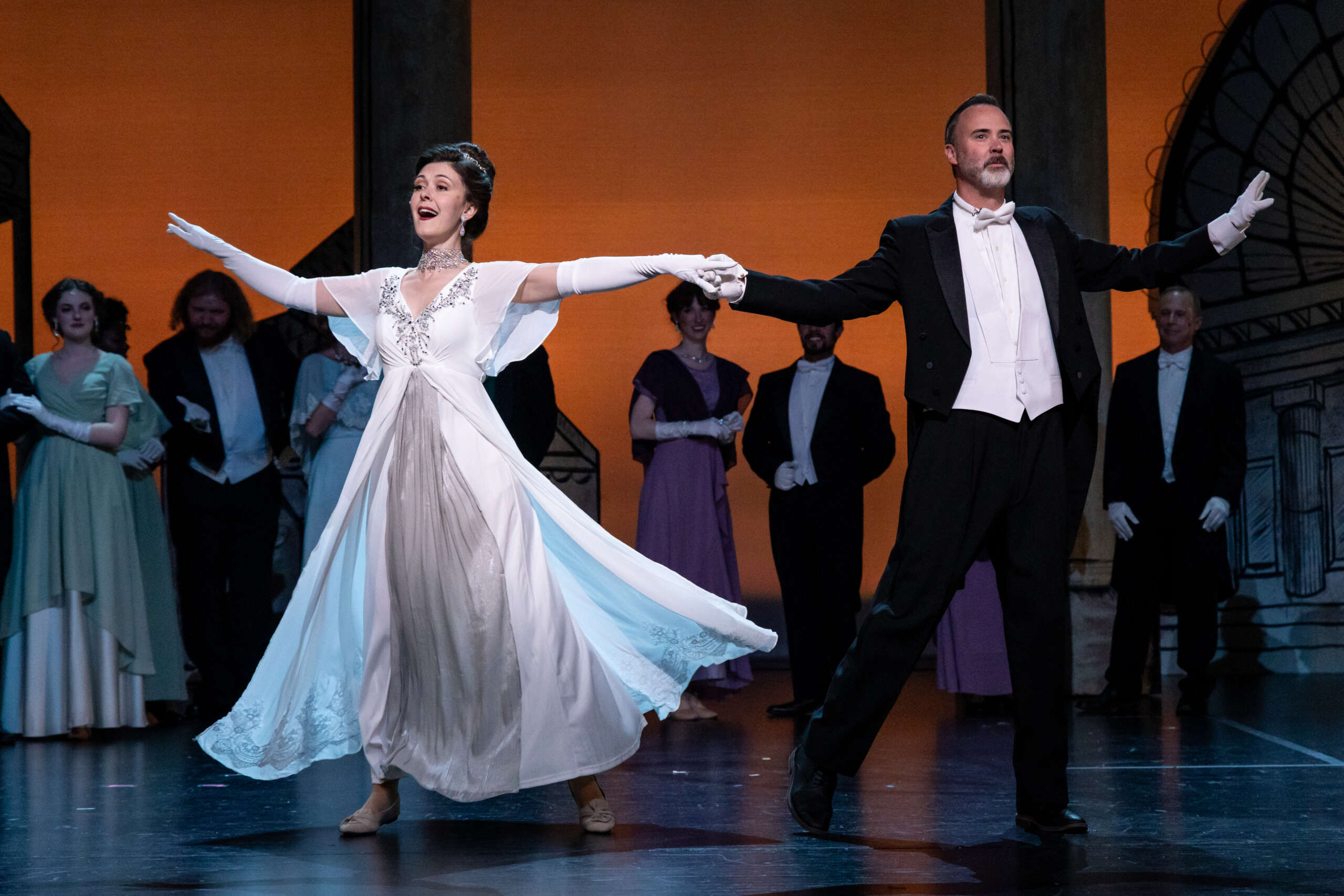
Charlotte Campbell, Bill Diggle and the cast of My Fair Lady at Performance Now Theatre Company in Lakewood, Colo. | Photo: RDGPhotography
Diggle leans into Higgins’ worst qualities. His Higgins is a brilliant, domineering, self-satisfied man who treats wit as a weapon. In “A Hymn to Him” and “I’m an Ordinary Man,” Diggle finds the comedy in Higgins’ hypocrisy: He complains about women while describing, with stunning lack of awareness, many of his own most irritating traits.
It is a strong performance, but not one that suggests Higgins learns much. Van Oosbree’s director’s note argues that “Eliza teaches Higgins that intellect without humanity is incomplete.” In Diggle’s portrayal, there is sadness in “I’ve Grown Accustomed to Her Face,” but not much introspection. When he delivers the final request for his slippers, the gruff entitlement is still intact. That may be textually honest, but it undercuts any sense that Eliza is returning to a changed man.
The supporting cast adds richness around that central pairing. Munsil makes Pickering a warm and playful foil to Higgins, giving the household a gentler presence. Mary Campbell is dryly effective as Mrs. Higgins, whose embarrassment over her son’s behavior places her firmly on Team Eliza. Lars Preece brings a lovely voice to Freddy Eynsford-Hill, especially on “On the Street Where You Live,” even if the character remains more a romantic possibility than a fully drawn alternative.
Jim Hitzke is a comic standout as Alfred P. Doolittle. He tears through the role with the gift of gab, making Doolittle’s resistance to “middle-class morality” both ridiculous and oddly persuasive. “Get Me to the Church on Time” is one of the evening’s big musical bursts, with Hitzke gleefully at the center of the chaos.
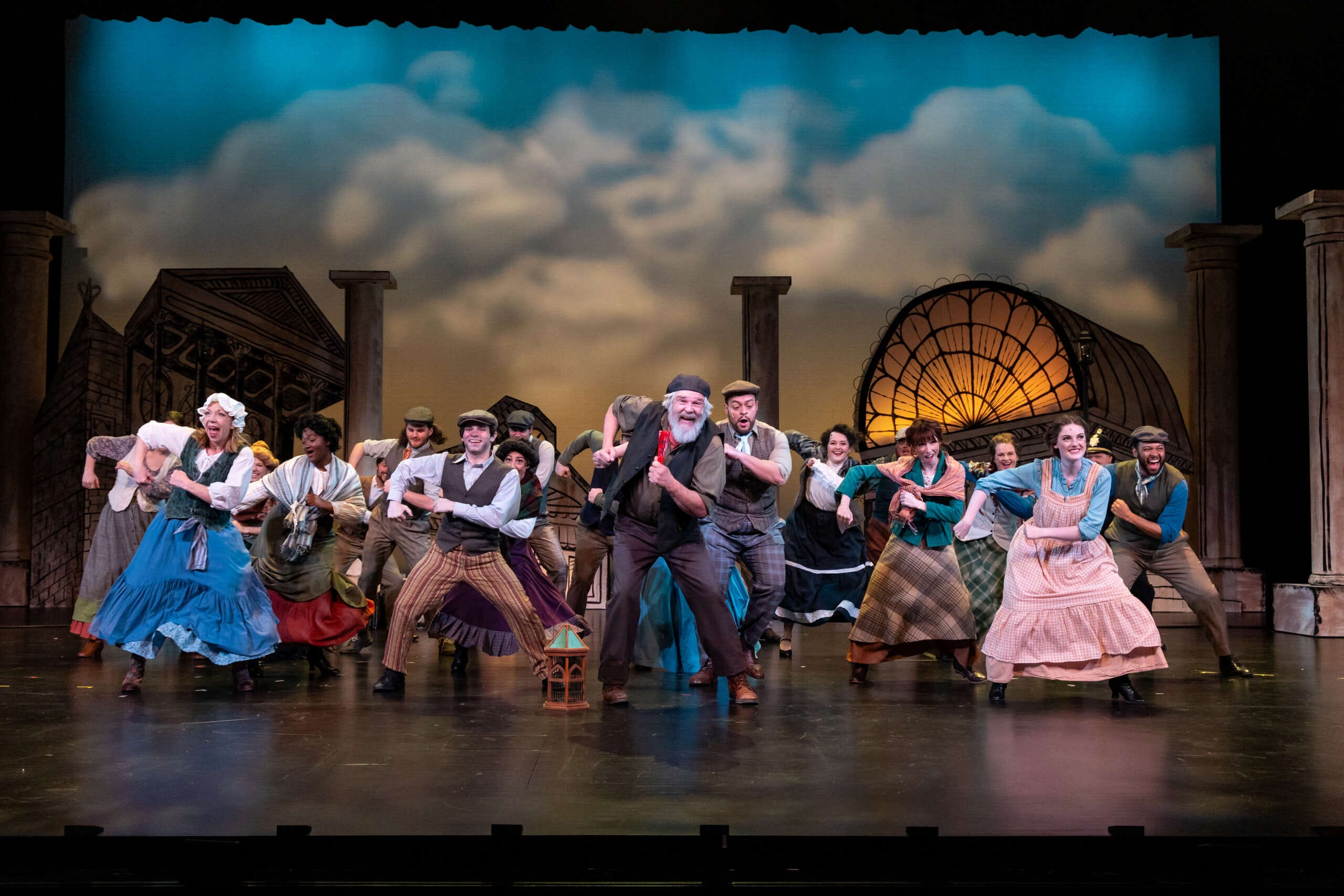
Jim Hitzke and the cast of My Fair Lady at Performance Now Theatre Company in Lakewood, Colo. | Photo: RDGPhotography
A stylish Golden Age showcase
Van Oosbree keeps the nearly three-hour production moving briskly, and the ensemble work is generally sharp. The group numbers have energy and style, from grand ballroom movement to lively street scenes. The only notable stumble came in “With a Little Bit of Luck,” where the unison footwork among Doolittle and his companions looked noticeably uneven at the June 21 matinee. Elsewhere, the choreography has polish and momentum.
Music director Heather Iris Holt leads a splendid-sounding live orchestra, which gives the production much of its sweep. From the overture on, the score has the lushness it needs, and the cast meets it with strong vocal work throughout.
The scenery is a bit more mixed. Andrew Bates’ black-and-white scenic concept works beautifully in the London street scenes, where the sketched architectural backdrops create a storybook frame and allow light to glow through the windows. The same illustrative approach is less successful in Higgins’ study, where the bookshelf-and-staircase unit looks clunkier and less integrated with the more detailed furnishings around it.
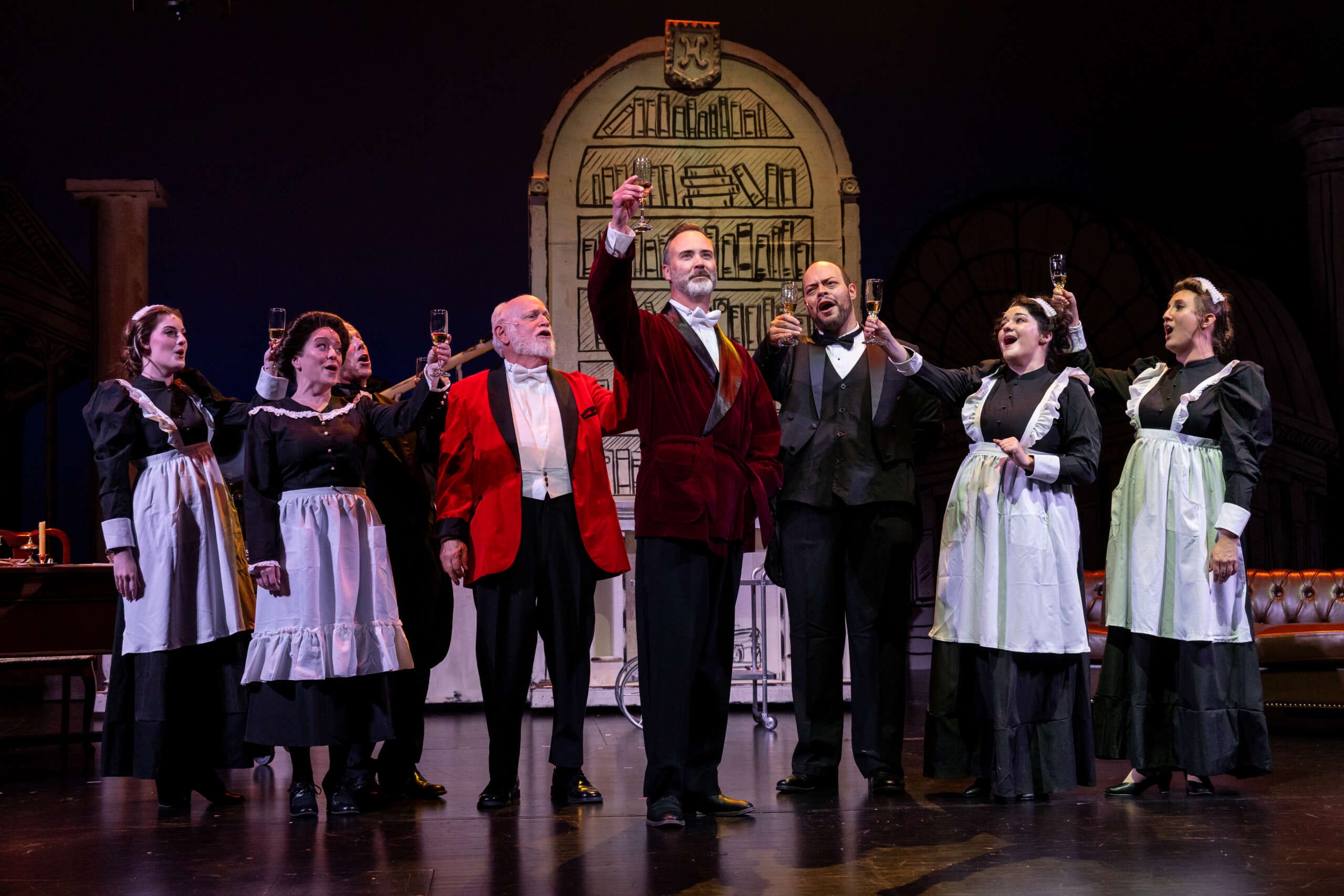
Bill Diggle and the cast of My Fair Lady at Performance Now Theatre Company in Lakewood, Colo. | Photo: RDGPhotography
Susan Rahmsdorff-Terry’s costumes, however, are a consistent delight. The production moves from ragged street clothes to crisp Ascot attire to elegant ballroom gowns with impressive range and detail. Eliza’s white ball gown is especially striking, but the achievement is broader than one dress; the ensemble is richly and carefully dressed across class, setting and occasion.
Brett Maughan’s lighting supports the shifts in mood and setting cleanly, while Emily Coleman’s dialect work deserves special mention. In a show where accent and class are inseparable, the dialects remain clear and intelligible, including the Cockney-heavy opening scenes.
Performance Now’s production of My Fair Lady is well-sung, well-paced, and often very funny. It understands the pleasure of Lerner and Loewe’s score, even if it does not interrogate the story as sharply as it could. Recent revivals have shown that the ending can be staged without changing the text, allowing Eliza to leave Higgins behind rather than soften toward him. Van Oosbree’s production chooses the more traditional route, which makes the final moment harder to swallow.
Still, before that last sour note, Campbell gives us an Eliza worth rooting for, and the production offers plenty of “loverly” reasons to spend an evening at the Lakewood Cultural Center.

An award-winning Colorado arts and culture reporter originally from Mineola, Texas. Tresca is the chief theatre critic for OnStage Colorado and managing editor of OnScreen Colorado. He’s the editor of Bucket List Community News, a contributor to Denver Westword and Estes Valley Voice, a resident storyteller for the Bonfils-Stanton Foundation and the co-host of the OnStage Colorado Podcast.

Leave A Comment