
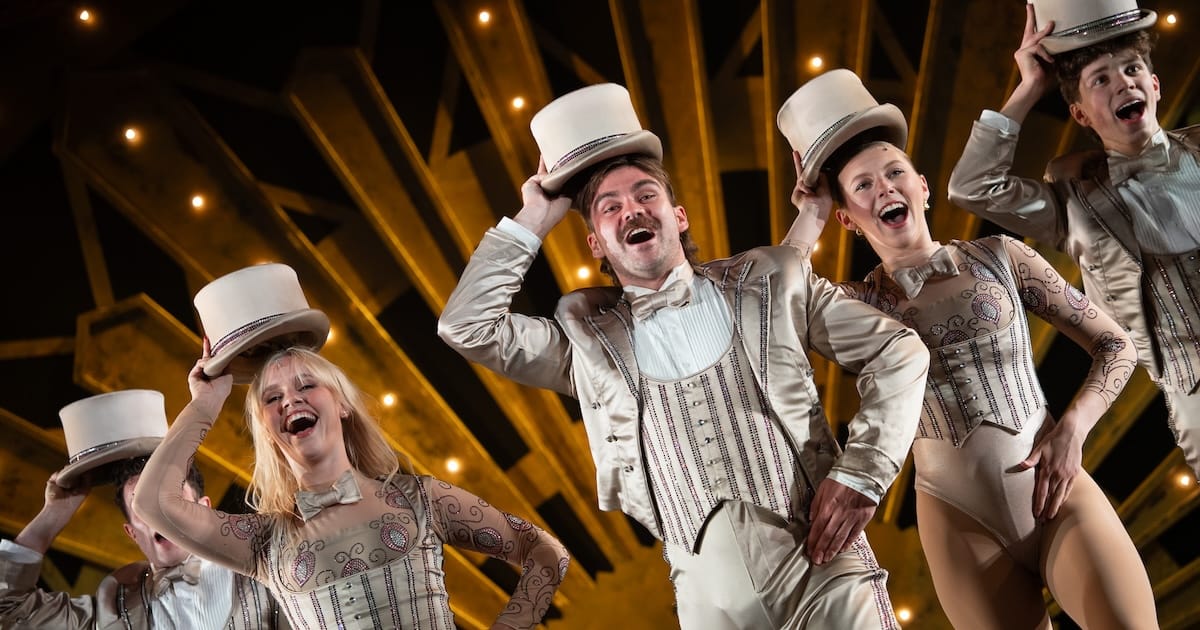
New choreography turns Michael Bennett’s classic into a full-ensemble showcase at Theatre Aspen.
Theatre Aspen has raised A Chorus Line to new heights by adding more dance, involving most, if not all, of the ensemble, as well as updated costumes.
Director Paige Price maintains every line and tune in honor of original musical’s legacy that made its splash on Broadway in 1975. However, she and Choreographer Eamon Foley created new, robust choreography, which encompasses more of the actors in all of the numbers. The only choreography completely true to the original is the iconic finale, “One.”
While the original version of A Chorus Line did include some dancing upstage during numbers like “At the Ballet,” Theatre Aspen’s “At the Ballet” involves a mesmerizing, swirling world of ballet, as barres appear on the stage, and multiple dancers — other than the primary three who traditionally sing about the magic, and the escape, of ballet class — practice in front of mirrors.
Numbers like “I Hope I Get It,” “Hello Twelve, Hello Thirteen, Hello Love” and “What I Did for Love” become incredibly energetic and robust by including the entire ensemble. The original version predominately relied on singling out characters in the spotlight, as opposed to this version, which only singles out Cassie (portrayed masterfully with an incredibly strong singing voice, dance skills and acting by Ahren Victory) and Paul (with Bryan Cortés delivering a powerful and emotionally stirring story balanced just right — not overly or too subtly stated; in fact, on opening night, you could hear a pin drop in the audience when he cried).
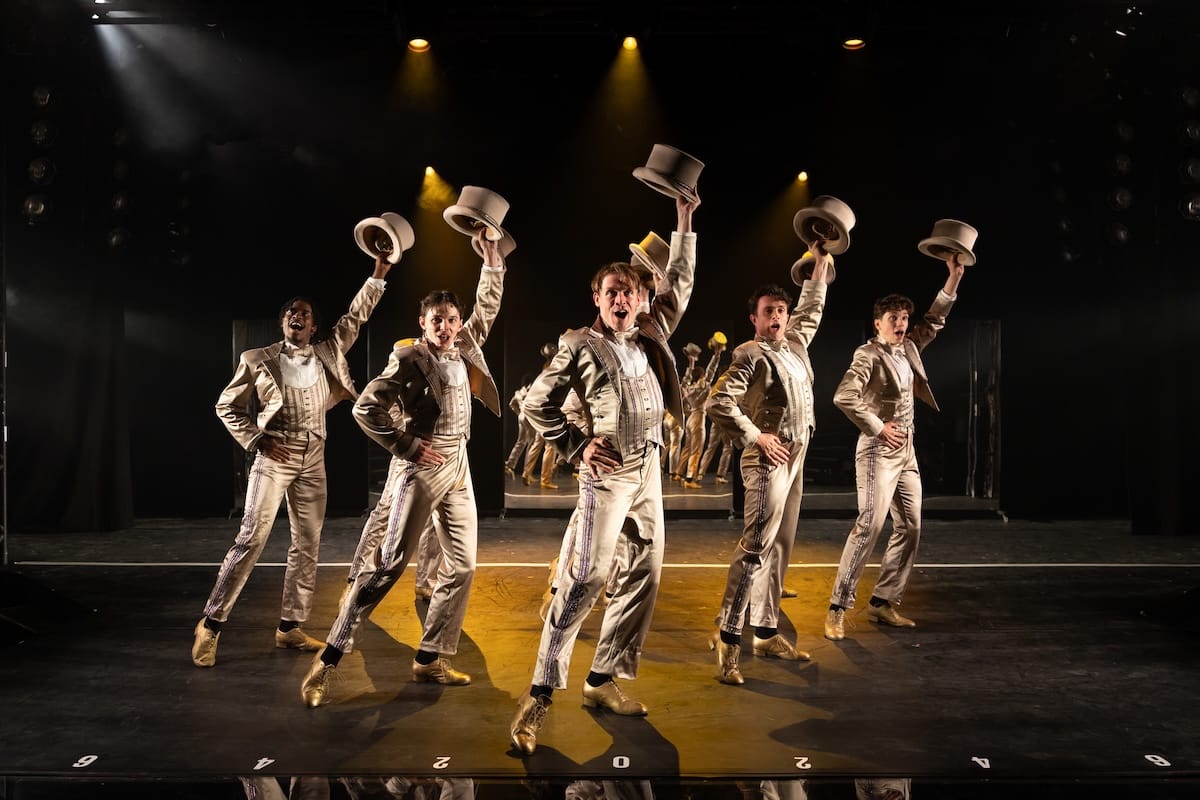
Photo: Nikki Hausherr
Big moves on a small stage
This more athletic and kinetic version of A Chorus Line fills literally every inch of the relatively small stage of the Hurst Theatre. In fact, it’s amazing that the dancers can pull off the series of leaps and turns diagonally across the stage, as if the area were much larger.
Equally as impressive is the efficient use of stage space given the huge number of dancers. “5, 6, 7, 8 … step, kick, kick, leap, kick touch” opened the performance with 22 dancers “learning” the choreography, before being reduced to 17.
With such an enormous number of actors on a small stage, the action could have seemed chaotic and unsettling in terms of where to focus your eyes. But effective lighting and well designed choreography draws the eye to exactly where it should go — be it the main character telling his or her story or the entire group creating artistic shapes, lines and other formations.
At times, characters sit on the edges of the stage. Zach (played convincingly by Stephen Cerf) physically disappears into a booming voice for most of the show as he decides who to cut and who to keep by prodding dancers to reveal their intimate stories.
Another effective strategy involves the ensemble lifting what otherwise would have been a spot-lit character telling her story over their heads — it only happens a few times, so as to remain distinctive but not overdone.
Both the Broadway veterans and the apprentices in the company are so top notch that it’s difficult, if not impossible, to distinguish between the two.
Only a few small things marred an otherwise stellar production. Mike (Joseph Ryan Harrington) has stronger dance skills than vocals, but he is always in tune and performs wonderfully for the rest of the show, including all of the other segments he embodies within the ensemble. During the ending finale, the ensemble didn’t remain in a perfect line with perfect precision on opening night, but, it’s a small thing — especially with a small stage on which to fit a line.
And, this is a personal preference, but I loved a version of “Nothing” when I saw A Chorus Line in Chicago well over a decade ago; that particular Diana showed no emotion, paused and emphasized the word “nothing” when singing “(I felt) nothing.” In the Aspen version, Anissa Marie Griego adds more emotion into the whole song, which, again, comes down to personal preference and personal expression. Aside from that, she did an excellent job with the song, and Price’s decision to add the ensemble acting out what Diana was supposed to feel definitely enhances the piece.
A fully realized production
As mentioned, Price’s decision to add more dance, subtle acting and interaction between characters greatly enhances the musical. I truly can’t imagine seeing the traditional version again; it would feel a little thin without backup characters adding to the numbers. Songs like “Hello Twelve, Hello Thirteen, Hello Love” weave so seamlessly between character vignettes and ensemble participation that I almost lost track that it remained the same piece throughout all of the action.
With the entire ensemble singing, “What I Did for Love” becomes so rich that I noticed at least one audience member wipe a tear from her eye. The beautiful harmonies literally fill the outer reaches of the theater.
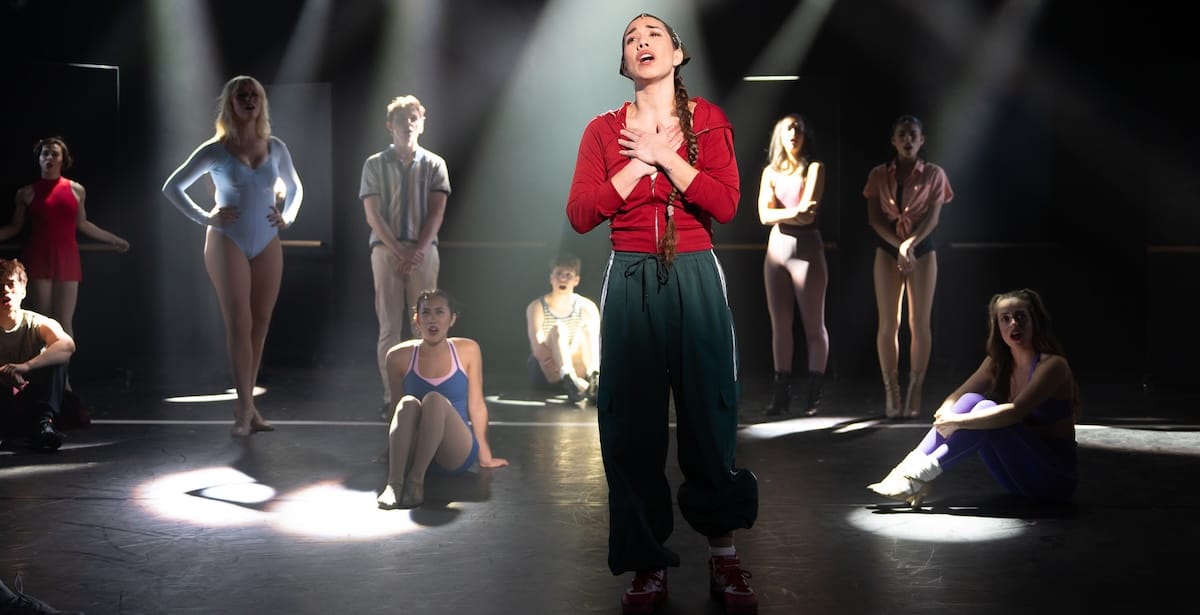
Anissa Marie Griego as Diana and the company of Theatre Aspen’s ‘A Chorus Line’ | Photo by Nikki Hausherr
Tech and standout performances
While the lighting seems relatively simple and doesn’t draw attention to itself, lighting designer Wheeler Moon employs various colors and positions of lighting to match the mood and intention of each scene. Full, bright lights add to the exciting opening scenes, while blue lighting aptly characterized the internal thoughts of each dancer in “I Hope I Get It” — particularly as they express their anxieties in needing “this job.” Other colors and configurations enhance various stories.
A fullness of sound, in perfect balance between singing, talking and a live band comprised of acoustic and electric bass, trombone, trumpet, drums, reed and keyboards, contributed to the fully satisfying and energetic musical (with music originally composed by Marvin Hamlisch and lyrics by Edward Kleban).
Just over 50 years later, the stories of each character, conceived by Michael Bennett based on the book by James Kirkwood and Nicolas Dante, remain relevant today. They speak to hard times growing up and the grit, perseverance and passion it takes to follow individual dreams.
One of the more humorous numbers emerges in “Dance: Ten; Looks, Three,” performed brilliantly by Tiffany Nicole Furicchia as Val. She shows her anger and frustration in perfect balance with her charming and hilarious description of how a new pair of tits (and ass) led her to earn roles.
As Sheila, Evelyn Peterson is brilliantly sassy and confident, and her strong vocals stand out.
Likewise, Charlie Reyes as Al and Evelyn Duggan as Kristine share excellent chemistry — and, most importantly, timing — as Al fills his wife Kristine’s sentences, particularly the words that need to be rendered in the proper key. The duo delivers a spirited, loving and ever-flowing performance.
Virtually every actor in this production depicts the story in poignant, heartwarming, humorous and appropriately heart-wrenching manners.
Six moveable mirrors make up the main stage set. They reflect the dancers’ bodies but lack the sharp clarity of traditional mirrors — a deliberate choice, since anything sharper would pick up distracting reflections of audience members.
They’re particularly adaptable; when lined up, they reflect the chorus and when quickly moved by actors into single mirrors, they become effective “props” for dancers practicing, say, “At the Ballet.” Finally, they become a clean backdrop when turned backwards; this becomes particularly effective to truncate the stage and focus on Cassie as she takes the stage alone.
The costumes are spot on, ranging from retro leotards to two pieces to sweatpants and even a polo shirt, jeans and athletic shoes, in addition to classic dance shoes. Cassie wears a fitting red leotard with attached skirt. The finale reveals a golden stage backdrop with fabulous men’s and women’s costumes — the details on the women’s arms are exquisite.
While the show moves quickly with excitement and emotion at every turn, a little over two hours can be a bit long to sit through without an intermission, depending upon your disposition; just be prepared.
Interestingly, Producing Director Jed Bernstein sat in attendance at New York City’s Shubert Theatre in the spring of 1976, when A Chorus Line earned nine Tony Awards and thought to himself: “Someday, I want to produce this.” And so he has, introducing the performance on opening night by saying: “You have never seen dancing on the stage like (this).”
If you already enjoy A Chorus Line, Theatre Aspen’s version is a must-see; new choreography supports the already “thrilling combination” the traditional version presented.


Kimberly Nicoletti is an award-winning journalist, with accolades from the Colorado Press Association, Warren Miller/The Ski Journal, and Home Instead. Her work has allowed her to: interview international athletes, musicians, artists, chefs and entrepreneurs; write national travel pieces; review art, theater and dance; create he said/she said movie reviews; cover business and politics; and more.

Leave A Comment