
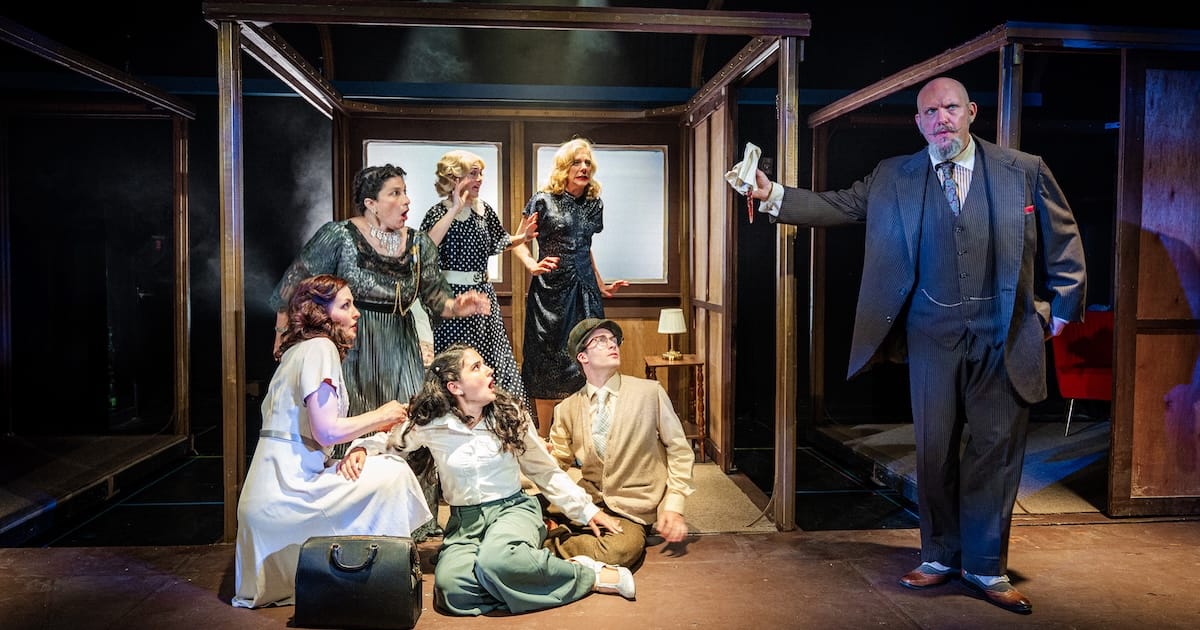
At the Breckenridge Backstage Theatre, an inventive transforming set and a twisty second act pay off a family-friendly whodunit.
Any good murder mystery ultimately surprises audiences, and the Breckenridge Backstage Theatre’s Murder on the Orient Express does so in spades. I won’t ruin the ending, but take my word for it: The twist in this mystery caused audience members, who packed the venue on July 1, to discuss it as they left the theatre and walked to their cars.
Based on the 1934 book by Agatha Christie and adapted for the stage by Ken Ludwig, Murder on the Orient Express revolves around eight memorable suspects — any one of whom might have a motive to stab Samuel Ratchett (Ari Bird).
Bird, who portrays both Ratchett, the murder victim, and Colonel Arbuthnot — a possible suspect — pulls off both characters so masterfully that it’s hard to recognize it’s the same actor. Within the production, he transitions from a foreign accent to an American one seamlessly.
The beginning of Act 1 delivers a rapid-fire visual introduction to all 13 characters (not including the little girl, Sophie Sullivan, whom audiences don’t see — they only hear a scream). It’s a lot to jump into, but each character carries a distinct personality, dress code and mannerism, making them easy to remember.
While navigating the characters is relatively simple (despite some complicated), the set initially compounds the challenge. The main segment of the set clearly represents the outside of the train, but two elements seem disorienting at first: On each side of the stage, the train extends in front of the primary train facade, and those side extensions of the set don’t quite make sense as actors stand in between them while the action takes place in a hotel — not inside or directly outside of the train.
Granted, it’s a small detail, and these two protruding side elements do greatly contribute to the setting for the remainder of the production. Overall, Martin Andrew’s set is quite brilliant: It not only depicts the outside of the train, but it’s also used as a hallway outside of individual cars — then the set transforms from the three modular units into interior dining cars, as well as sleeping cars.
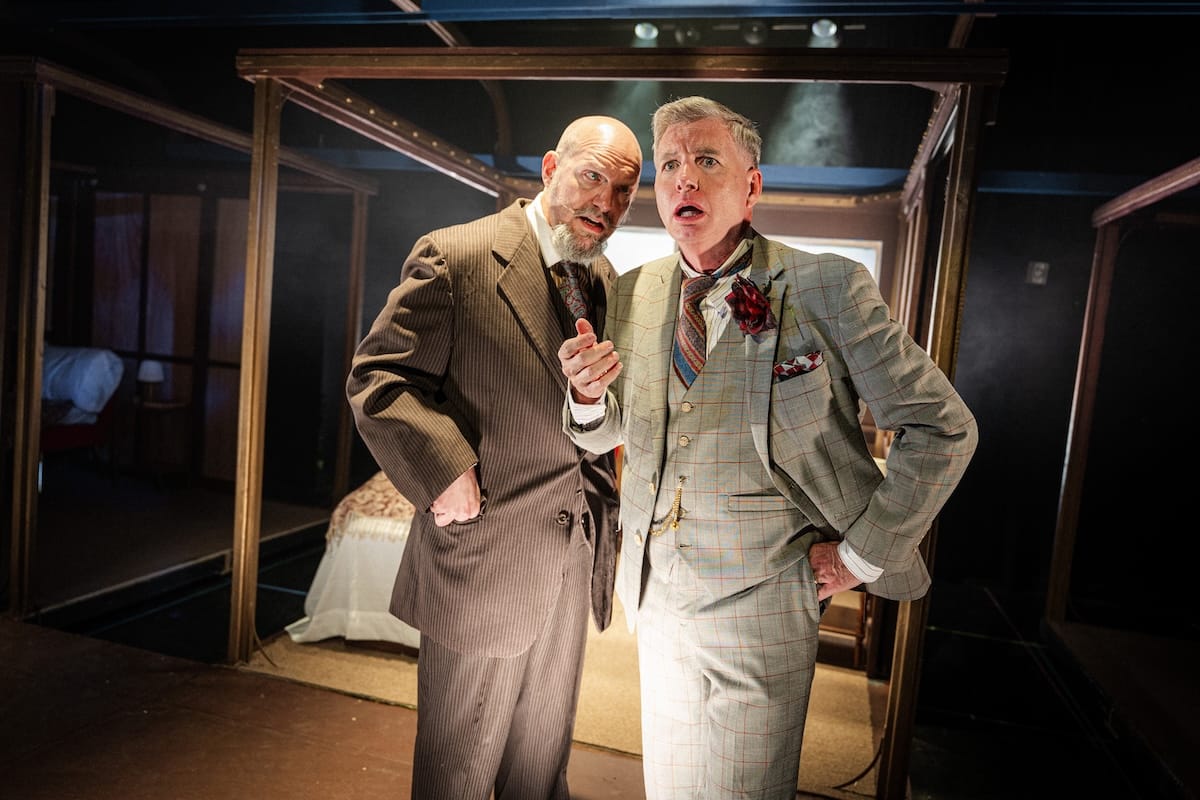
Photo: Curtis DeVore
These transformations take time, but the company has turned them into an artistic process. Rather than simply running on and off stage to bring props on and off, both the stagehands and the characters — namely the train conductor and the announcer (played most convincingly by Collin Nolt and Randy Losch, respectively) — assist in carting beds, chairs and tables. As lights flash and music plays, the segues provide a mesmerizing rest for audiences without breaking the storyline’s tension.
The manner in which stagehands and actors carry out the work, with sharp movements and precise, right-angle turns when moving from one direction to another, keeps the production flowing, as opposed to feeling like a stop in the action that screams: “Hold on! We have to drastically change the set.”
A signature of excellence in lighting occurs when any given audience member wouldn’t notice subtle illuminations that draw out the best in characters and the set. Such is the case with award-winning and Broadway-experienced lighting designer Keith Parham. The only time lighting stands out is when it’s boldly flashing through filtered “windows” of the train setting, so as not to become blindingly intrusive, during modular unit transformations. Throughout the production, sound and lighting stand out only when they should — during the set changes. Otherwise, they naturally enhance the production without drawing attention. For example, the actors’ voices are amplified enough to easily hear without seeming overly produced.
On the other hand, the costumes do stand out — Princess Dragomiroff and Countess Andrenyi’s dresses are stunning, with sequins and a nice flow below the waistline; I admit — I wanted to have shadowed costume designer Beth Laske-Miller to buy them in my size. Likewise, the fur coats and wraps were fabulous. Women’s wigs, like the one on Greta Ohlsson reflecting the era, look natural, and the men’s attire, including the train conductor’s uniform, fit in perfectly, transporting audiences back to the 1930s.
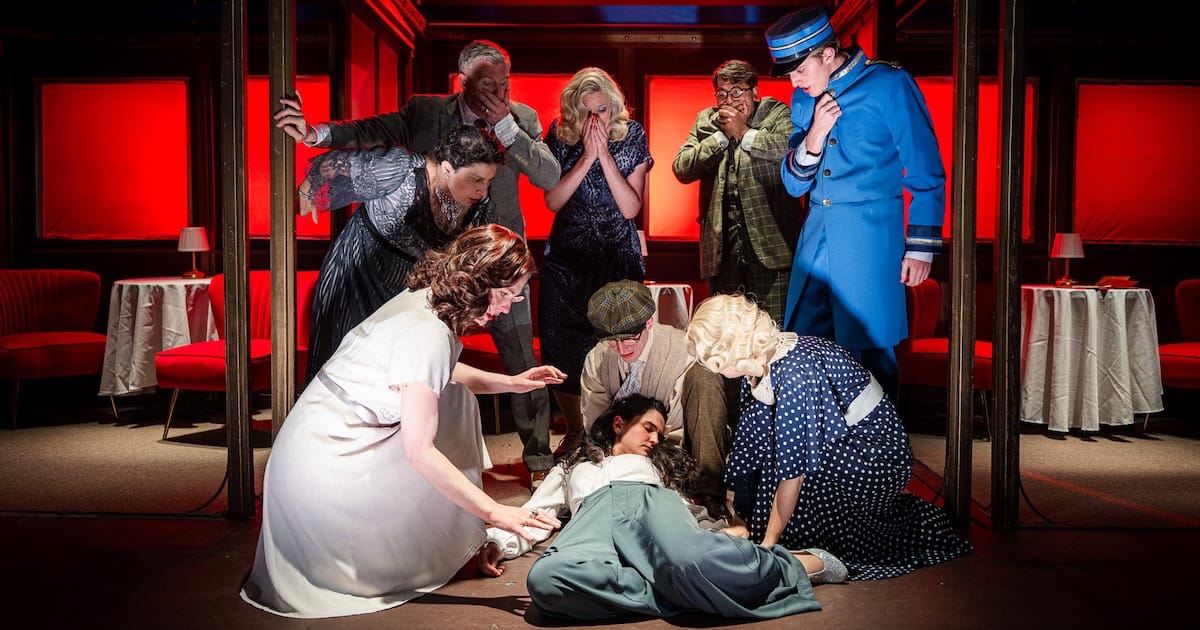
Photo: Curtis DeVore
The investigation
As Detective Hercule Poirot, Matt Miles ushers the audience through the mystery in a most compelling manner. When he boards the sold-out train — an anomaly to begin with, considering it’s the slow season — he points out that something is amiss, due to tensions and incongruencies among the passengers. Monsieur Bouc, solidly played by Michael Sullivan, grants the detective an otherwise unattainable ticket on the train.
Of course, each passenger has plenty of quirks. Clair Sullivan humorously depicts the over-the-top, aging actress traveling under the name of Helen Hubbard. She flirts with the young conductor and dances the Charleston in her car just before the murder takes place. She mentions four former husbands and claims a man burst into her room that night, leaving behind a button, which lands her on the list of suspects.
Then, there’s the couple having an affair. Are Mary Debenham (Molly Martinez-Collins) and Colonel Arbuthnot (Bird) — who easily draw audiences into their world — simply tense because of that secret, or are they hiding even more?
And, did Ratchett’s under-the-radar secretary, Hector MacQueen (played with perfect subtly by Sebastian Medina-Torres) know more than he initially let on to about Ratchett? And is Countess Andrenyi (Rebekah O’Connor) really a doctor?
Additionally, what’s the story with Princess Dragomiroff (whom Amy Gorelow characterizes with extravagant dresses and hilarious dramatic mannerisms) and her sidekick, the ever-anxious-yet-seemingly-innocent Greta Ohlsson?
Finally, is the second conductor, whom some claim to have witnessed, real? It’s hard to say, but the fact remains: The killer is still on the train because it’s stuck in a snowdrift, offering no escape.
While each character has an alibi by intermission, I would have preferred Act 1 to offer more motives, so that I could truly puzzle over whodunit. Instead, I emerged halfway through the story with thin arguments as to who may have possessed enough motive.
Nevertheless, Act 2 is a thrilling doozy, as the whodunit train gathers more and more steam. And, the humor — both silly and dry one-liners— continues, despite the grave circumstances.
In the end, a moral dilemma reveals itself. As with all good theatre, a question lingers for audiences to turn over in their own minds, as well as in those post-show conversations.


Kimberly Nicoletti is an award-winning journalist, with accolades from the Colorado Press Association, Warren Miller/The Ski Journal, and Home Instead. Her work has allowed her to: interview international athletes, musicians, artists, chefs and entrepreneurs; write national travel pieces; review art, theater and dance; create he said/she said movie reviews; cover business and politics; and more.

Leave A Comment