
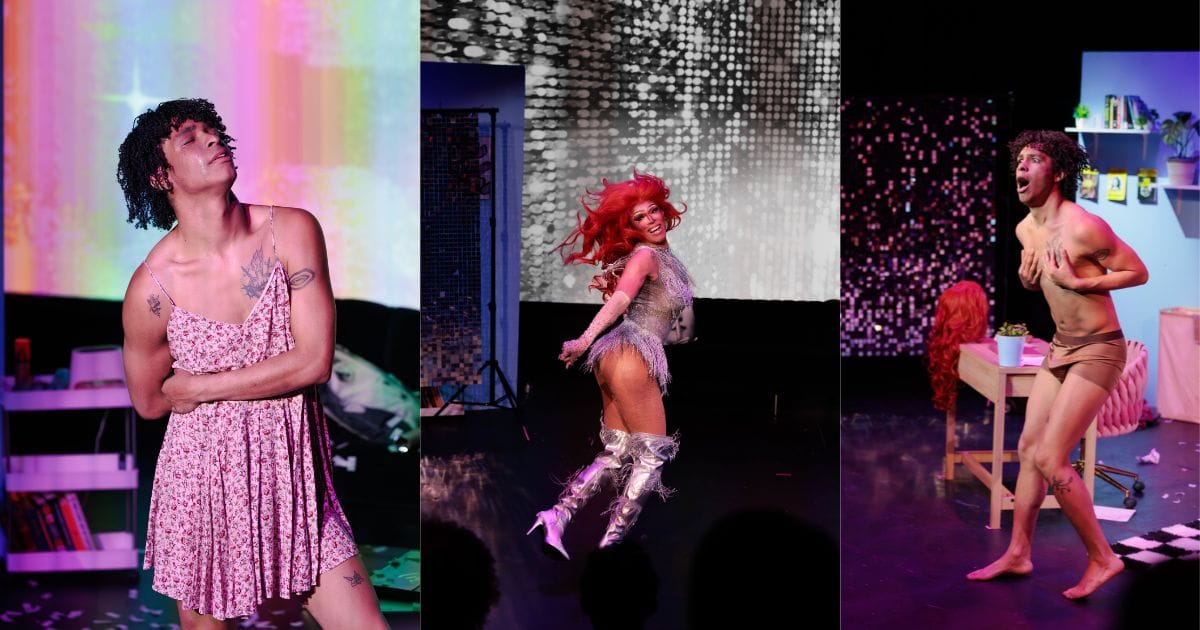
Angel Garcia’s one-person show is hilarious, unsettling and deeply empathetic in its portrait of a Black trans performer navigating a hostile world.
Summa Dat BBC starts in the club, in the middle of a drag performance by the lovely and charming Katrina Mist, played by Angel Garcia, the show’s writer, director and sole performer. She’s dressed in a short silver dress with lots of dangling fringe and a long, wavy red wig. She’s happy and confident, if not a little awkward.
In the next scene, Katrina gets home from the club and we enter her apartment, where the rest of the show takes place. There’s a black couch in the middle, flanked by walls adorned with art by Jack Klein. Some shelving fills the space on the walls, and a few storage containers sit on the floor. There’s also a chair at a desk with a laptop on it, and a big fuzzy black-and-white checkered rug in the middle of the room. A clothing rack sits to the side with a variety of slinky clothes hanging on it.
We watch as Katrina methodically undresses, pulling out silicone boobs and tossing them on the floor, then taking off her dress. She pulls out her hip pads before peeling down her pantyhose. This process is the first of many intimate peeks at this character’s Black trans life — a life I can’t possibly relate to, but which I yearn to understand and empathize with through storytelling exactly like this.
Disrobed from all the drag gear, Katrina is now Tre. They slip on something more comfortable (a loose-fitting, deep-plunging red and black floral dress) and, at 3:30 in the morning, move on to arranging a hookup over an app.
It’s another deeply personal look at the norms of this culture, right down to setting expectations about the nature of the sex they’re arranging. When Tre tells Thomas, a potential hookup, that they’re a bottom who’s “divorced from their dick,” Thomas says it’s fine. But when Thomas — played by a male blow-up doll — violates that agreement and Tre kicks him out, you start to get a sense for the underlying tension of the whole show.

The person behind the persona
Our main character is Black and trans and these identities are in conflict: the woman who is supposed to be submissive and demure vs. the well-endowed Black man expected to be powerful and dominating.
Adding to their stress, Tre is also strapped for cash and facing pressure from their roommate to get a job. So we follow along, through song and dance, as Tre sets up a ring light and opens an OnlyFans account. Original lyrics (again by Angel Garcia) make this number stand out, as movement conveys the strange emotional buildup of launching the account much better than dialog could have.
Sitting at the desk with the laptop open, Tre again demonstrates the tension between identities while setting up the OnlyFans profile as a “straight male looking to drain the pockets of some submissive sissies,” even though it’s clear that’s not who they are — and only what they think their audience wants.
A dystopian turn
But when Tre consistently doesn’t meet their desired earnings goal, the show takes a sci-fi turn and starts to feel more like an episode of Black Mirror than a drag comedy. Presented with the option to join a new, alternative platform with more earnings potential, Tre unknowingly agrees to terms and conditions they’ll soon regret.
Those conditions are hostile, controlling and exploitative. Suddenly ruled by an unseen voice belonging to a Southern white man, Tre enters a “digital auction” where they’re being treated like livestock (or dare I say a slave) at an actual auction. The bids keep coming, but so does the money, while that unseen, demeaning voice belittles and minimizes every aspect of Tre’s physical existence.
It’s maddening to watch the breakdown. Tre is hopeless and helpless, and the audience feels that right along with them — like you’ve lost control and are going insane. I imagine that this is not an unfamiliar sensation for trans folks navigating the world today as they try to find their place in it, and that this nightmarish episode is a sort of metaphor for that experience.
Finding laughter in resistance
If there is another parallel between this work of fiction and the trans experience, it is the way that humor and wisecracks are omnipresent throughout. Even when Tre is being beaten down by that cruel, invisible force they manage to tell it, “You hit like a bitch,” as they sit up, shaking off a knockout. Joy, as they say, is a form of resistance. So when you feel like you have nothing left, or like it’s all been taken away from you, you can still always find humor in your situation, and no one can take that away from you.
Which is what this show does from the beginning to the end. Even though it explores difficult subject matter, we’re laughing about it, too, all along the way. Summa Dat BBC is a comedy just as much as it is a drama, filled with sassy one-liners, lots of vulgarity and tons of references that only queer community members might catch. It pokes fun when and where it can, because sometimes that’s all you can do when the weight of the world feels so heavy.


Danielle Riha is a digital marketer by trade and a lifelong writer. She is an active member of the Denver theatre community as a regular contributor for No Proscenium and a marketing volunteer with Immersive Denver. When she's not taking in local theatre, Danielle hikes and attends jam band concerts with her husband.

Leave A Comment