
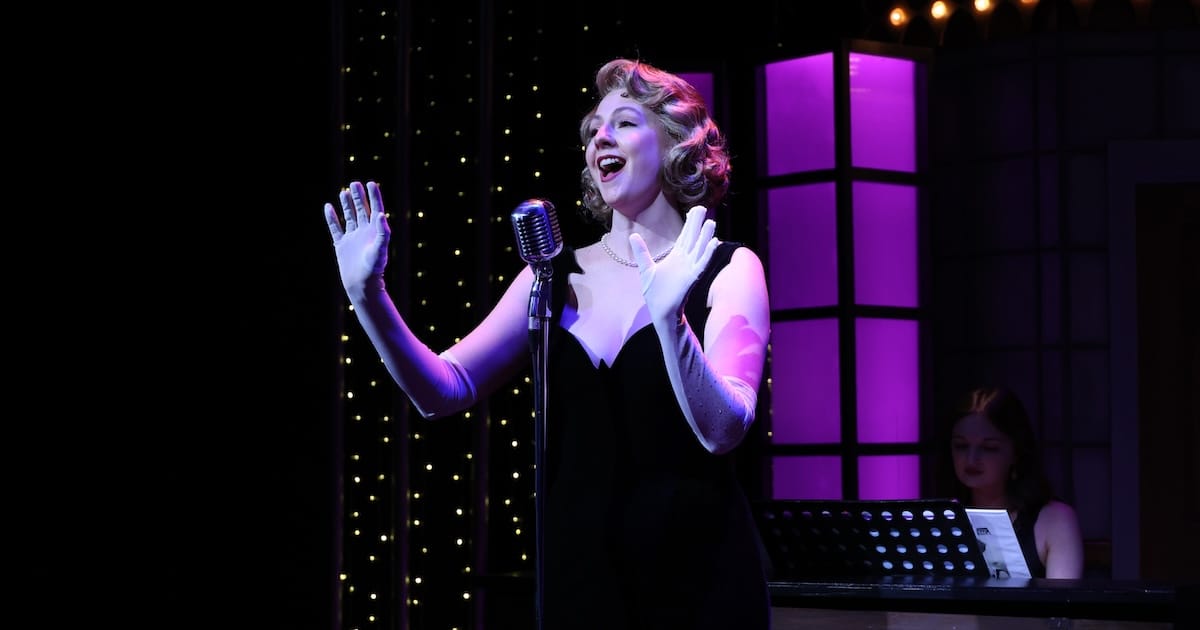
Kenny Moten directs a powerful production of Tenderly at Theatre SilCo.
I had heard of Rosemary Clooney, but, before seeing Tenderly, had no idea how musically influential — and humanly complex — she was. About all I knew going in was that my mom started singing “Come On-A My House” when I told her I was going to Theater SilCo. I thought to myself, “Oh, boy, what am I about to spend two hours listening to?”
Turns out, I ended up totally immersed in an incredibly compelling story with some of the best solo female singing I’ve heard in live theater for a while.
Directed by Kenny Moten, Anne Terze-Schwarz completely nails it as Clooney. From the beautiful blonde wig, which so seamlessly fit that I thought it was her own hair, to her opening soaring vocals belting out “Hey There (from Pajama Game),” she transports audiences into Clooney’s dramatic story from the first few minutes of the show and keeps them engrossed until the close of the production with “This Ole House.”
The story structure is quite brilliant; overall, it takes place in a psychiatric hospital, which happens to bear Clooney’s name, thanks to her financial support. But, in this context, she’s the patient. As the doctor (Ben Griffin) elicits her story, the two embody scenes that flash back to illustrate her life, from childhood to the present time and beyond.
Both Terze-Schwarz and Griffin have quite an emotional range they must cover — in addition to all of the amazing singing that carries the story.

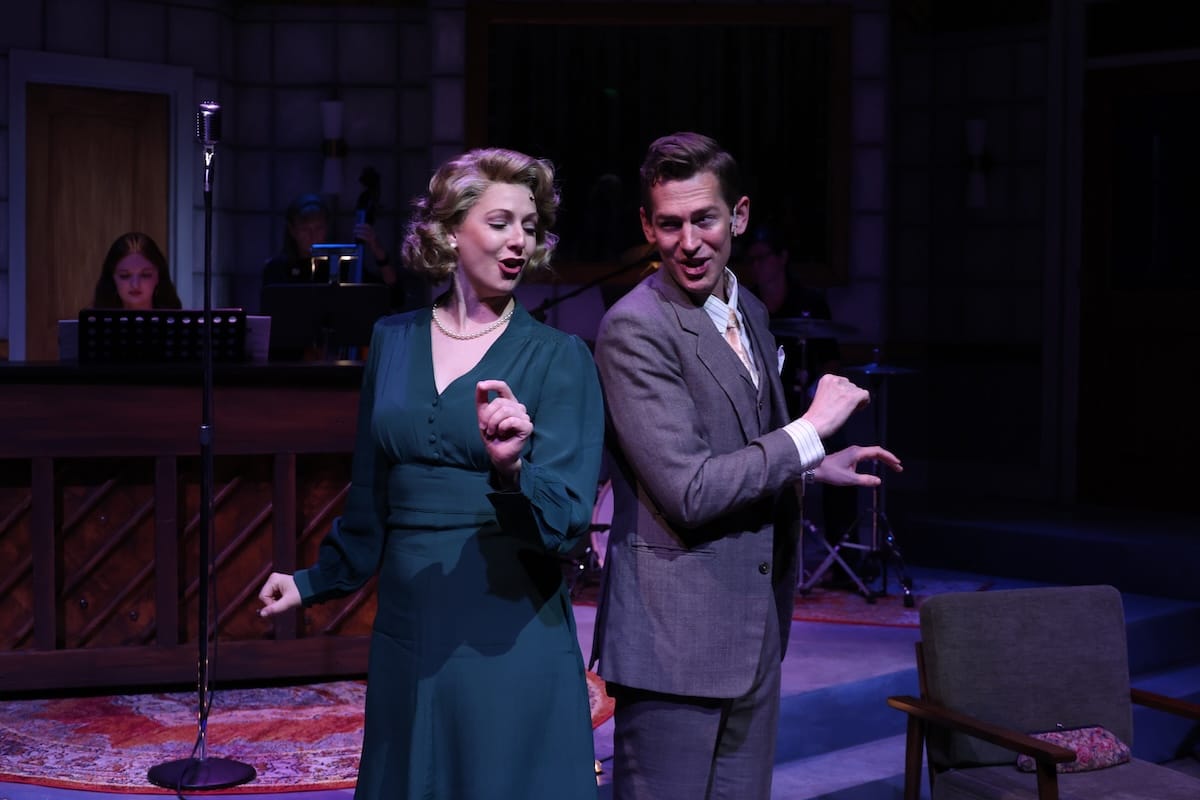
Anne Terze-Schwarz and Ben Griffin in ‘Tenderly.’ | Photo: Graco Hernandez
Confident to fragile
Terze-Schwarz portrays Clooney from a confident star on stage to a fragile drunk and just about everything in between — including her biting humor meant to deflect her psychiatrist’s probing questions. For example, she notes that she’s in the “Clooney bin” and that her family is part of the CIA: Catholic, Irish, Alcoholic.
Griffin’s load is especially hefty. He plays a dozen or so characters, transforming on a dime from psychiatrist to Clooney’s mother, sister, priest, lovers and friends. He masterfully alters his posture, demeanor, movements and tone of voice to fit each character, but you do have to employ that handy willing suspension of disbelief to truly go along with it all.
While he guides you through his excellent performance, you have to use your imagination, particularly in the beginning as he abruptly jumps in character from a professional psychiatrist to Clooney’s younger sister, Betty, and joins in for the show’s second song, “Sisters.” Once you’re oriented to the fact that he plays so many characters, he makes it easy to follow along as, say, he puts on a hat and speaks like Frank Sinatra or smokes a pipe as Bing Crosby or hunches over a bit, moving slower as Father O’Reilly.
Setting the tone
Through it all, Tenderly drifts back and forth between the star’s iconic public image and her personal tragedies, with Brett Maughan’s lighting design setting the tone: Blue hues bathe Terze-Schwarz as she delivers a sweet “Count Your Blessings Instead of Sheep,” a full curtain of lights and spotlight illuminates when Clooney performs professionally, and floor lighting on the rounded riser enhances the effect.
The show takes audiences on an emotional journey of ups and downs, paired with 19 tunes. Songs naturally flow to and from story scenes, supporting the narrative as it develops.
It portrays highlights, such as how 16-year-old Clooney and her 13-year-old sister took a bus from small-town Maysville, Kentucky to Cincinnati, Ohio to audition for a radio gig, where they first became popular. Clooney hated “Come On-a My House,” which her record executive insisted she record — going so far as threatening to fire her if she didn’t. The 1950s hit rocketed her into stardom, but the pressure of public life — including starring in White Christmas with Crosby — along with her personal traumas led her to abuse tranquilizers and alcohol.
The story takes a deep dive into how her mother left her and siblings to grow up with an alcoholic father, who also simply disappeared one day, as well as her adult life. After having a passionate affair with actor Jose Ferrer, she married him, only to suffer from the subsequent affairs he continued. Their intense attraction resulted in two marriages and two divorces — and five kids.
The only person Clooney could truly be herself with was dancer Dante DiPaolo, and that captivating story also unfolds during Tenderly.
She ends up in a psychiatric ward after witnessing her friend, Robert F. Kennedy, being assassinated from just yards away. The violence triggered a breakdown, which Terze-Schwarz renders so intensely as she embodies Clooney screaming and accusing fans during a show in Reno that you feel like you’re shockingly a part of that Nevada audience.
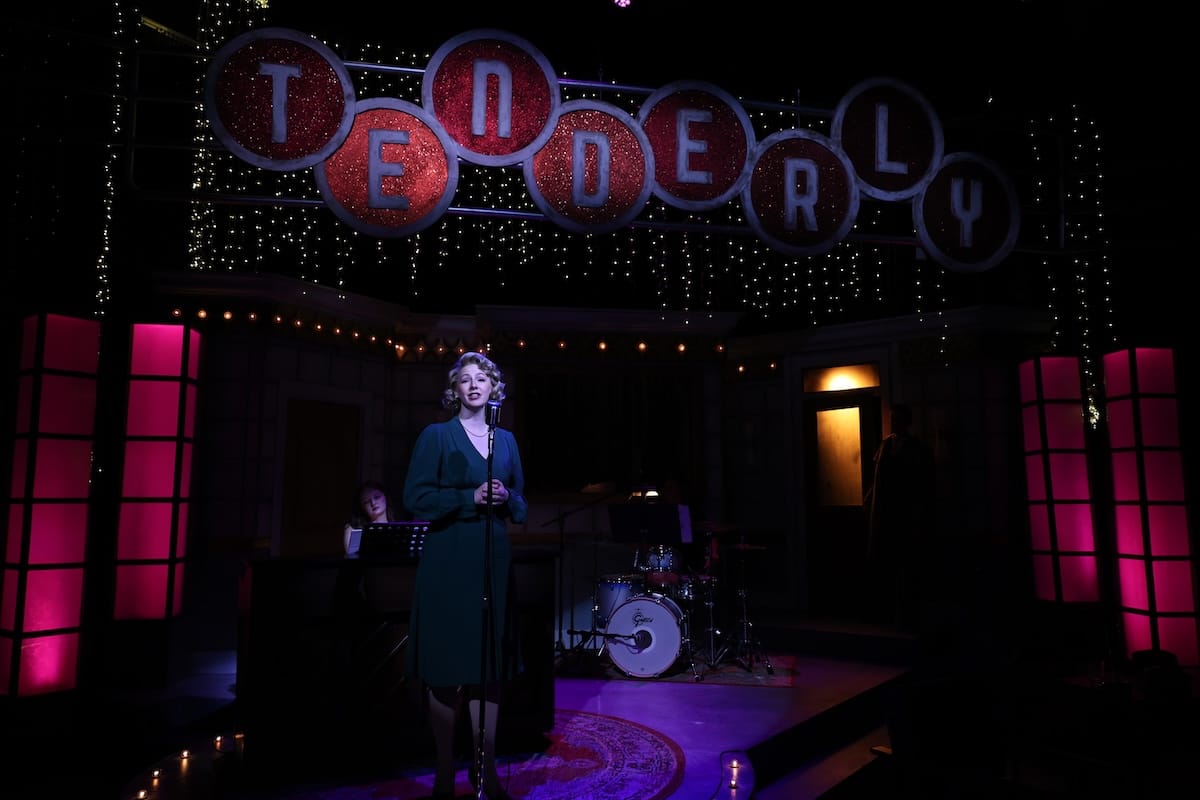
Photo: Graco Hernandez
The band
A live band, located on stage, backs Terze-Schwarz and Griffin. Rather than the pianist, upright bass player and drummer simply supporting the two actors musically in the background, Terze-Schwarz sporadically interacts with them. This becomes especially effective when the pianist reacts to her drunken rage.
Brian Mallgrave’s set also contributes to the story. It welcomes audiences with a huge curtain of lights and each letter of “Tenderly” surrounded in glittery circles. Most songs take place behind a retro microphone on the riser, while the psychiatrist appointments occur to the right, at a desk and chair. Windows glow in various hues throughout the performance, adding to whatever mood arises. One transparent window becomes particularly prominent, hosting scenes ranging from a Paramount producer having a fit because Clooney has breached the moral clauses in her contract to a hot and fun (and age-appropriate) sex scene, in which all you can see is clothing flying.
The sound design by Pan-Pan Gou is perfectly balanced, with the musicians never dominating Terze-Schwarz and Griffin’s vocals. The music not only backs the vocals but, at one point, also furthers the narrative by playing ethereal music while Clooney acts under the influence of drugs and alcohol. The piano also plays a prominent role in Act One’s closing tune, “Have I Stayed Too Long at the Fair?”
In Act 2, both the band and the actors deliver a fiery and bittersweet tango between Clooney and Ferrer. Because the musicians have been backing Clooney’s singing throughout, when they walk off stage during the singer’s breakdown, the gravity of the situation sinks even deeper.
Costume Designer Nicole Harrison has Terze-Schwarz change from her opening song in a long, blue velvet dress with full white gloves to a modest green dress with beige heels in Act 1 and a dressy white blouse paired with a blue skirt and the same heels in Act 2. Again, it takes a bit of a willing suspension of disbelief to “buy” her wearing heels in the psychiatric ward — along with her carrying a purse containing cigarettes to her therapy sessions — but that’s why the heels are beige and modest, allowing audiences to be swept away by the story and music, as opposed to getting hung up on minor details.
Theatre SilCo calls Tenderly “soulful, elegant, resilient,” and it’s all that and more. Indeed, Terze-Schwarz plays Clooney entirely elegantly, as well as soulfully. And, Clooney’s story stands as a testament to resilience. After a diagnosis of bipolar and ongoing therapy, she not only returns to the stage for a respectable jazz comeback but also reunites with Dante.
Theatre SilCo recommends Tenderly for ages 10 and up, stating it’s “great for families and adults who love classic jazz and pop standards.” I’d add that you don’t need to love classic jazz or pop standards — you just need to appreciate a compelling story and perhaps even better singing. It’s a spectacular evening of high-quality entertainment.



Kimberly Nicoletti is an award-winning journalist, with accolades from the Colorado Press Association, Warren Miller/The Ski Journal, and Home Instead. Her work has allowed her to: interview international athletes, musicians, artists, chefs and entrepreneurs; write national travel pieces; review art, theater and dance; create he said/she said movie reviews; cover business and politics; and more.

Leave A Comment