

A solo performance staged just three days after shoulder surgery becomes a captivating night of theatre.
Theatre SilCo offers a rare opportunity to experience The Catastrophist live and in-person, something that has only occurred in a handful of theatres across the nation.
California-based Marin Theatre Company commissioned award-winning playwright Lauren Gunderson to create the play and co-produced it with Round House Theatre in Maryland during the height of the COVID-19 shutdowns in 2020. As a result, it debuted as a streaming, rather than live, performance in January 2021, portraying the story of Gunderson’s then-husband and world-renowned virologist Nathan Wolfe. The Catastrophist didn’t open to a live audience until March 2022, and since then, few theatres and universities have produced it.
Although Gunderson — the country’s most-produced living playwright (according to American Theatre magazine) — tends to revolve her scripts around science and history, she revealed her then-husband’s professional and personal story for the first time through The Catastrophist. It’s both intellectual and emotional, in a way that only a wife can tell.
And it’s intimate, nuanced and masterful in a way that only Theatre SilCo can present.
Director Chris Alleman said the theatre originally planned to produce The Catastrophist on a bare stage with no set — just lights up and lights down. But Theatre SilCo’s longtime technical director, Ben Whitmore, dreamed up a host of images to project on the 10 vertical screens of various sizes hanging behind actor Josh Blanchard.

In fact, Whitmore came up with about three times as many images as they finally settled for, resulting in just enough imagery to support the more complex scientific information and to ground Wolfe’s shared experiences, while not overstimulating audiences. For the most part, the background screens remain blank, simply reflecting whatever lighting hues match Wolfe’s emotions — from panicked, emergency reds to introspective blues and worldwide journeying greens.
Whitmore and the rest of the SilCo team edited the images and words down to the essentials that support the story, so they wouldn’t overshadow Blanchard’s heartfelt acting. For example, they show people in the Republic of Cameroon to humanize the place where Wolfe discovered that rural hunters had become infected with a retrovirus related to HIV that jumped from animals to humans. When scientific information Wolfe talks about includes terms many people aren’t familiar with, circular graphics illustrate how the eukaryotes and prokaryotes he mentions relate to human beings.
Meanwhile, subtle sounds, ranging from a fetus’s heartbeat to the clickety-clack of letters being typed on the screen, seamlessly weave in and out to support the story, with production stage manager Kyrsten Goodrich impeccably working in tandem with Blanchard’s words and movements.
The artistic team also packaged three different aromas within plastic containers for audience members to smell, if they choose to, at certain times during the play; it’s a reminder of how poignantly scents can bring back memories.
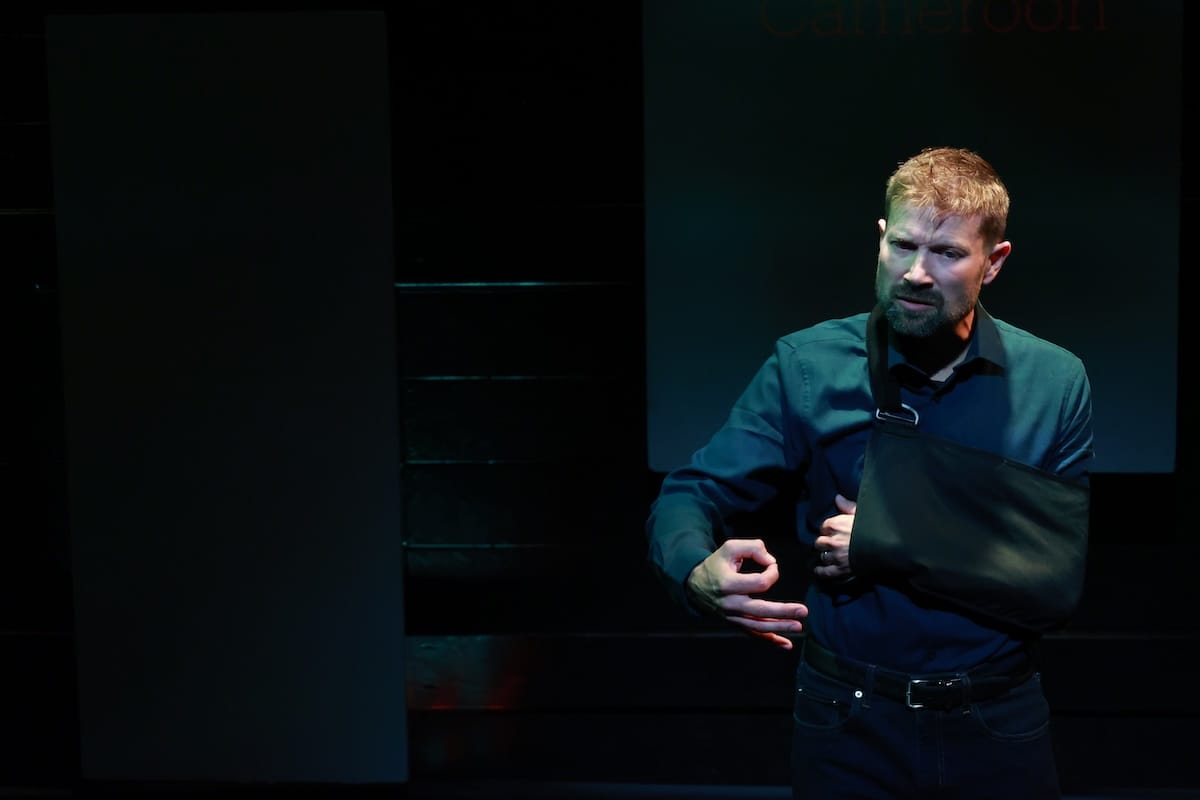
Josh Blanchard in the Theatre SilCo production of ‘The Catastrophist.’ | Photo: Graco Hernandez
Life experiences
The Catastrophist blends Wolfe’s personal life experiences, particularly those of being a son, father and husband, with incredibly interesting scientific knowledge that revolves around Wolfe’s study of viruses and how they “live,” spread and can turn into pandemics. While Gunderson does impart plenty of hefty academic facts, she doesn’t let them bog down the script or the action. Rather, she balances Wolfe’s professional findings and curiosities with the larger story of how death and life affect him on a very personal level.
Blanchard interprets the script in the warmest and most engaging way possible. He humanizes the scientific facts Gunderson has already made user-friendly and deepens the emotional connection between the story and the audience through his consummate acting.
Once the theatre’s executive director, Blanchard is now the Director of Colorado Creative Industries and hasn’t taken the stage for eight years. It’s an absolute thrill to watch him embody the passion, the frustration, the drive, the sadness and the curiosity of one of the world’s leading virologists. Offstage, he exudes a warm, delightful personality, and it comes through in his onstage performance as he naturally drops into the perfect rhythm and pacing to portray Wolfe’s story. He captivates audiences; it’s as if he’s speaking personally to each one of the 60 people seated in the theatre as they accompany the character through his deepest sorrows and joys.
Blanchard first took the helm with Alleman in steering Theatre SilCo’s previous incarnation, the Lake Dillon Theatre Company, from a local theatre to a professional-level organization nearly 25 years ago, and his heartfelt passion and professional skills have never waned.
He’s so committed to excellence — and the fact that the show must always go on — that he debuted this one-man production literally three days after reconstructive surgery on his collarbone and shoulder. The fact that he’s in a sling doesn’t impede his ability to deliver an intellectually rousing and emotionally compelling monologue one bit. During the talkback on Sept. 20, audience members commented that they thought the sling was part of the costuming — and it does work, as Wolfe suffers a heart attack, clutching his left side, which happens to be the same side that Blanchard shattered in an accident.
The script opens with both the character and the audience unsure exactly what’s happening. It unconventionally draws attention to itself; Wolfe realizes he’s experiencing Act One of a play his wife wrote. He even talks to his wife — and talks to the audience as he conveys what she said while writing the play. But Blanchard portrays the whole thing, from the opening scene until the very end, with such conviction and vulnerability that audiences remain glued to his every word.
The Catastrophist employs art to pose questions that science alone cannot answer. In doing so, it takes audiences on a journey from biological evidence sourced in Cameroon’s forests to the inner chambers of the heart, both literally and metaphorically.
It elicits some of our most essential questions as human beings, such as: How does family affect us emotionally and biologically? How are we all connected — including our link to viruses — and how do we carry on when so much of life lies beyond our control?
And it does so in a memorable 80- to 90-minute time span that seems to fly by.



Kimberly Nicoletti is an award-winning journalist, with accolades from the Colorado Press Association, Warren Miller/The Ski Journal, and Home Instead. Her work has allowed her to: interview international athletes, musicians, artists, chefs and entrepreneurs; write national travel pieces; review art, theater and dance; create he said/she said movie reviews; cover business and politics; and more.

Leave A Comment