
Kirsten Wilson’s No Contract finds piercing truths about dementia but runs nearly three hours and loses its theatrical shape.
Throughout Kirsten Wilson’s No Contract, a new tragicomedy about her mother’s dementia, Wilson keeps returning to King Lear.
“Have you seen that play, King Lear?” she asks the audience in Act One. “It’s too much.”
The same could be said about No Contract.
That’s a particularly vexing issue because Wilson explicitly states she wants to prevent her mother’s story from becoming tragedy. Marie Wilson — an activist, author and creator of Take Our Daughters to Work Day — was, by her daughter’s telling, brilliant, glamorous and aggressively alive. No Contract sets out to preserve that vitality even as dementia strips pieces of it away.

Yet the world-premiere Motus Theater production spends so long cataloging that decline that it eventually overwhelms the joy Wilson is trying to protect.
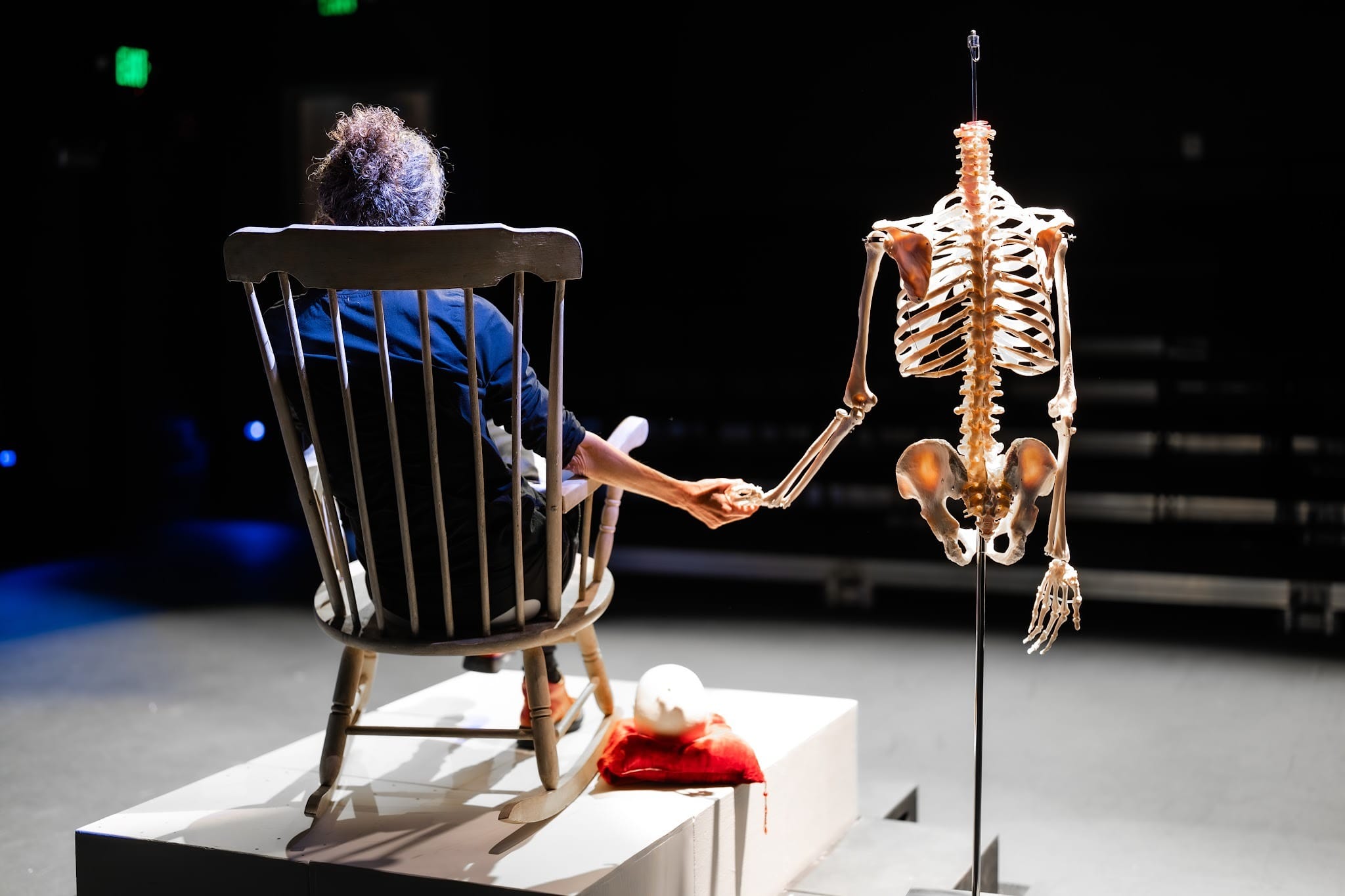
The warning comes early. After a preshow conversation in which audience members discuss their own relationships to dementia, Wilson enters a bare-bones setting and cradles a clothed skeleton beneath a hanging crown. Slowly, she removes its skull.
It is an effective image of a mind disappearing, but it didn’t need to go on for as long as it does. That pattern repeats throughout the nearly three-hour performance.

Kirsten Wilson in No Contract. | Photo: Lan Vo Photography. Courtesy of Motus Theater
Wilson initially takes her time establishing who Marie was, including the remarkable story of a beauty-pageant talent performance involving “Flight of the Bumblebee,” a marimba and pointe shoes. Dementia does not enter the story until roughly 20 minutes into the piece. The context matters, but No Contract repeatedly struggles to distinguish between detail that deepens Marie and detail that simply delays the drama.
When Wilson gets the balance right, the show can be piercing. A frantic “Flight of the Bumblebee” sequence captures cognitive decline with theatrical imagination. Wilson beautifully recreates one of Marie’s last flashes of public brilliance, when she stood at a Drunk Shakespeare performance and recited Hamlet’s “To be or not to be” speech from memory. A later story about trying to get her mother into the shower captures something painfully recognizable about dementia: an ordinary task metastasizing into anger, confusion and betrayal.
Anthony Salvo’s live violin also gives Wilson something to push against. Whenever his underscoring becomes too mournful, she cuts him off, insisting that this will not become King Lear.
The trouble is that the production does become exactly what she keeps rejecting.
Where the theatrical contract breaks
Act One piles painful episodes upon painful episodes, interrupted by deliberately goofy devices, including a clapboard gag in which Wilson mimes dying and dementia-themed karaoke. The play’s laborious length impacts how the material lands. Repetition flattened experiences that should have devastated, and people clearly had had enough by intermission, as several audience members left during the performance’s break.

Kirsten Wilson in No Contract. | Photo: Lan Vo Photography. Courtesy of Motus Theater
Act Two compounds the problem by largely abandoning the physical and metatheatrical vocabulary established earlier. Wilson settles into a rocking chair and begins telling longer stretches of Marie’s story directly. The shift feels less like an evolution than a breach of the theatrical contract: What had been an unpredictable collision of memory, Shakespeare, music and performance becomes story hour.
There are thornier questions here that No Contract only brushes against. Wilson acknowledges that much of her mother’s decline happened at a distance and that she often experienced crises over the phone. She also admits to moments of cruelty and guilt. Those complications suggest a more vulnerable play about what children owe their parents, what they cannot provide and how guilt reshapes memory. Too often, the production moves past them toward another anecdote instead.
Still, there is clearly an audience for No Contract. When Wilson asked how many people knew someone affected by Alzheimer’s or dementia, hands rose throughout the theater. For viewers living through something similar, its refusal to sanitize the anger, exhaustion and absurdity may feel deeply validating.
Wilson has found powerful material. What No Contract needs now is the thing Hamlet recommends: brevity. There is a moving 90-minute play buried inside these nearly three hours — one capable of honoring Marie’s joy without making the audience endure quite so much of her suffering.

An award-winning Colorado arts and culture reporter originally from Mineola, Texas. Tresca is the chief theatre critic for OnStage Colorado and managing editor of OnScreen Colorado. He’s the editor of Bucket List Community News, a contributor to Denver Westword and Estes Valley Voice, a resident storyteller for the Bonfils-Stanton Foundation and the co-host of the OnStage Colorado Podcast.

Leave A Comment