
Karen Zacarías’ Colorado premiere finds real feeling and big laughs in a whirlwind of mistaken identities.
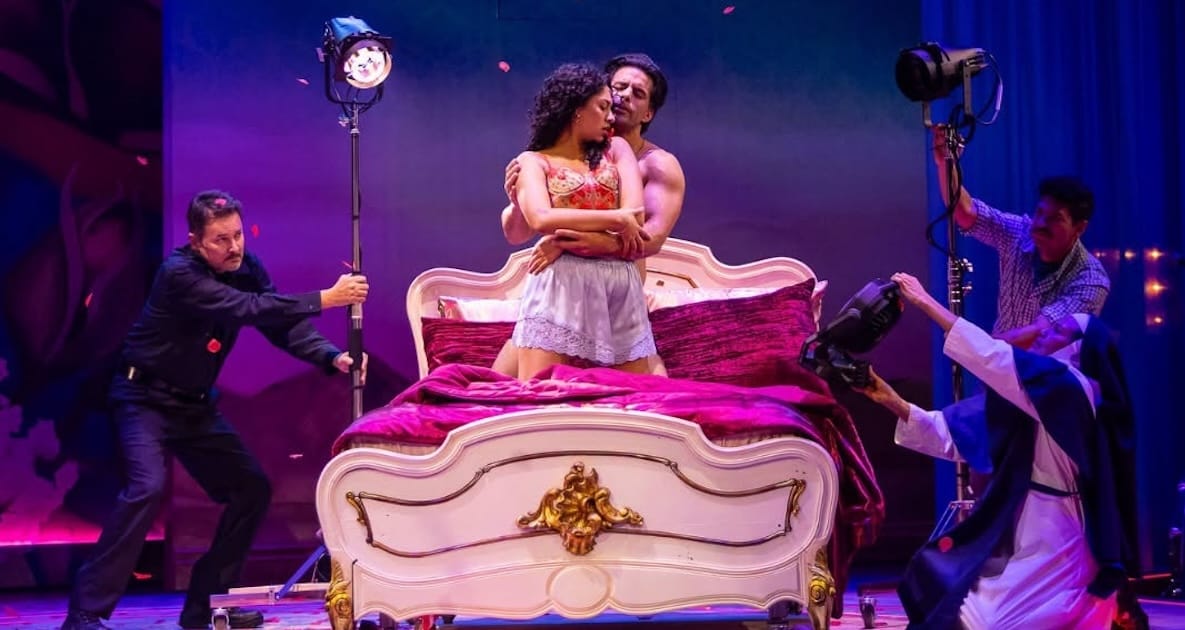
In the middle of Act 2, a nun walks onstage holding a sign that reads “CLIMAX” before a sex scene. It is an objectively hilarious visual gag and about as subtle as Destiny of Desire: A Telenovela Play with Music gets.
The joke also tells you a lot about how Karen Zacarías’ play operates. The DCPA Theatre Company’s Colorado premiere, directed by Marcela Lorca in a co-production with Center Theatre Group in Los Angeles, is a loving, Brechtian riff on the telenovela.
There is no fourth wall to speak of. Actors announce scene titles, push scenery into place and deliver some lines directly to the audience. Ge Enrique waits at the piano to punctuate revelations with exactly the dramatic sting they deserve. Yet once the actors step into the story, everyone treats its betrayals, romances and astonishing coincidences with complete sincerity.
That collision of theatrical playfulness and deadly serious melodrama makes the production such a raucous good time. It captures the experience of watching a telenovela: breakneck plotting, shameless romance, enormous stakes and the certainty that whatever just happened can always become more dramatic.


The cast of the DCPA Theatre Company’s production of Destiny of Desire: A Telenovela Play with Music. | Photo: Jamie Kraus Photography
Everybody has a secret
Wealthy former beauty queen Fabiola Castillo (Bianca Marroquín) and poor Hortensia del Río (Francisca Muñoz) give birth at the same hospital in Bellarica, Mexico, on an appropriately dark and stormy night. Fabiola’s daughter is frail. Hortensia’s daughter is healthy. Terrified of disappointing her powerful husband, Armando (Zeus Mendoza), Fabiola convinces Doctor Mendoza (Al Rodrigo) and Sister Sonia (Cheryl Umaña) to switch the babies.
Zacarías immediately undercuts the apparent absurdity with one of the factual interruptions that recur throughout the play: About 18 babies born in U.S. hospitals are handed to the wrong mother each year.
That device becomes one of the play’s smartest running jokes. Whenever the story threatens to become too improbable, Zacarías points toward reality.

Al Rodrigo and Cheryl Umaña in Destiny of Desire: A Telenovela Play with Music. | Photo: Jamie Kraus Photography
The baby swap leads into “El Destino del Deseo,” a company number carrying the story forward roughly 18 years. Watching it brought back memories of seeing Spanish-language telenovelas with my Italian grandmother in New York. I was sometimes too young to read the subtitles, yet it was rarely difficult to know who was in love, who had been betrayed or when something very important had happened.
Destiny of Desire operates on that same wavelength. You do not need to speak Spanish or know every telenovela trope to get swept up in it; Lorca makes the form immediately legible and enormously fun.
Now Pilar (Jessica Lopez) has grown up wealthy but constrained, while Victoria (Victoria Gómez) is poor, chronically ill and determined to become a doctor. From there come estranged sons, secret affairs, false identities, gunshots, a machete and people falling desperately in love with exactly the wrong person.
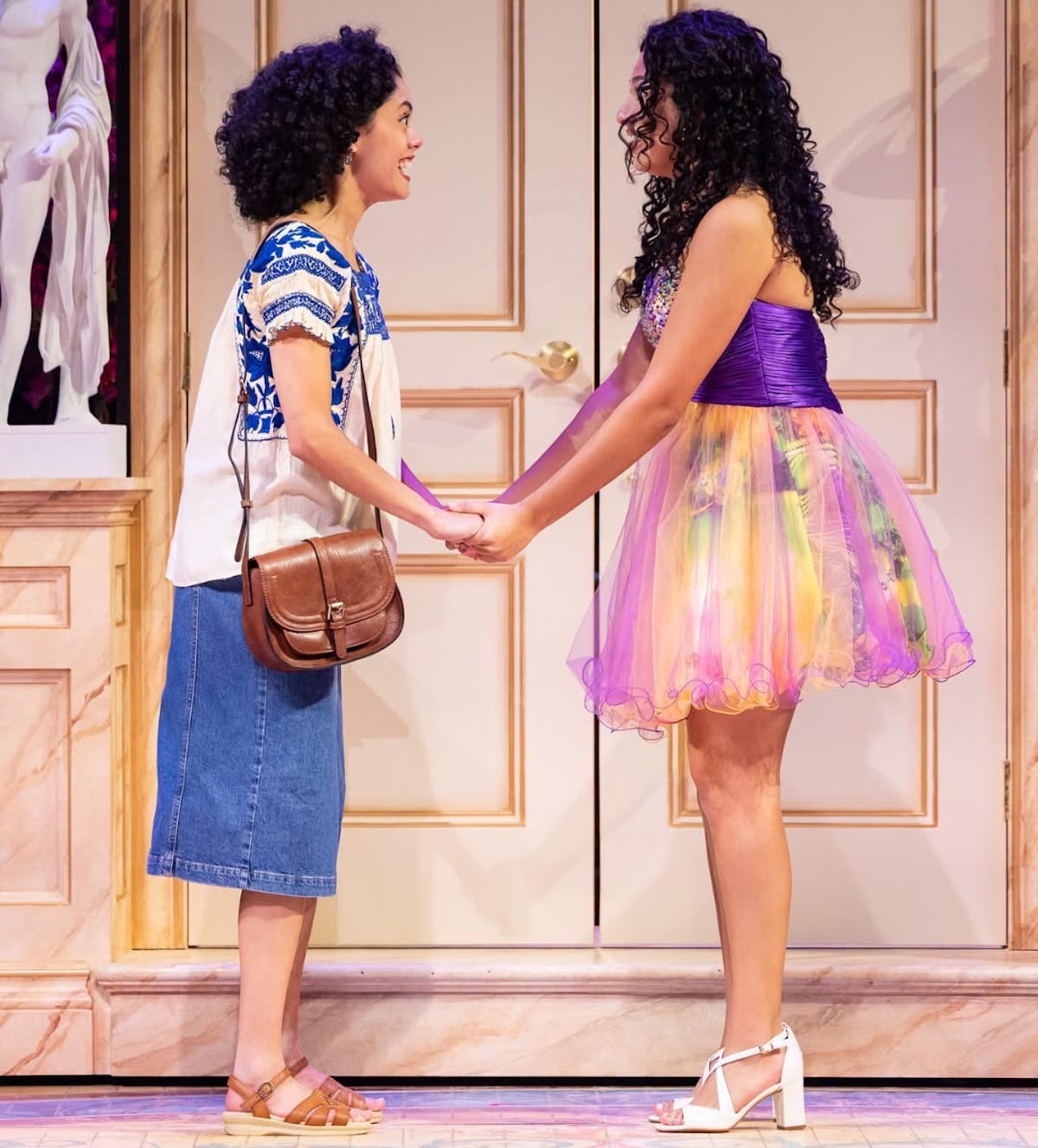
Vitoria Gómez and Jessica Lopez in Destiny of Desire: A Telenovela Play with Music. | Photo: Jamie Kraus Photography
Lorca’s smartest directorial move is recognizing that a stage cannot imitate television, so she makes theatricality the production’s special effect. A desert storm is conjured from fabric. Scene titles arrive on placards, revelations get piano chords and actors openly assemble the world around one another. Lorca turns every limitation of live theatre into another opportunity for melodrama, giving the production the velocity of a telenovela without pretending there is a camera anywhere in the room.
Nobody enters like Fabiola
Marroquín takes full advantage of the playground Lorca has built for her. Her Fabiola treats every entrance as an event and every conversation as a chance to assert her power. In one of the production’s best sight gags, a doorway rotates toward the audience to reveal her already posed inside it, leg raised, as though the architecture itself exists for her benefit.
Raquel Barreto’s costumes and Kata’s scenery operate on the same wavelength. Golden doors and marble statuary define the Castillo mansion, while scenery slides through the playing space fast enough to keep pace with the plot.

Bianca Marroquín and Adam Enrique Hollick in Destiny of Desire: A Telenovela Play with Music. | Photo: Jamie Kraus Photography
The music is the production’s one notable indulgence. “El Destino del Deseo” earns its place by collapsing nearly two decades into a few minutes, but several later songs feel more like elaborate transitions than moments the story truly requires. At roughly two and a half hours, this telenovela could survive with slightly less “with music.”
What it should not lose is the humanity underneath the machinery.
At one point, Hortensia demands of Victoria, “Why do you defy me?”
“Because you are my mother!!” Victoria replies.
That exchange gets at what Zacarías does best: beneath all the improbable plotting are relationships that feel immediately recognizable.
Late in the evening, the production notes that more than 2 billion people — roughly one-third of humanity — watch telenovelas every night. By curtain call, Zacarías and Lorca have made the appeal easy to understand.

An award-winning Colorado arts and culture reporter originally from Mineola, Texas. Tresca is the chief theatre critic for OnStage Colorado and managing editor of OnScreen Colorado. He’s the editor of Bucket List Community News, a contributor to Denver Westword and Estes Valley Voice, a resident storyteller for the Bonfils-Stanton Foundation and the co-host of the OnStage Colorado Podcast.

Leave A Comment