
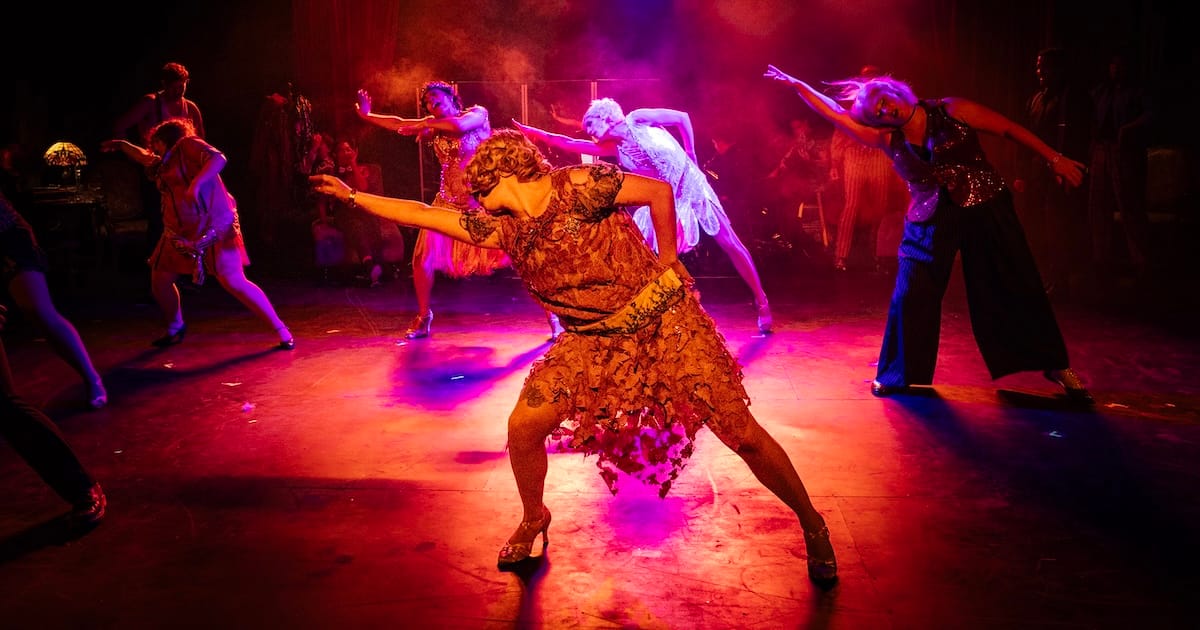
The Wild Party is a seductively staged musical that puts you in the middle of the action.
Sit close enough to the stage in The Wild Party at The Storyteller Theater in Aurora, and you just might get kicked in the face. During the title number, performer Brandon Guzman sent one leg flying so close to the front row that leaning forward another few inches would have resulted in a painful collision.
That is not a complaint. It’s exactly what director Lexie Lazear gets right in this co-production from Bright Heart Stages and Shifted Lens Theatre Company: There is basically no separation between the audience and the debauchery.
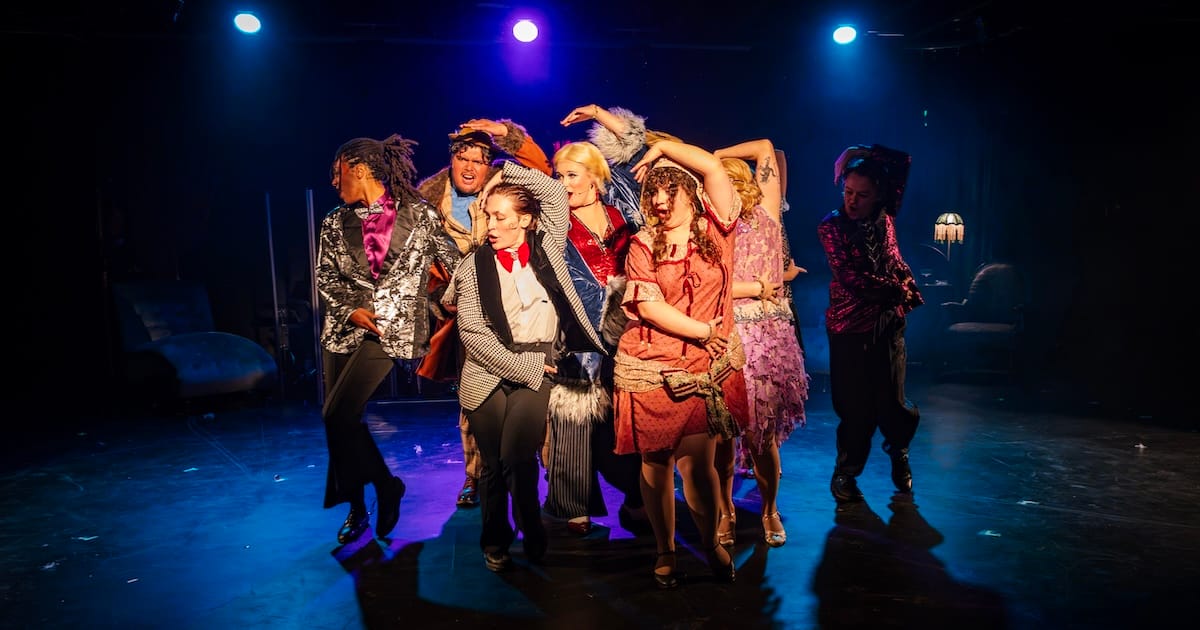
Bright Heart Stages and Shifted Lens Theatre Company’s production of The Wild Party. | Photo: Cohagen Wilkinson
The boundary starts disappearing before the story does. A trumpet player opens “Queenie Was a Blonde” from behind the audience, then slowly creeps forward and settles into the band pit as the smoky room comes alive around him. By the time the party begins, the line between spectators and performers has blurred.
That proximity makes this dark Jazz Age musical exhilarating when everything clicks. It also leaves its weaker performances nowhere to hide.
No corner left unused
Andrew Lippa’s musical, adapted from Joseph Moncure March’s narrative poem, follows faded vaudevillian Queenie (Mo Bailey) and her volatile lover, clown Burrs (Alexander Watson), as their poisonous relationship erupts during an apartment party. Queenie hopes the night might give her a way out, but the arrival of mysterious newcomer Black (Lloyd Harvey) sends everyone toward catastrophe.
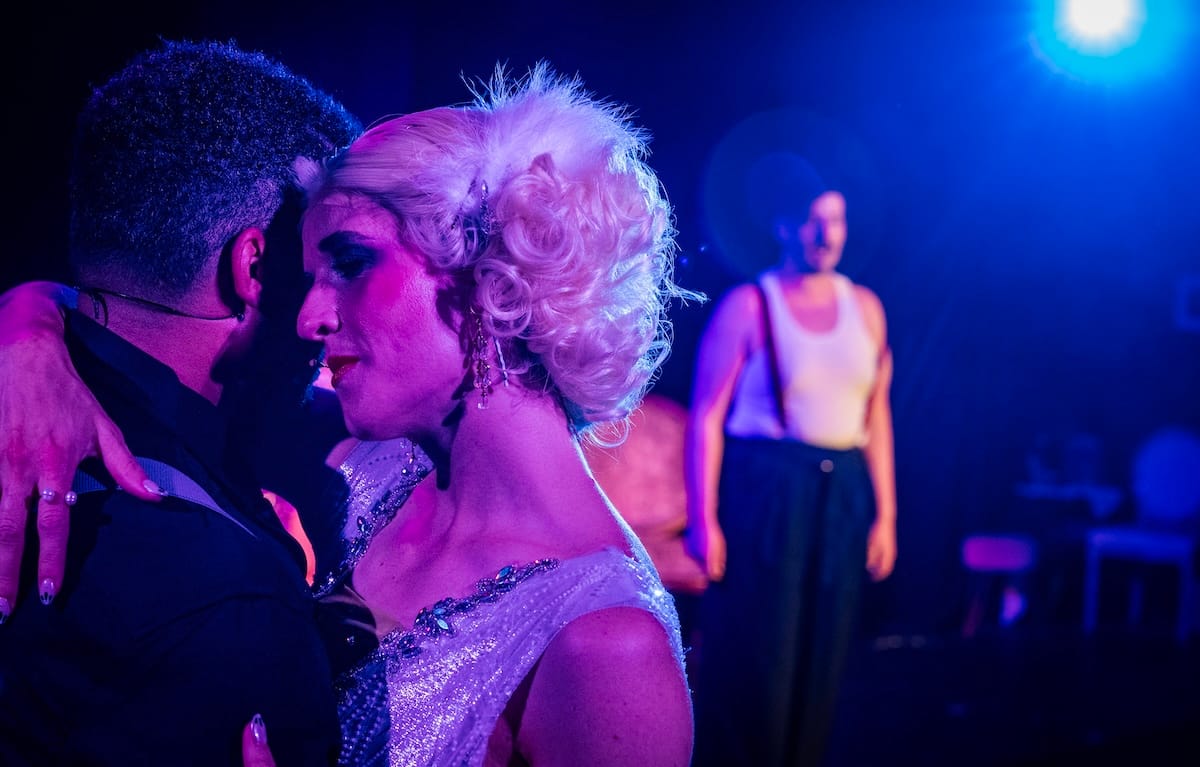
Mr. Black holds Queenie as Burrs looks on in The Storyteller Theater’s production of The Wild Party. | Photo: Cohagen Wilkinson
Lazear treats The Storyteller’s black box as one large apartment rather than a conventional stage. Performers slip behind spectators, play scenes near the venue’s entrance and occupy corners that could easily have remained dead space.
Danielle Morris’ choreography follows suit, filling the room with sharp, swinging movement that makes numbers such as “Raise the Roof” feel combustible. During that sequence, the ensemble snaps through frenetic choreography as Queenie and Burrs circle one another, maintaining furious eye contact before crashing together in a partnered dance. It is spectacle that also clarifies their volatile relationship.
Andrew Russell’s lighting deepens the seediness, carving bodies out of the persistent haze with side light, backlight and textured gobos that throw long shadows across the room.
The live band, led by music director Paul Falk, is another major asset. Reeds and trumpet give Lippa’s jazz-inflected score bite, while Matt Rogers’ sound design keeps the musicians from overwhelming singers even at close range.
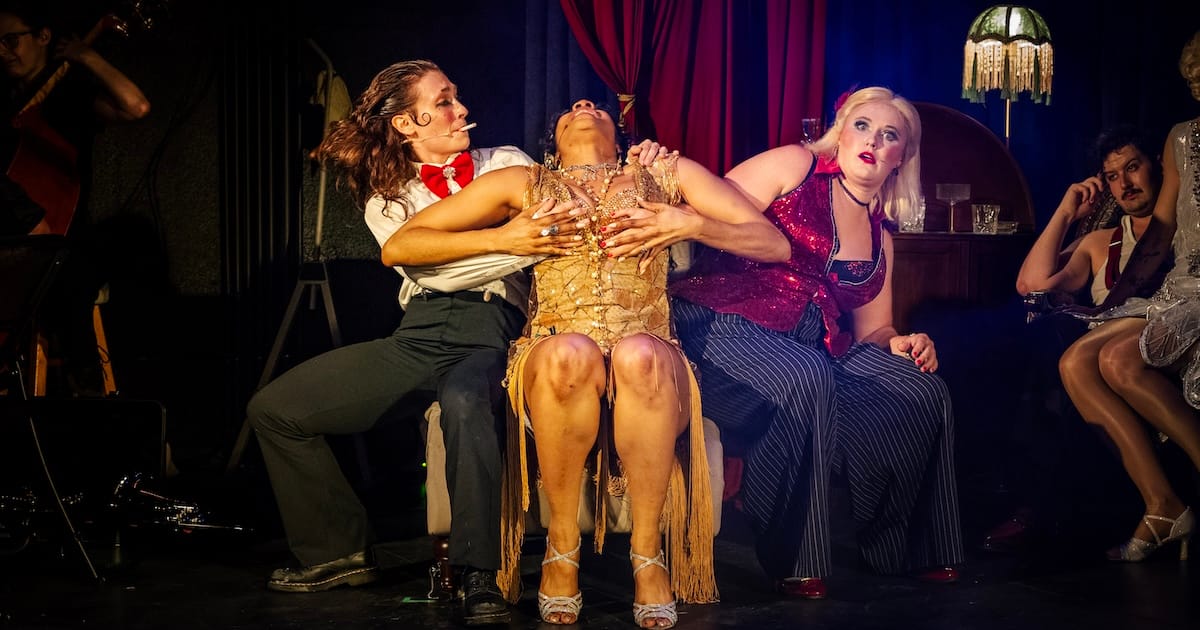
ThurZday as Kate throws herself between Max Lubeck as Jackie and Brekken Baker as Madeline in The Wild Party. | Photo: Cohagen Wilkinson
Where the party really pops
Several supporting performances flourish under that scrutiny. Brekken Baker nearly steals the show as Madeline, a lesbian partygoer perpetually on the prowl. During “An Old-Fashioned Love Story,” Baker sings, “Send the men off to hell,” while hilariously singling out male audience members for particular scorn. Her shameless flirtation with seemingly every woman at the party becomes a hysterical running gag.
Guzman and Quinnie Wolfe are equally delightful as boxer Eddie and Mae. Their “Two of a Kind” has the easy chemistry of a practiced vaudeville act, which makes Guzman’s ability to turn Eddie’s temper on a dime more startling.
ThurZday is magnetic as Kate, whose body rarely seems capable of standing still. “Life of the Party” becomes a miniature acting showcase as Kate’s chemically fueled energy visibly drains, only to snap back after another line of cocaine. Yet Kate’s bravado cracks whenever she throws herself at Burrs and receives little in return, revealing how painful his lack of reciprocation is for her.
Watson, meanwhile, finds the danger beneath Burrs’ clowning. He remains watchful and tightly coiled, constantly measuring who has Queenie’s attention and how much control he is losing. That tension comes to a head in the Act 1 finale, “What Is It About Her?” in which Watson begins with remarkable restraint before letting Burrs’ desperation explode. He goes deeper in Act 2’s “Let Me Drown,” stripping away the swagger to expose the fear underneath Burrs’ possessiveness.
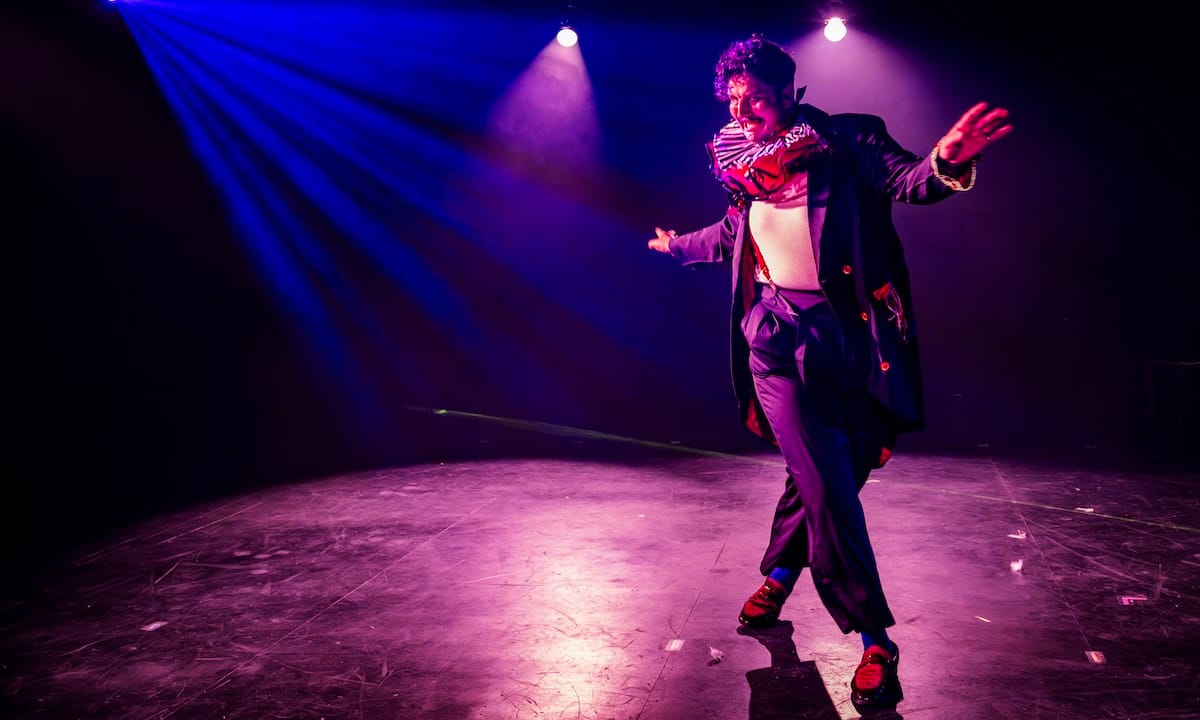
Alexander Watson as Burrs in The Wild Party at The Storyteller Theater in Aurora, Colo. | Photo: Cohagen Wilkinson
The central relationships are less persuasive. Bailey and Watson generate little chemistry as Queenie and Burrs, though that can partly be understood as the point: Their attraction has curdled into resentment. More troublesome is that Queenie has even less spark with Harvey’s Black, whose arrival is supposed to offer the possibility of escape. Harvey gives Black an appealing confidence and romantic earnestness, but their whirlwind attraction never catches fire.
Bailey conveys Queenie’s dissatisfaction, yet the character remains fixed in much the same wide-eyed uncertainty as the party forces her toward a choice. Her character’s trajectory consequently feels more plotted than felt. Both Bailey and Harvey also have vocal passages that sound effortful rather than lived-in, creating another small layer of separation between the characters and the emotions they are meant to be experiencing.
Lazear has spent the evening training the audience to notice everything: the sidelong glances, wandering hands, jealous stares and bodies passing inches from their knees. Most of the time, that scrutiny makes The Wild Party a seductive, dangerous good time. Occasionally, though, you can also see (rather than feel) the acting.

An award-winning Colorado arts and culture reporter originally from Mineola, Texas. Tresca is the chief theatre critic for OnStage Colorado and managing editor of OnScreen Colorado. He’s the editor of Bucket List Community News, a contributor to Denver Westword and Estes Valley Voice, a resident storyteller for the Bonfils-Stanton Foundation and the co-host of the OnStage Colorado Podcast.

Leave A Comment