
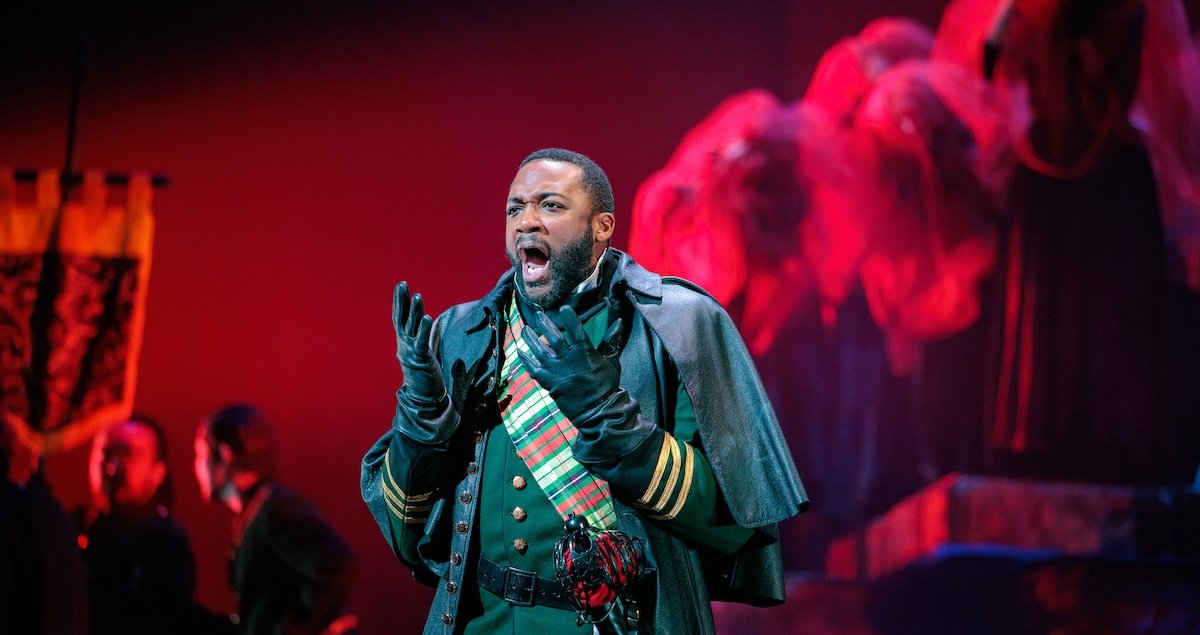
A standout Lady Macbeth and a fine chorus can’t overcome static staging in Verdi’s blood-soaked tragedy.
It’s not hard to understand why the great Italian composer Giuseppe Verdi created an opera of the Macbeth story. Shakespeare’s play is itself of operatic proportions. Set in a gloomy medieval Scotland, the play delivers murders and then more murders — of kings, their family members, their vassals and their vassals’ families. There is a scheming wife who pushes her conflicted (at least initially) husband to horrendous violence, a loyal friend who is betrayed and sacrificed to a king’s lust for power and a son who determines to avenge his father’s unjust killing. There is even a supernatural force at work to foresee the bloody future.
In other words, there is more than enough drama and tragedy to merit a full-blown theatrical production of singing, acting and thundering music, which Verdi and his librettist Francesco Maria Piave readily deliver. Almost everyone in an audience for Macbeth likely knows the plot reasonably well, so it is up to its creators and perhaps even more its cast and director to captivate spectators for almost three hours.
Over the years, and most recently at the Metropolitan Opera, there have been towering productions of Macbeth headed by superstars of their eras. I saw La Scala’s version in the 1970s, and it dazzled me from the minute the curtain rose. Although Opera Colorado has offered many first-rate productions, this Macbeth is not one of them. Despite a standout performance by Marcy Stonikas as Lady Macbeth, it lacks the energy and dramatic power this opera and the singers deserve.
This is largely due to Dan Wallace Miller’s static direction. Miller relies heavily on what is called “park and bark” staging. Rather than have the soloists move believably around the stage — as is the case in most contemporary operas — Miller keeps them largely motionless even during their most heart-rending moments. Both Macbeth (Norman Garrett) and Lady Macbeth (Stonikas) often sing their arias sitting in a lone chair at the center of the dark and spare stage. This reinforces the stasis of the staging and makes it more difficult for each of them to push their notes out than if they were standing.
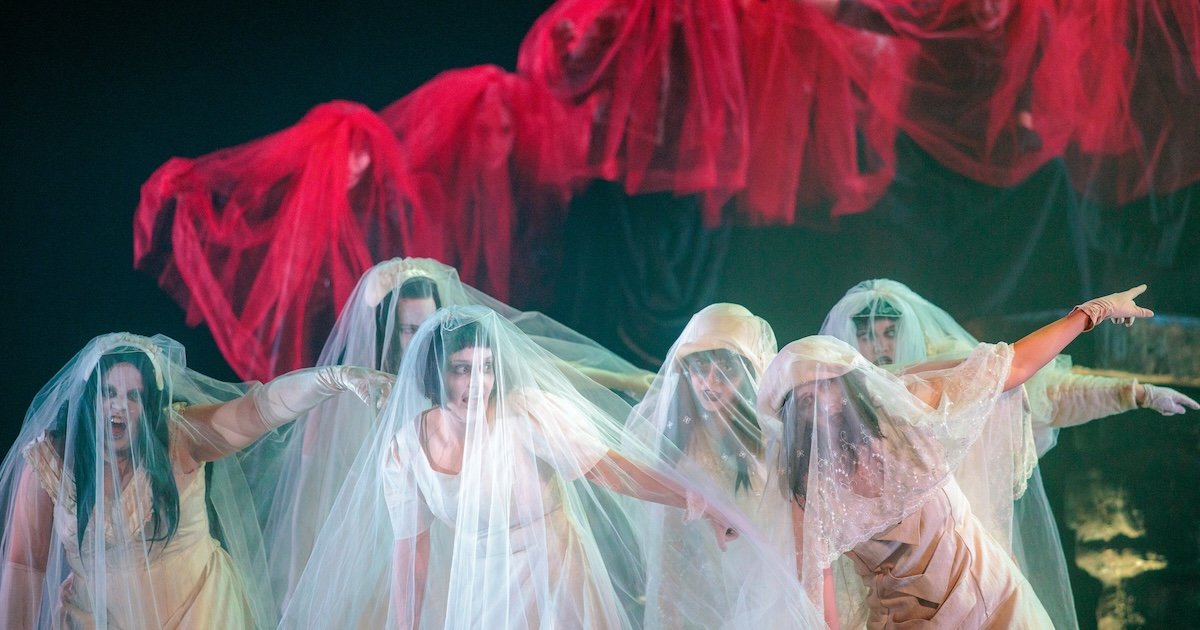
Photo courtesy Opera Colorado, Matthew Staver

As Lady Macbeth, Stonikas does a remarkable job of giving force to her character’s emotional ups and downs. Stonikas has a lovely, rich soprano and a physical dexterity that enables her to use subtle movements to convey her character’s inner turmoil. Her radiant voice hits all the high notes and her vocal control is impressive.
Garrett has a harder time, partly because his baritone voice isn’t commanding and his stage acting is reserved. But both are to be applauded for being able to communicate at all through the vast Ellie Caulkins Opera House under the physical constraints that Miller gives them.
Tenor Edward Graves as Macduff and bass Kenneth Kellogg as Banquo contribute significant moments to their roles, both in singing and acting. Graves is especially moving when the murder of Macduff’s wife and children by Macbeth’s henchmen is revealed; even crouching on the floor, he conveys his horror and grief.
The Opera Colorado chorus has a yeoman’s task in appearing in a number of diverse roles as Macbeth’s subjects, soldiers, townspeople and the witches (here presented as a group of 18 individuals). As usual, their voices blend beautifully and add real heft to the musical score.
But their glorious singing and the generally excellent performances of the entire cast can’t prevent this Macbeth from being a lackluster production. Although Verdi’s score is iconic, it marks his move away from the bel canto lyrical style of his earlier works. As Artistic Director Barbara Lynne Jamison writes in her program notes, this music is “dark, claustrophobic and rugged.” While some may laud Verdi for having moved to a different style, I missed the melodic notes of La Traviata, Aida, Rigoletto and his other popular operas.
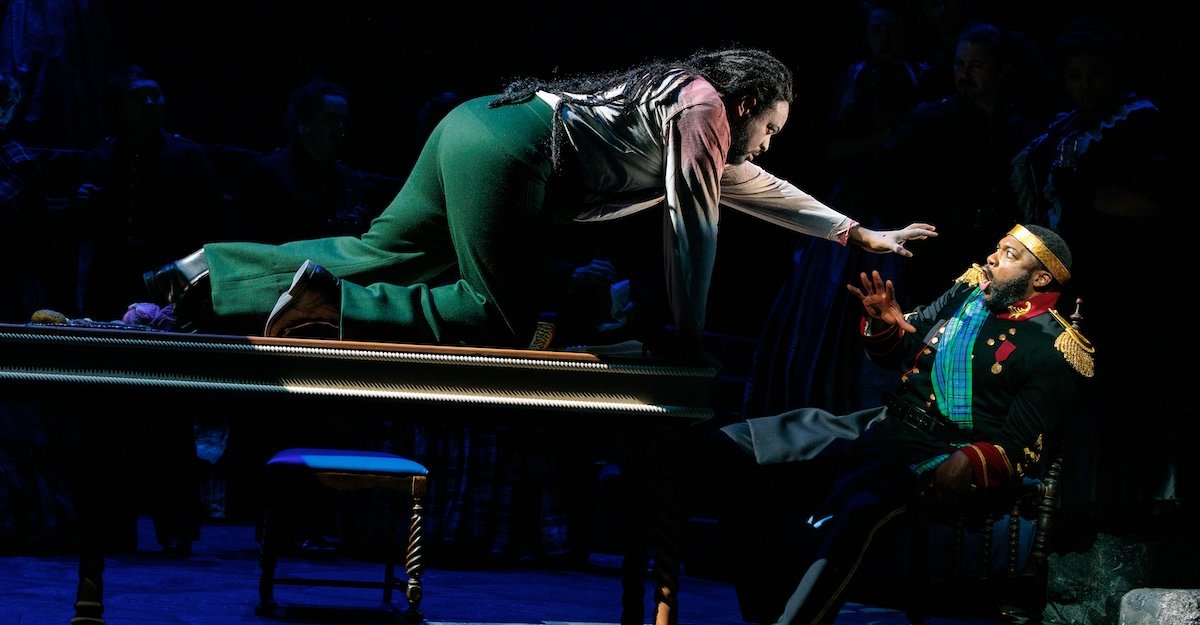
Photo courtesy Opera Colorado, Matthew Staver
The “dark” music is reflected in the sets and costumes Opera Colorado has rented from other companies. This is common in the opera world given the huge expense of supporting a design studio, costume shop and scene shop. But the stark, gray-black slanted platform from the New Orleans Opera Association that serves as the focal point for all the action, and the muted-color costumes from Seattle Opera, create a gloomy environment that drains vibrancy from the visuals.
A further problem is the veil of theatrical smoke that envelops the stage (and wafts out into the opera house). This is no doubt intentional to convey the Scottish setting and reinforce the gruesome events being depicted, but it often makes it difficult to see the singers. Thankfully, we can hear them through the fog. Stonikas, in particular, cuts straight through it — and makes you wish the whole production had followed her lead.

Alice Kaderlan is a long-time dance and theatre critic and general arts writer. She has written for newspapers and online news sites in Seattle, Washington D.C., Pittsburgh and other cities for more than 40 years. She has also appeared on various public radio stations including WAMU-FM in D.C. and KUOW in Seattle and covered arts for NPR. She currently lives and writes in Denver.

Leave A Comment