

Springs Ensemble Theatre stages Will Arbery’s talky drama of faith and politics with one of its strongest casts in years.
With its first-rate production of Heroes of the Fourth Turning, Springs Ensemble Theatre (SET) continues to bring significant works by contemporary playwrights to the local stage. Will Arbery’s 2019 play made a splash as a Pulitzer Prize finalist and winner of Obie and New York Drama Critics’ Circle awards.
It’s 2017, a few days before the total solar eclipse crosses North America. A conservative Catholic liberal arts college in Wyoming has chosen a new president. Four alumni return for the occasion to discuss their post-college lives, politics and religion.
They are Teresa (Maia Rychlik), an ambitious ideologue; Kevin (Justin Rubenstein), an alcoholic who either wants a girlfriend or wants to be a priest; Emily (Rose Mitchell), the incoming president’s empathetic daughter, who lives with chronic pain; and Justin (Jeremiah Walter), an older Marine veteran with a bunker mentality.
It’s an evening full of conflict, misunderstanding, regret and drunkenness. So, your typical college reunion? Not quite.
The play opens with brief, silent scenes in which Justin shoots a deer (offstage) and skins the carcass on the porch. Bloodstains remain. In the first scene with dialogue, Kevin confesses to Teresa his inability to feel love for the Virgin Mary. It’s framed as emotional alienation, not a theological objection. Teresa diagnoses him with “the scandal of particularity,” a difficulty accepting that an infinite, universal God reveals himself through a specific person, such as Jesus of Nazareth, or a particular people, such as the Israelites.

Teresa’s abstract argument doesn’t touch Kevin’s experience. That gap between ideology and experience, and how it warps both ideas and lives, is one of the play’s main themes. The characters ricochet off one another, ignoring, criticizing or taking offense at each other but rarely seeing each other as potential sites of distinctive revelation.
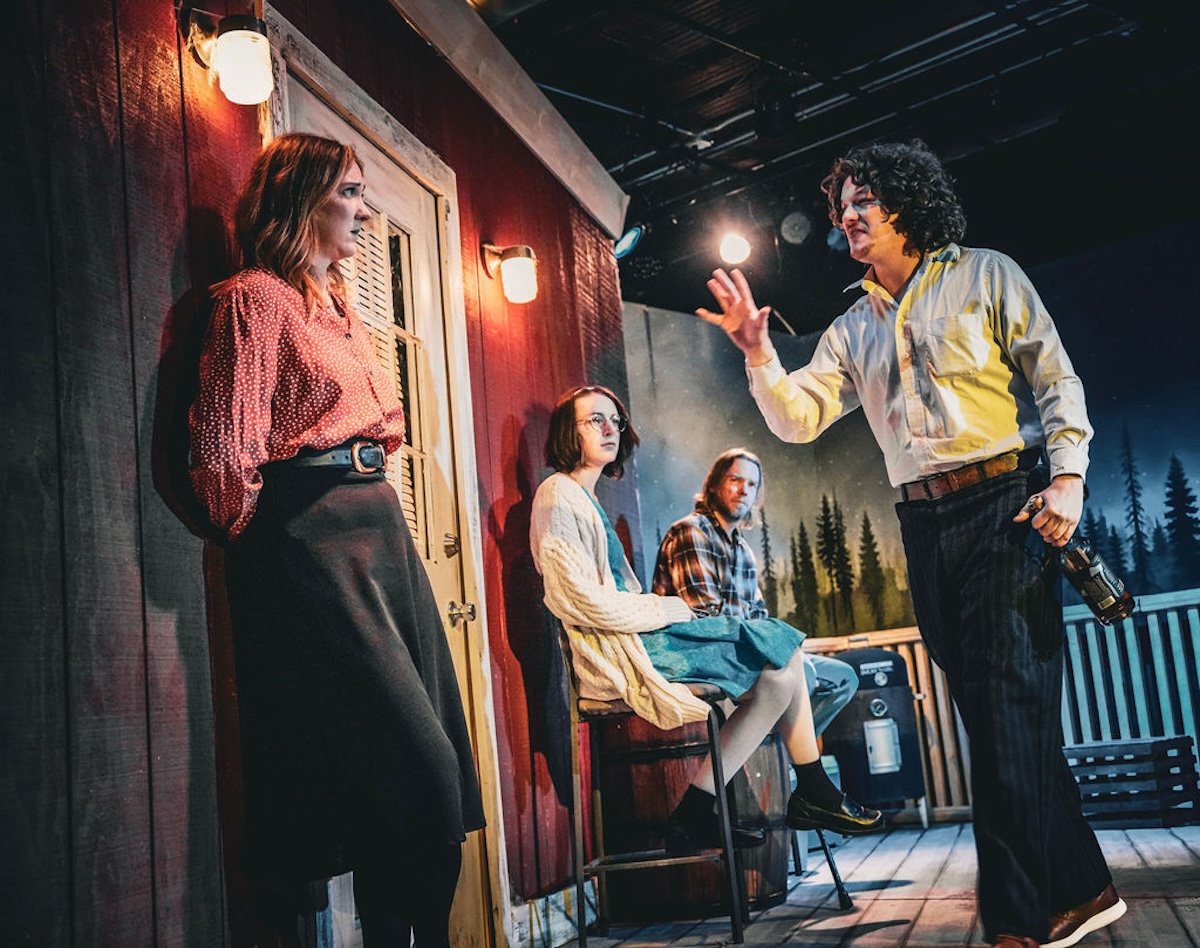
A scene from ‘Heroes of the Fourth Turning’ at SET. | Photo: SET
A formidable ensemble
Director Matt Radcliffe sets a brisk pace for a long and talky evening. He has assembled one of SET’s strongest casts in recent years. As Teresa, probably the least likable of the characters, Rychlik commits wholeheartedly to the character’s crusading bent. Mitchell is equally convincing showing Emily’s pain and delivering a brilliant rant that relives the experience of a pregnant, inner-city Black woman.
The two young women make a great contrast. Rychlik delivers in a high-pitched voice with a rather frenetic energy, while Mitchell maintains a lower pitch and a deliberate pace.
Rubenstein lives rather than acts Kevin’s inability to believe, behave or walk away. His candid confessions of confusion and failure make him very sympathetic. Walter (also handling sound design) contributes a portrait of a stoic, rural man and some beautiful but lamentably brief guitar strumming.
The incoming president, Gina, enters in Act II ostensibly to offer some clarity and resolution. As Gina, Julie Williamson exudes dignity and authority. It’s an effective characterization; however, Williamson’s voice is rather soft and occasionally fails to project, even in the tight confines of the Fifty-Niner Speakeasy.
Setting the stage
In an otherwise smooth production, a hiccup or two in the lighting can be chalked up to opening-weekend glitches. Elspeth Stitcher’s contemporary costumes don’t call attention to themselves, but they do reflect and contribute to characterization.
David Cook’s set effectively establishes the backyard locale. Perhaps more could be done with the fire pit or a starry sky. The action takes place late at night, but the set doesn’t evoke that atmosphere.
Dueling monologues
Curiously, for a play concerned with experience over ideology, most of the drama is argumentation about … argumentation. The interpersonal conflicts play out in an ideological frame via dueling monologues. Character isn’t revealed so much as announced with bullhorns.
Despite those shortcomings, SET offers an accomplished evening of theatre. The play would profit from more mysterious cleaning up of bloodstains. Also, more guitar! Those moments live in the memory when the noise has died down.


Judith Sears has had a 25-year career in marketing and corporate communications. Over the last several years, she has pursued playwriting, and several of her short plays have received staged readings at Colorado theatres.

Leave A Comment