
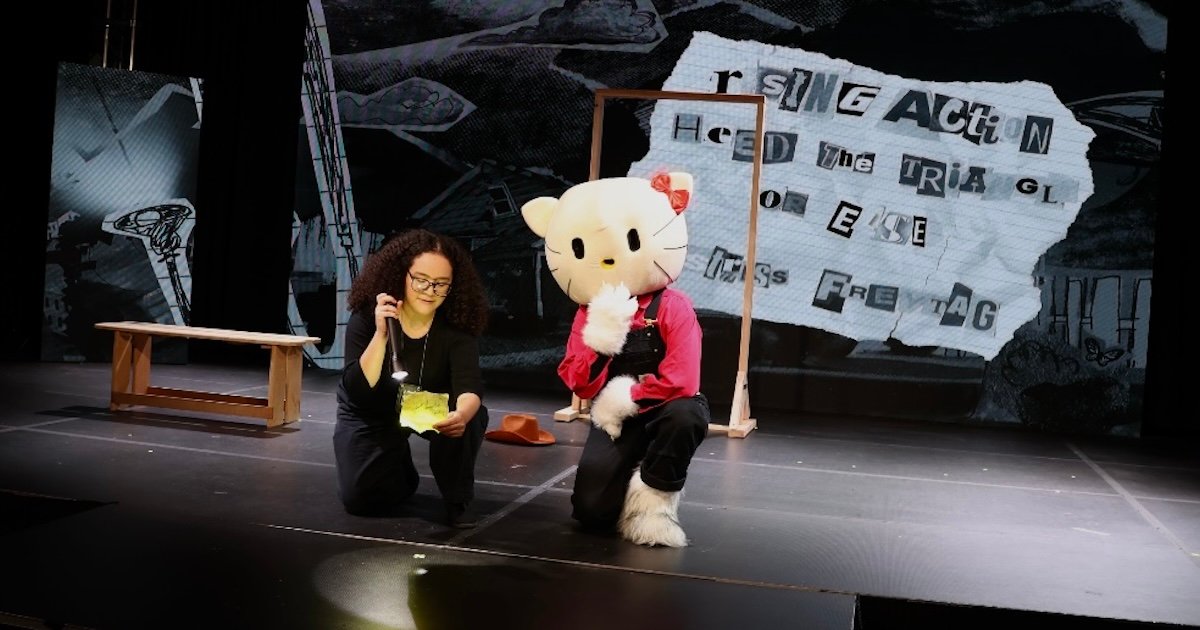
The Moot Point Project’s latest experiment turns a familiar cartoon mascot into an unsettling examination of identity and catharsis.
Sixty-two percent of the audience at Sunday’s matinee voted to see what was beneath hk’s oversized, off-brand Hello Kitty head. We got what we asked for. Watching hk (Meg Burless) strip off nearly every other piece of clothing before finally removing the mascot head and looking visibly shaken made our curiosity feel suddenly cruel.
That vote was the climax of h*llo k*tty syndrome, a funny, vexing mindfuck about identity, performance and theatre’s insistence on catharsis. The Moot Point Project staged Brian Dang’s play, with devising by the ensemble, for just three performances Nov. 21-22 at The Warehaus Space in Sheridan.
Before the show, hk wanders among the audience asking for help inflating balloons. Behind them, three LED screens display a tactile-looking collage featuring the show’s title and cartoony world created by projection designer Megan Dille. Originally assembled by hand and then scanned, the artwork makes digital scenery look physical, introducing the play’s suspicion that appearances tell us less than we think.
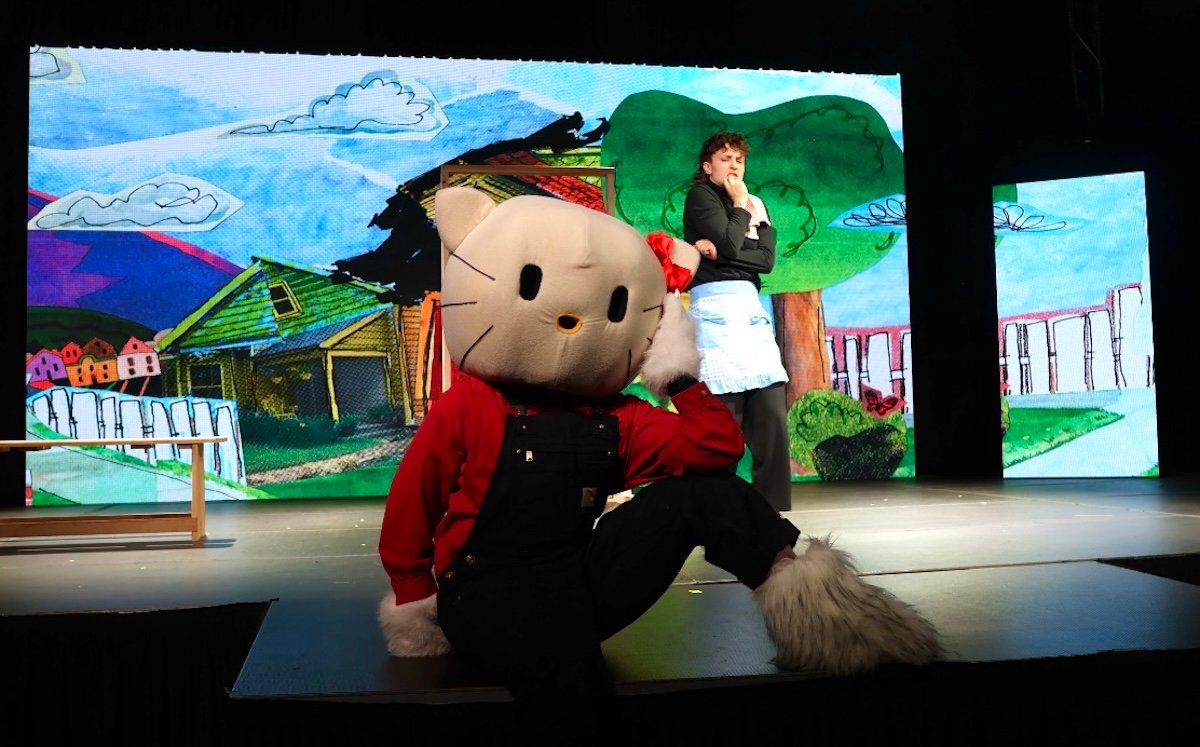
Meg Burless and Syd Grossman in h*llo k*tty syndrome. | Photo: The Moot Point Project
To start the performance, stagehand Taylor Mock stiffly reads a welcome speech, in part, explaining that this is a comedy and encouraging us to laugh. From there, we fly into the play’s action, which features scenes labeled with signs as “Exposition” and “Rising Action” while hk navigates a family drama, murder investigation and cowboy romance.

Under True Smith’s whirlwind direction, a few chairs, a wonderfully silly fake cow and Dille’s shifting projections transform the room with remarkable economy. Zoë Barkurst, Izzy Enriquez and Syd Grossman rotate through supporting roles, repeatedly changing who these people are to hk. Every switch exposes how readily an audience accepts an identity simply because theatre tells us to.
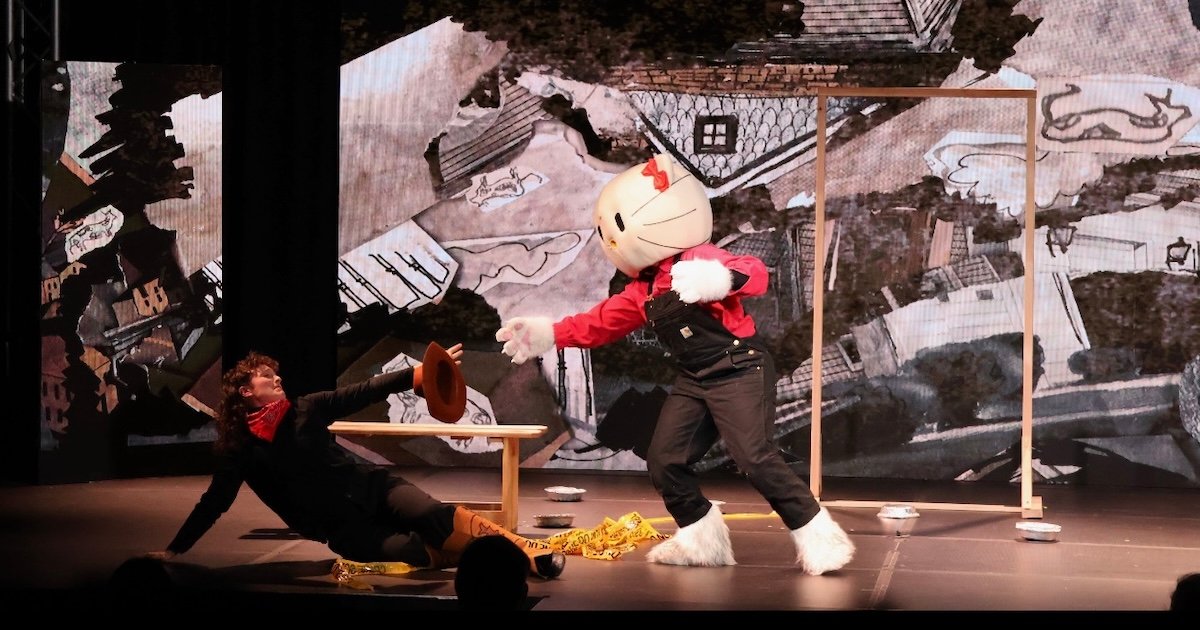
A scene from “h*llo k*tty syndrome”. | Photo: The Moot Point Project
The cost of catharsis
The jokes darken as the play demands a resolution. Other characters press hk to remove their mask, learn a lesson and deliver the emotional payoff supposedly required to end a story.
hk refuses. They like the costume. Why should anyone else decide what their authentic self must look like?
Dang keeps inventing new ways to force an answer. Mock becomes a stand-in for the playwright, who can barely explain why he created hk in the first place. Then the actors appear to abandon their fictional roles and offer fragments of themselves, each asking hk, “Who are you?”
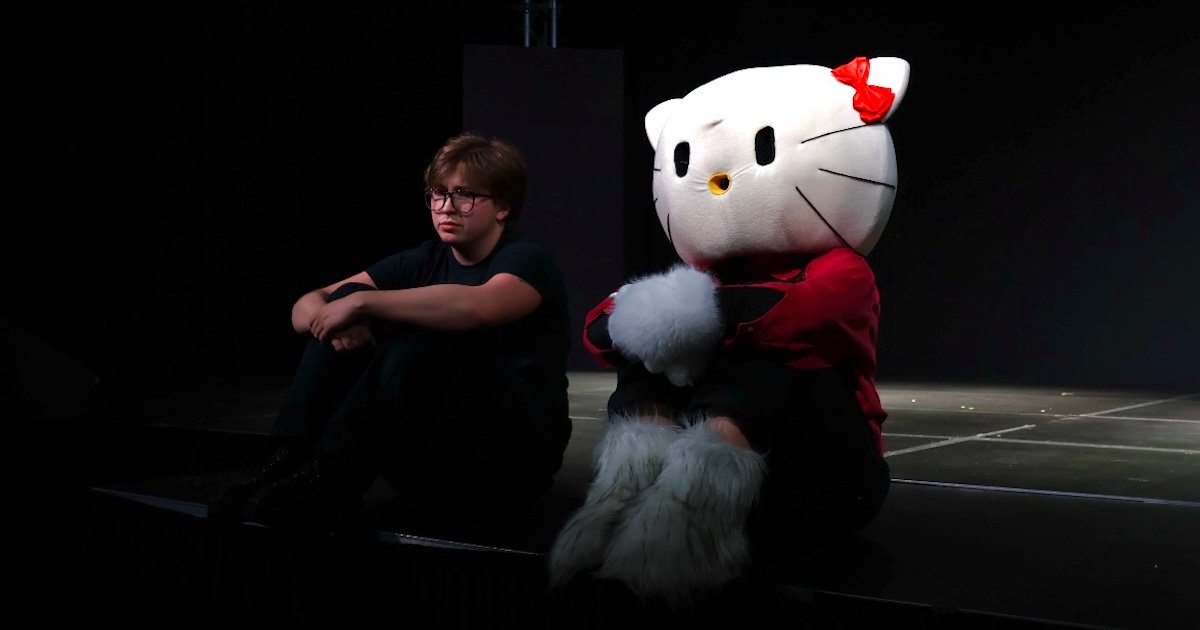
Taylor Mock and Meg Burless in h*llo k*tty syndrome. | Photo: The Moot Point Project
Burless makes the transition from absurd comedy to vulnerability riveting. Their big monologue near the conclusion challenges the audience’s eagerness to decode the person under the costume: Would learning their race or gender suddenly make the play about that identity? And why is hk’s stated comfort with the mask insufficient? The desire for a tidy interpretation begins to look suspiciously like a demand for exposure.
Then comes the vote. hk complies, shedding clothes down to their underwear before removing the head and fleeing in distress. The screens ask, “Are you happy? I hope you’re happy.” No curtain call follows.
The company told me afterward that the other two audiences had voted to leave the head on; those performances ended with a dance party and bows. Ours makes spectators into the force the play has spent its runtime resisting. We want a show, goddammit, and we get one. Whether we have any right to demand it is another matter.
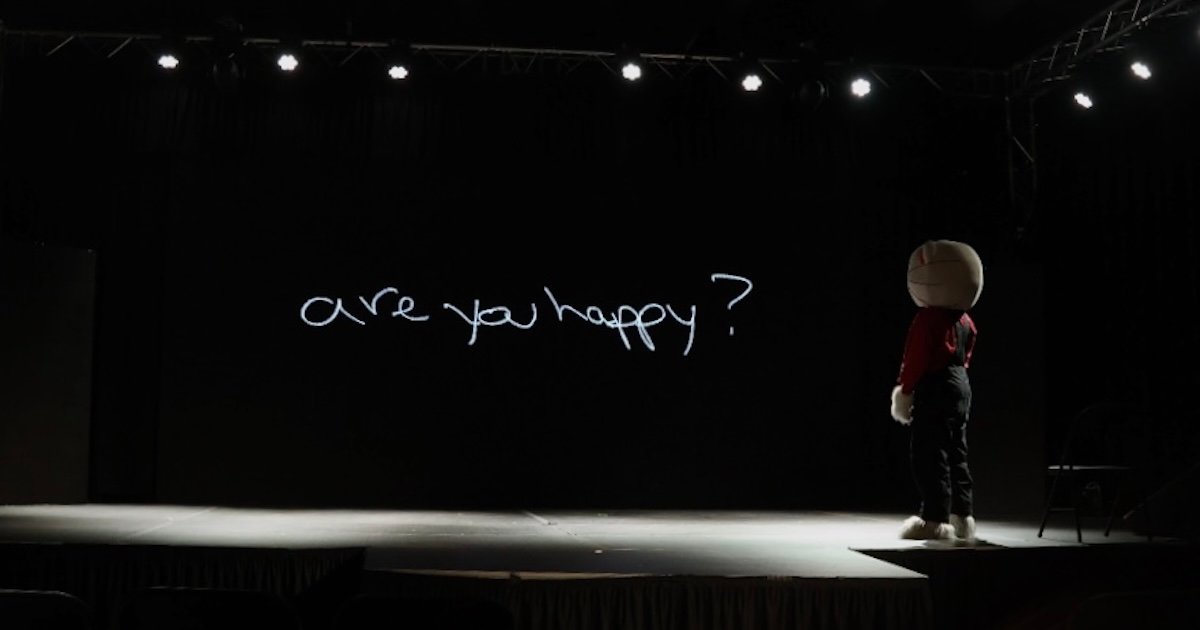
Meg Burless as hk in h*llo k*tty syndrome. | Photo: The Moot Point Project
The Warehaus, typically used for photography and recording, proves an unexpectedly versatile home for the intimate, technically ambitious production. Following Revolt. She Said. Revolt Again. and Do You Feel Anger?, The Moot Point Project is establishing itself as one of the Denver area’s more adventurous experimental theatre companies.
Financial constraints limited this production to three performances. There’s no encore to recommend, but there is a company worth following. Its next experiment may look nothing like this one, which is precisely why I’m interested.

An award-winning Colorado arts and culture reporter originally from Mineola, Texas. Tresca is the chief theatre critic for OnStage Colorado and managing editor of OnScreen Colorado. He’s the editor of Bucket List Community News, a contributor to Denver Westword and Estes Valley Voice, a resident storyteller for the Bonfils-Stanton Foundation and the co-host of the OnStage Colorado Podcast.

Leave A Comment