
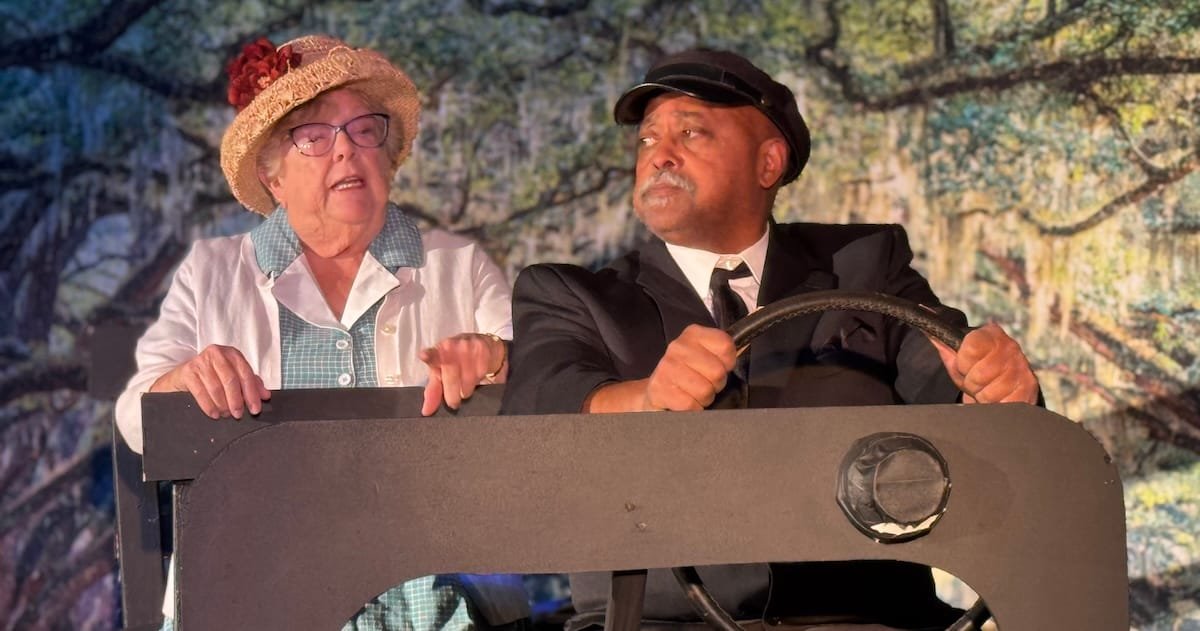
Two first-rate leads carry Alfred Uhry’s quiet, decades-spanning drama in Palmer Lake.
With Driving Miss Daisy, Funky Little Theater embarks on a journey of understanding. The company brings a respectful sensitivity to a play that chronicles decades in an unexpected relationship.
The 1988 Pulitzer Prize-winning play by Alfred Uhry, more widely known in the Academy Award-winning movie version, follows the enforced acquaintance of a proud septuagenarian Southern Jewish woman, Daisy Werthan (Gayle Abe), and her Black chauffeur, Hoke Coleburn (Melvin Grier).
Daisy’s son, Boolie (Jude Bishop), has insisted on the arrangement after Daisy crashed her car. Over the years, Daisy and Hoke move from a virtual standoff to a warm friendship. The slowness is necessary given that Daisy’s communications consist mostly of complaint and accusation. Hoke occasionally pushes back but mainly refuses to take the bait.
This understated, character-driven drama earns its heartwarming, affirmative outlook with a clear-eyed view of human nature. It has several lighter moments, and it offers a home-brewed hope.
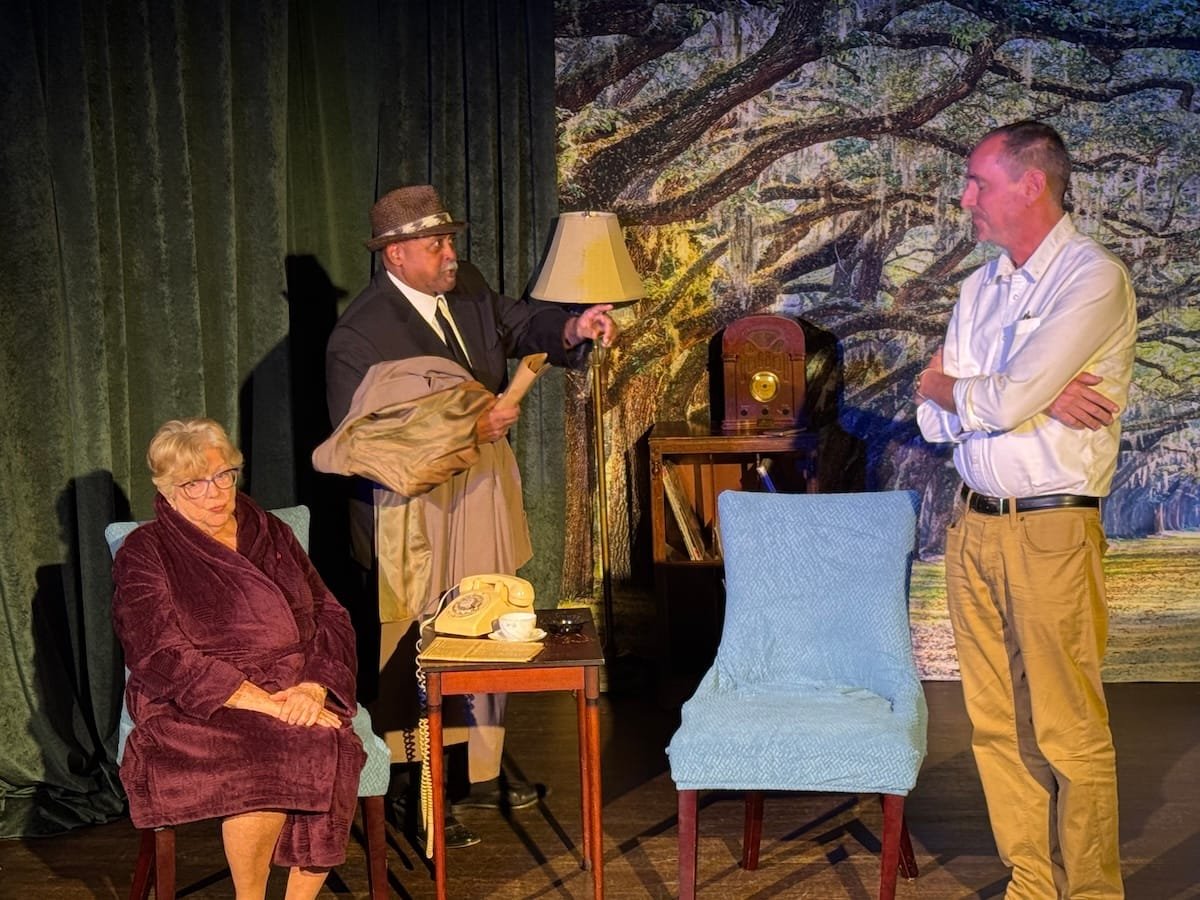
From left: Gayle Abe, Melvin Grier and Jude Bishop in ‘Driving Miss Daisy.’ | Photo: Funky Little Theatre Co.

Two first-rate leads
Funky’s production benefits from a first-rate Daisy and Hoke. The two characters are the play, and Abe and Grier make a potent pair as directed by Patrick Neill.
Abe is wonderfully expressive over a wide range of emotions. She manages to be high-handed, fretful, tearful, and affectionate, often within just a few lines. She also displays a lovely singing voice.
As Hoke, Grier convincingly portrays a chatty, confident man, who, in mid-20th-century Atlanta, often needs to keep his strength under wraps. Never servile, he cannily reads power relationships to navigate an unjustly restricted cultural landscape. Grier’s tone and mannerisms casually but firmly establish Hoke’s tenacious insistence on his dignity.
The show starts hesitantly. Like a car on a cold morning, it doesn’t quite turn over. Daisy and Boolie struggle to establish an easy conversational rhythm. Throughout the performance, there are times when lines are delivered well enough, but the tempo is uneven. Neill’s pacing settles in after the first scenes
The role of Boolie may be underwritten. Bishop does a fine job with Boolie’s moment in the spotlight, winning Atlanta’s Man of the Year award, but doesn’t quite have the edge of repressed anger that the son has toward his mother.
Lean design
The audience’s proximity to the stage at Palmer Lake increases our involvement in the relationships. The set design, by Nancy Hankin, is effectively lean. The car rightly takes center stage. Stage right and left, respectively, serve for Daisy’s living room and Boolie’s office.
Costume design by Kim Dobson and Chris Medina, Funky’s artistic director, is on target. Daisy receives an array of hats befitting her assumed gentility, as well as a particularly elegant, fringed shawl. Funky’s characteristic attention to detail is evident in the characters’ period wristwatches.
The play feels like looking at still shots in someone’s print photo album. The snapshots are revealing and often charming, but the momentum stalls from time to time. Once Daisy and Hoke are thrown together, there are no more big, dramatic decisions. They rub along, as in life. It gives an episodic, vignette-like experience.
In what has been written as a reflective look at two lives, Daisy and Hoke keep our interest and affection. Like Daisy’s horror of going over 19 mph in a 35-mph zone, the change in this play is slow. But it is real change and in a good direction. It’s worth the trip.

Judith Sears has had a 25-year career in marketing and corporate communications. Over the last several years, she has pursued playwriting, and several of her short plays have received staged readings at Colorado theatres.

Leave A Comment