
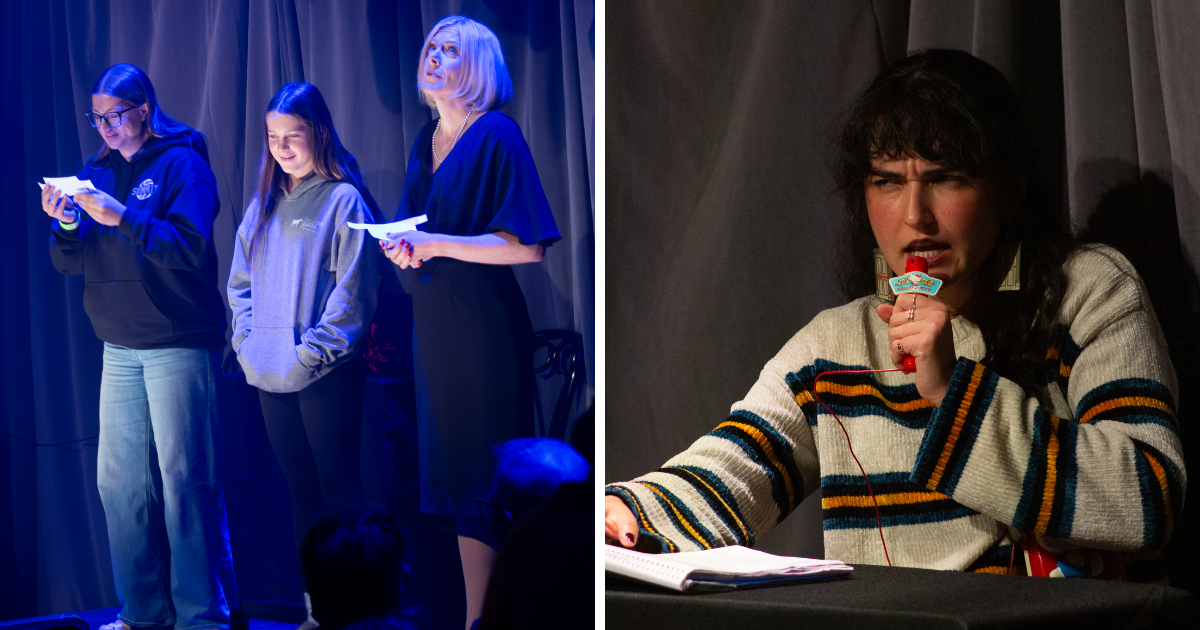
The Backstage Theatre becomes a hidden speakeasy where guests help crack the case.
The actual backstage of Breckenridge’s Backstage Theatre transforms into a speakeasy for Last Call: A Live Cocktail Murder Mystery.
After crafting flowers out of pipe cleaners and collectively solving three clues in the lobby, participants — and this is an interactive evening — file into the theatre’s backstage and stage area, which has been reconfigured to accommodate about a dozen round tables — high and low, for great sightlines wherever guests sit.
If you’ve been to the Backstage Theatre before, this new look is excitingly disorienting. A huge, thick, black curtain hides the theatre’s seating. Scenic and Lighting Designer Keith Parham brilliantly created a bar and lounge area solely within the theatre’s backstage and stage area, so it truly does feel like a hidden speakeasy.
Old-time locals — we’re talking the 1990s and earlier — will love seeing how the small bar in the Backstage Theatre stands on the same wall that a larger one did when the building hosted a fairly seedy bar, Shamus O’Toole’s, with fun, live bands. (The Town of Breckenridge purchased the building in 2001 and renovated it into the Breckenridge Theater — home to the Backstage.)
The interactive murder mystery starts as actors take the small stage, which sits opposite the small bar, to honor Helena, the owner of the speakeasy, during her wake. But things get a little spooky when all the lights flicker, as they state that she committed suicide. Then, suddenly, the covers they placed over three mirrors on the side wall disappear, replaced by clues from the ghost of Helena. The notes urge everyone to quickly figure out what really happened.
Note that the evening begins with general talk of suicide and also includes water-based haze, flashing lights, loud screams and a gunshot sound effect, so if you’re sensitive to any of these, be forewarned.
Other than that, it’s family-friendly, with the 4 p.m. show rated PG. I attended the 7 p.m. show and didn’t see or hear anything I wouldn’t take an older child to, save for what I just mentioned.
Music and cocktails
Within the speakeasy, the interactive night begins with paying tribute to Helena with a song and dance. Trevonne Coleman, who plays bar employee Jimmy Hall, does an excellent job not only teaching those who don’t know the lyrics to The Temptations’ “My Girl,” but also instructing everyone on the playful arm movements that go along with the words. His vocals soar, and his enthusiasm works to get the whole crowd on their feet, singing and dancing in unison — even before the cast serves the first official cocktail.
The ticket includes two cocktails, mocktails or children’s nonalcoholic drinks. The first cocktail is a gin and lavender mix, while the second is a sweeter bourbon mix. There’s also a choice of sparkling wine, sparkling apple cider or water when you first enter the lobby.
Though the program states that the 90-minute mystery includes an intermission, it’s not a traditional intermission, where everyone streams into the lobby; most people remain seated with their drinks, while those fortunate enough to win a VIP card through the luck of the draw are escorted into a small room outside the speakeasy to gather insider information before the rest of the audience discovers key elements of the story. But if you’re a VIP, you have only 30 seconds to examine the small room, which makes the sleuthing even more exciting.
With all the fast-paced action, the evening flies by.
Interactive
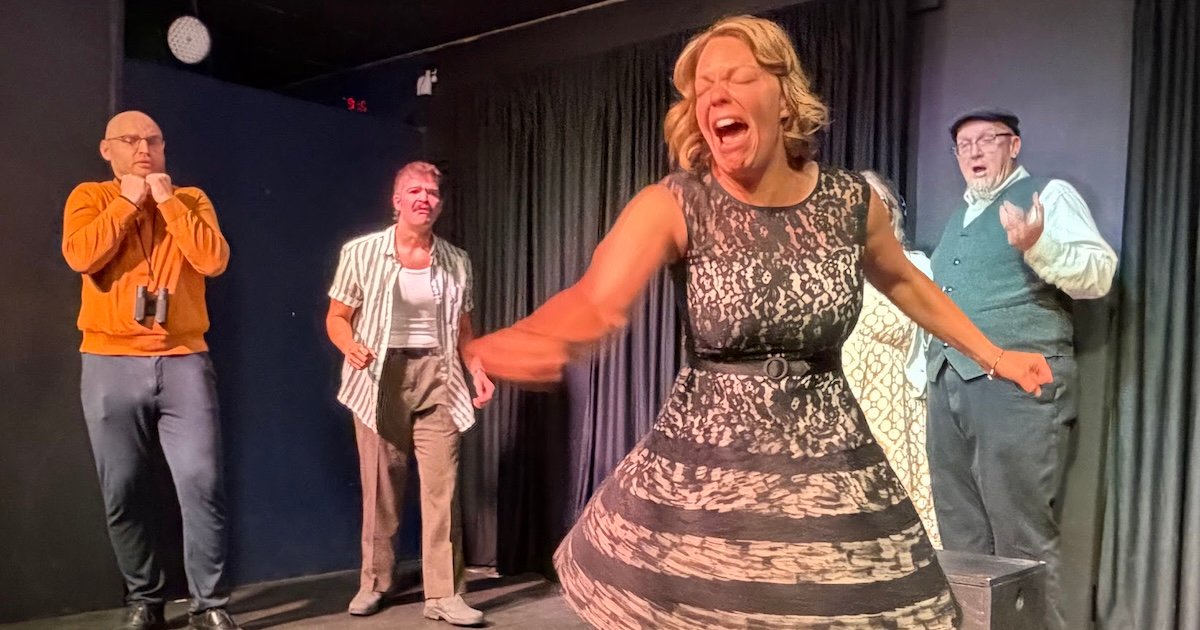
Molly Martinez-Collins, who plays an incredibly enthusiastic podcaster, Annie Osborne, captures the audience’s attention with her drive and verve in ensuring listeners remain up to date on the latest clues in what has now been established as a murder, rather than a suicide. She invites audience members up onto the intimate stage, adding an entertaining element to the night. And, of course, you can say no — Annie isn’t dissuaded; she just finds another willing participant who can answer simple questions, such as their first name and a few of the pertinent facts delivered thus far.
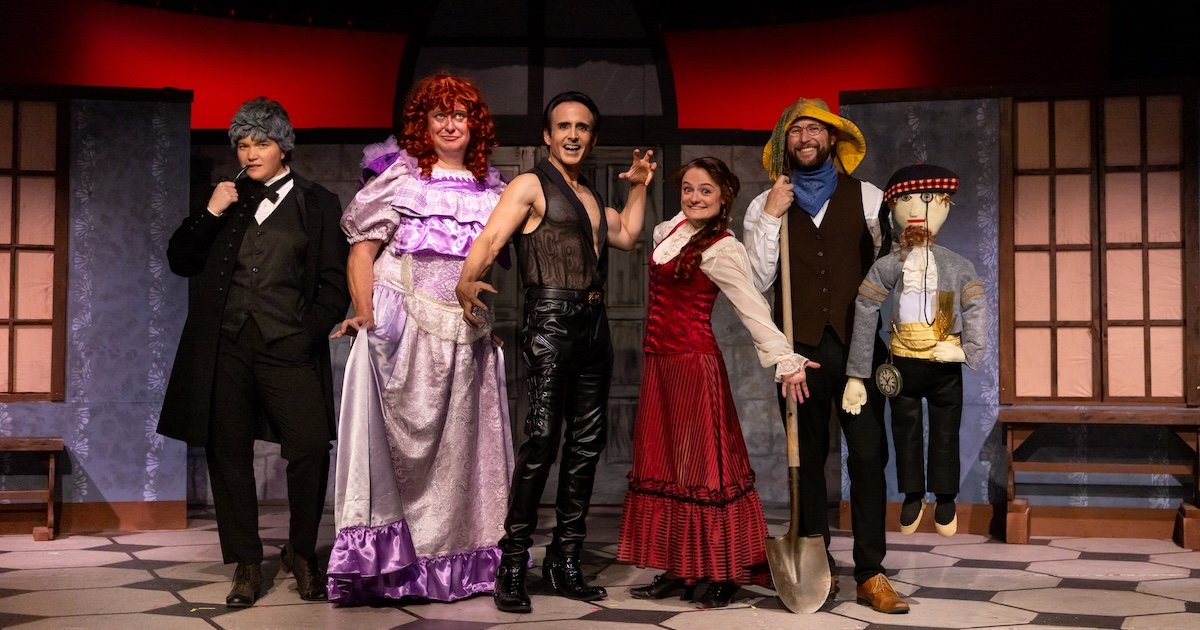
Jimmy Hall is a suspect, as is fellow bar employee Rebecca Williamson, played by Laurie Rambaud — both were upset when they heard Helena was going to lay them off. Helena’s sister, Charlotte, portrayed by Clair Sullivan, is the third suspect, and the fourth, Bella Wilson, played by Katie Cunningham, barges into the speakeasy unannounced and quickly disappears until key information draws her to the stage in the second act.
Martinez-Collins and Coleman give the strongest performances — and both have strong characters to embody, particularly Martinez-Collins. Cunningham beautifully depicts the doe-eyed, possibly innocent but definitely innocent-acting Bella. Sullivan is also convincing as Helena’s sister, though just a tad less so than others. Rambaud’s character felt a bit less authentic. It’s hard to tell whether the issue was the acting or how the character was written and directed. She had a slightly rough-edged, don’t-care attitude, which made it difficult to distinguish whether the disconnect I felt was due to weaker acting or a not fully developed character.
Either way, it didn’t ruin any part of the energetic evening, as the actors served drinks and held their own on the small stage dotted with a desk and two chairs for Annie’s podcast.
Intimate space
The space felt roomy enough to be comfortable, yet small enough to feel intimate with the actors as they walked to and from the stage and bar between round four-top tables covered in sophisticated black tablecloths. A long, rectangular table accommodated larger parties. We were a party of two and had a four-top table to ourselves.
Sound effects such as screams and a gunshot, as well as the laid-back Motown songs (Helena’s favorite) that ushered guests into the speakeasy, were loud enough for effect but not so loud as to make you jump out of your seat (though my friend did flinch a couple of times).
The lighting was simple and effective: White spotlights flooded suspects onstage during interrogation, intense flickers conveyed Helena’s message from the grave, and bluish (later white) light reflecting off a large disco ball overhead created a nice but relatively subtle nightclub vibe.
Props were similarly simple and effective: a few mirrors with ghostly written clues, a small bar where bartenders prepared drinks for the actors to hand out, a simple and fairly small “stage” with podcast furnishings and sleek black tables at which to sit and figure out the mystery.
Too-quick resolution
In the end, the suspicion seemed to point at one main character, and this is where I think the production went astray. First, Playwright Miranda McCauley could have left more doubt.
Second, all of us had pencil and paper on which to list suspects, their alibis and any details we wished to note. Up until the end reveal, the production involved plenty of audience interaction (including asking people to read evidence as it emerged and choosing one man to play a Breck ski patroller, which was highly entertaining and localized the story).
But then, audience participation suddenly shut off. Rather than collecting the papers, each of which included a line to name the culprit, the actors took over, and the suspect was named — and admitted guilt.
I’ve attended one other interactive theatrical murder mystery, and there the actors collected papers, read the answers and awarded a small prize to the winning sleuths. Not getting the satisfaction of hearing a “yay!” for guessing correctly — and the missed opportunity to build a little more tension, which the cast did nicely as the facts unfolded — were a bit of a letdown.
The disconnect between the note-taking, which the paper and pencil encouraged, and the reveal was similar to the missed opportunity with the flowers we fashioned from pipe cleaners before entering the speakeasy. Although an actor mentioned we’d be paying tribute to Helena with our flowers, we never had a chance to do so. As a result, at the end of the night, we were left with furry flowers and no clear idea why we’d made them in the first place. Both left a sense of incompletion.
While the atmosphere — set design, lighting and music — made for a pleasurable experience, as did the drinks and audience interaction, the production would have felt more satisfying with a chance for audiences to place flowers by Helena’s photo and to turn in their papers — or take turns, table by table (since there were only a dozen), accusing whomever they named.
Nevertheless, Last Call is a great way to spend a pre-Halloween night out.

Kimberly Nicoletti is an award-winning journalist, with accolades from the Colorado Press Association, Warren Miller/The Ski Journal, and Home Instead. Her work has allowed her to: interview international athletes, musicians, artists, chefs and entrepreneurs; write national travel pieces; review art, theater and dance; create he said/she said movie reviews; cover business and politics; and more.

Leave A Comment