

Phamaly’s optimistic, intersectional new musical centers the sit-in that led to a landmark disability-rights victory.
Before 504: The Musical began on opening night, director and Phamaly Theatre Company artistic director Ben Raanan told the crowd at the Denver Center’s Kilstrom Theatre that the company had wondered whether audiences wanted a disability-rights musical with a number in its title.
“This is our first opening night sellout since COVID,” Raanan said.
Question answered.
The enthusiasm is warranted. With book and lyrics by Abbie Goldberg and music by Mason McDowell, 504: The Musical is one of the strongest things Phamaly has produced in years and a confident world premiere that, with further development, could have a substantial life beyond Denver.
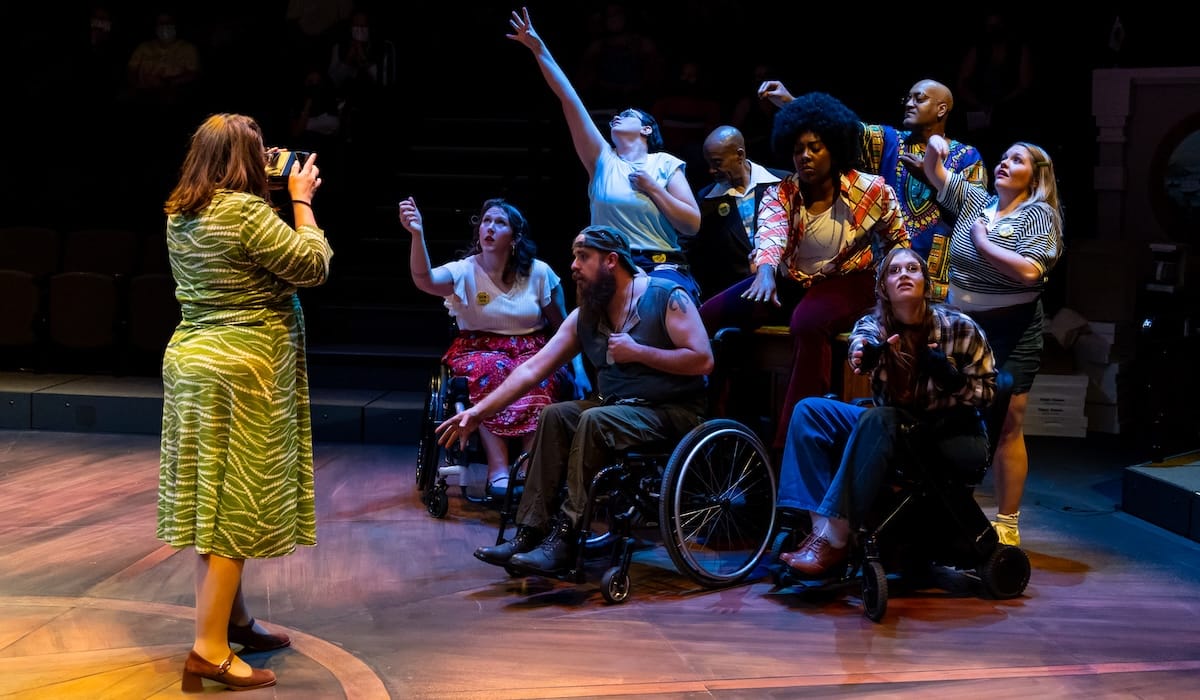
A scene from Phamaly Theatre Company’s production of 504: The Musical. | Photo: RDGPhotography
A movement under pressure
Before the action begins, the audience learns in voiceover that Section 504 of the Rehabilitation Act of 1973 prohibits disability discrimination in federally funded programs, but federal officials delayed implementing the regulations needed to enforce it. In 1977, roughly 150 disabled activists occupied a San Francisco federal building for 26 days, demanding that the government enforce Section 504.
Goldberg fictionalizes that occupation through an ensemble of characters whose lives give the legislation weight. Florence wants access to an art class. Billy wants Deaf children to attend public school. Heather is still working out what disability means within her growing inventory of identities. Their needs gradually coalesce into a movement, even as their disagreements threaten to pull it apart.
Director Raanan keeps those personal and political struggles braided together throughout. Working within the Kilstrom’s in-the-round configuration, scenic designer Brian Watson uses governmental flourishes, including a California seal on the wall, to give the space an institutional character before the activists gradually clutter and claim it as their own. Once officials restrict access, the surrounding audience magnifies the occupation’s claustrophobia.
Jolee Harston gives June a commanding certainty that begins to buckle under the weight of leadership. “Being Human” peels away her unyielding organizer persona, and Harston lets that exhaustion accumulate until June’s relentless drive to keep everyone moving begins to read as an inability to let herself stop.
Leonard E. Barrett Jr. brings warmth and magnetism to Bruce, a Black Panther whose terrific voice is particularly effective in “Stay,” as he talks Florence through a panic response triggered by memories of institutionalization.
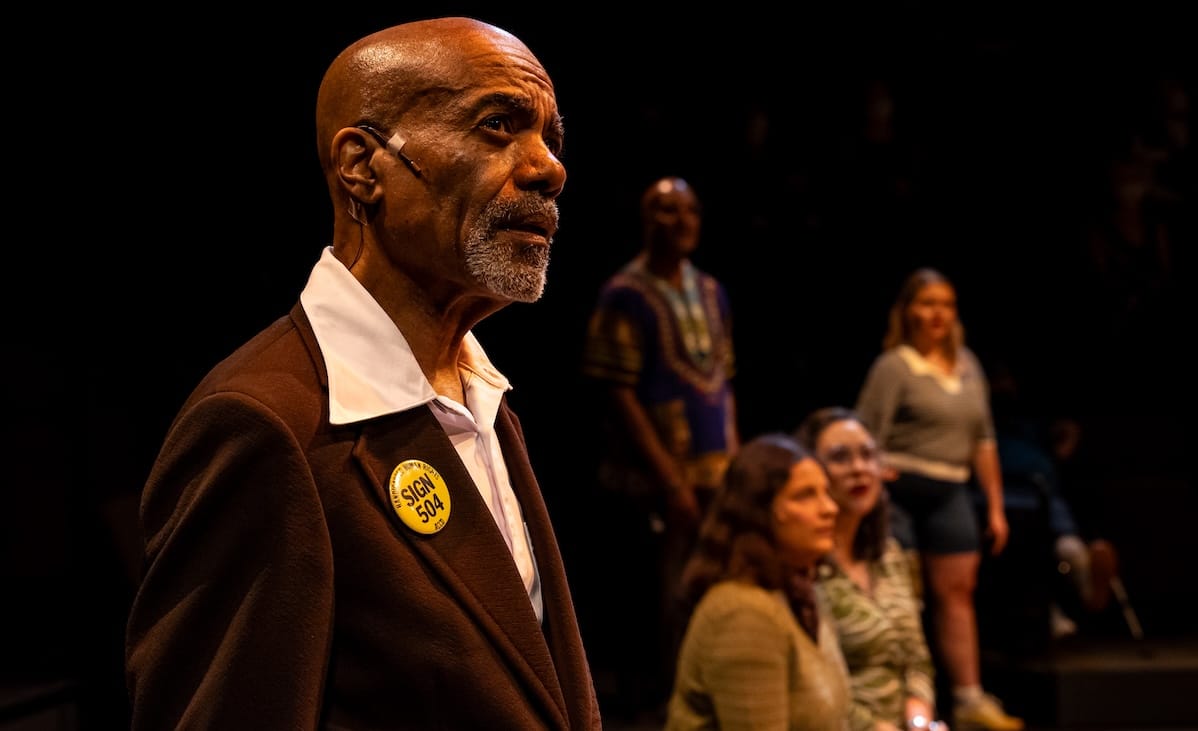
Leonard E. Barrett Jr. as Bruce in 504: The Musical. | Photo: RDGPhotography
The ensemble also allows Goldberg to tease out fault lines within disability culture. Atlas Drake is especially funny as Heather, whose uneasiness gives “Another Label” a restless edge as she inventories being Black, Korean, chronically ill and newly confronting her attraction to June. The romantic spark between Heather and June is less persuasive. Drake and Harston play the tentative awkwardness well, but the relationship develops so rapidly that its happy resolution feels under-earned.
Grey Dumois and Trenton Schindele develop an affecting rapport as brothers Paul and Keith, while questions about invisible disability — and who feels entitled to claim the word disabled — ripple through their relationship.
Those debates widen during the hearings and conversations inside the building. Characters spar over whether addiction belongs under the disability umbrella, whether chronic pain is something anyone should be expected to embrace and whether Deaf identity necessarily fits within disability culture.
Goldberg lets those disagreements remain unresolved: They can share a political objective without agreeing on what disability means.
Choreographer Savannah Svoboda lets each performer’s body shape the movement vocabulary rather than forcing the ensemble into uniform musical-theatre choreography.
In “Access Intimacy,” Svoboda’s approach becomes especially evocative, as the ensemble creates a gentle dream ballet around the sensation of existing among people who understand access needs without constant explanation. Similarly, during the final hearing, activists form a circle around a seated politician; their bodies dominate the space, while the supposedly powerful official appears diminished in the center.
McDowell’s score alternates between intimate character numbers and ensemble songs about the occupation itself. “All We Need to Do” is one of the evening’s sharpest feats of musical storytelling. The activists rhythmically inventory cities where other Section 504 sit-ins are underway. As reports arrive that those occupations have ended, the names disappear from subsequent verses, leaving holes in the rhythm until San Francisco stands alone. The song makes the movement audibly crumble around them.
What victory leaves unfinished
For all the pressures Goldberg layers into the occupation, one of its most productive conflicts arrives surprisingly late. “How Rights Are Won” finally puts June and Bruce’s organizing philosophies into direct opposition: June emphasizes urgency, planning and numbers while Bruce stresses care, trust and adapting to what the community actually needs.
Establishing that tension sooner could give the first act a firmer dramatic spine. It occasionally becomes a string of strong, self-contained character numbers before hunger, exhaustion and disagreement begin tightening their grip after intermission. By then, the activists are no longer simply fighting the government. They are fighting to remain a community.
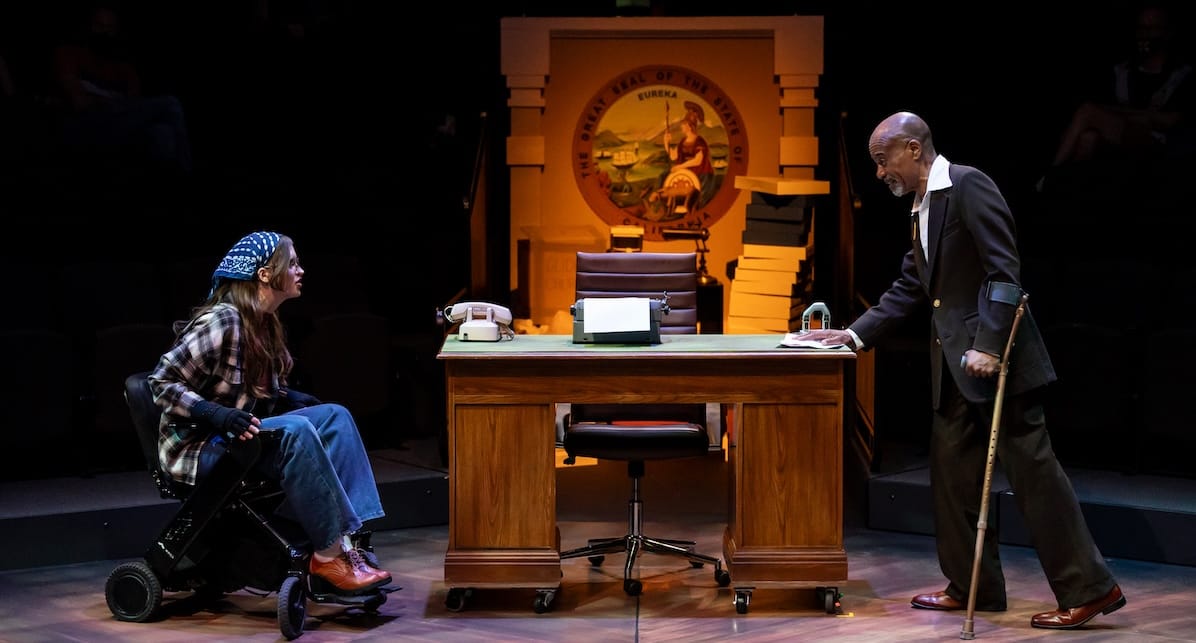
Jolee Harston and Leonard E. Barrett Jr. in 504: The Musical. | Photo: RDGPhotography
504: The Musical spends much of its running time embracing the messiness of the movement, which makes its final stretch feel unusually neat.
The San Francisco activists achieved an extraordinary victory, and the production earns its full-throated celebration of that accomplishment. Near the finale, however, June asks whether they won. The ensemble answers with an unequivocal “yes,” and the musical surges toward its bows.
That certainty feels harder to sustain in 2026. Alaska, Florida and Texas remain plaintiffs in Texas v. Kennedy, challenging updated Section 504 regulations, including the integration mandate protecting disabled people’s ability to receive services in their communities rather than in institutions. Allowing a little of that unfinished business to bleed into the finale would deepen the catharsis instead of diminishing it.
That unfinished edge should not obscure how much 504: The Musical gets right. Goldberg, McDowell, Raanan and Phamaly have created a vibrant, funny and big-hearted musical that turns disability-rights history into a celebration of collective power.
For all the struggle packed into its two hours, 504 leaves you exhilarated by what people can accomplish when they refuse to disappear.

An award-winning Colorado arts and culture reporter originally from Mineola, Texas. Tresca is the chief theatre critic for OnStage Colorado and managing editor of OnScreen Colorado. He’s the editor of Bucket List Community News, a contributor to Denver Westword and Estes Valley Voice, a resident storyteller for the Bonfils-Stanton Foundation and the co-host of the OnStage Colorado Podcast.

Thank you for a balanced and informative critique. Having been with Phamaly since its first show I have witnessed and experienced many of the situations in 504. I loved the show in so many ways and it was a trip down memory lane in others. The battle ain’t over as you stated. It’s another battle to have to fight.