
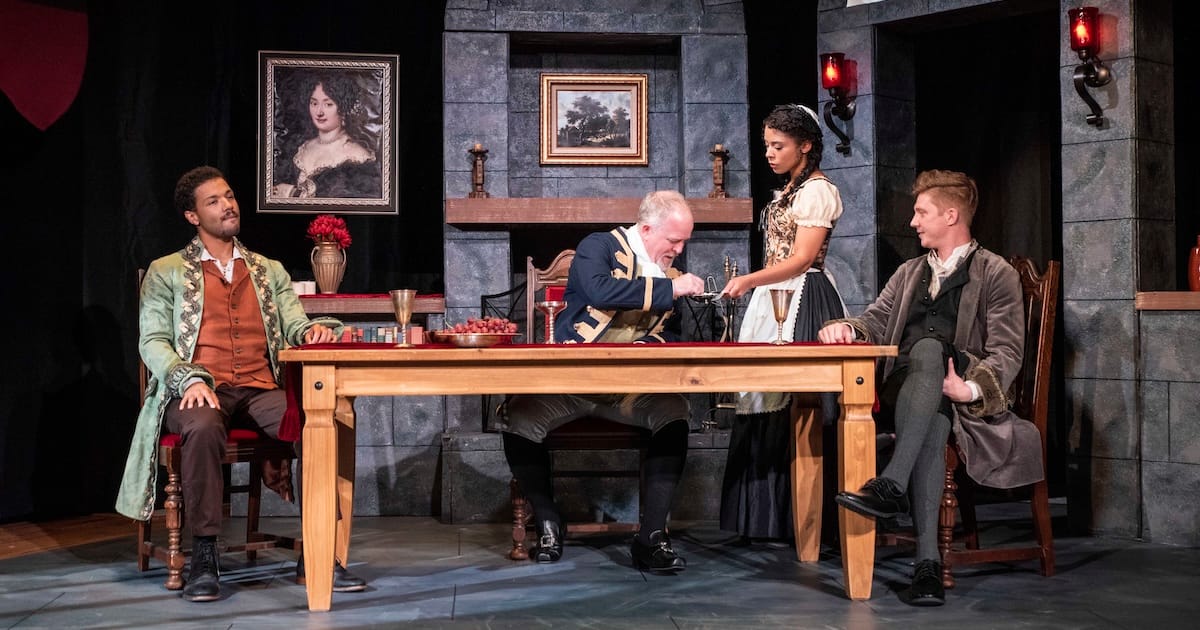
Jessica Robblee and Marco Alberto Robinson ignite Jen Silverman’s bleak comedy.
Fairly early in Boulder Ensemble Theatre Company’s Witch, Elizabeth Sawyer invites the devil into her home for a nightcap.
Scratch has already failed to persuade the suspected witch to sell her soul. The two have nevertheless become friends, drinking beside her stone fireplace and comparing notes on a world that has mistaken cruelty for common sense. Elizabeth asks whether he is still working. Scratch cannot believe she has failed to notice that he stopped trying to close the deal some time ago.
Those taut, unexpectedly poignant conversations between Jessica Robblee and Marco Alberto Robinson provide the reason to see director Josh Hartwell’s production. Jen Silverman’s 90-minute dark comedy asks how much a soul is worth when hope has become difficult to sustain. Hartwell’s polished staging locates the human pulse inside that philosophical question.

Yet Silverman repeatedly abandons the play’s most compelling relationship for a broadly comic household melodrama that never fully earns the devastating judgment Witch ultimately renders on humanity.

Marco Alberto Robinson (Scratch) and Jessica Robblee (Elizabeth Sawyer) in Witch. | Photo: Michael Ensminger
Devil off the clock
Inspired by the 1621 drama The Witch of Edmonton, Silverman’s play follows a devil who arrives in a small village expecting brisk business. Nearly everyone wants something: wealth, affection, status, validation or escape. Elizabeth is the exception.
Ostracized by neighbors who call her a witch, she recognizes that Scratch’s offer would merely place another transactional system around pain she already possesses. Robblee gives Elizabeth a prickly defiance that gradually exposes the loneliness underneath. She braces for each encounter, then allows that armor to loosen as Scratch proves willing to listen without deliberately misconstruing her.
Robinson enters with the boyish magnetism of a junior salesman confident that charm will handle the difficult parts. Scratch has chosen the body of a handsome young man because people trust young men and assume they are destined to succeed. He discusses training manuals and promotions as though damnation were a corporation with quotas and middle management.
The role draws upon Robinson’s familiar charisma while revealing a gentler register. He deployed that charm for antic seduction in the Denver Center’s Dracula: A Comedy of Terrors and paired it with leading-man confidence in Lone Tree Arts Center’s Nice Work If You Can Get It. Here, the swagger melts around Elizabeth. Scratch rests his head in her lap, weeps at the prospect of losing her and seems startled by his own tenderness.
Robblee and Robinson make their peculiar intimacy feel spontaneous and alluring. Both want to be recognized as something more than the identities imposed upon them. Silverman’s writing is sharpest when they inventory the systems that shaped them: Scratch maximizes human insecurity, while Elizabeth has lived long enough on society’s margins to recognize the pitch.
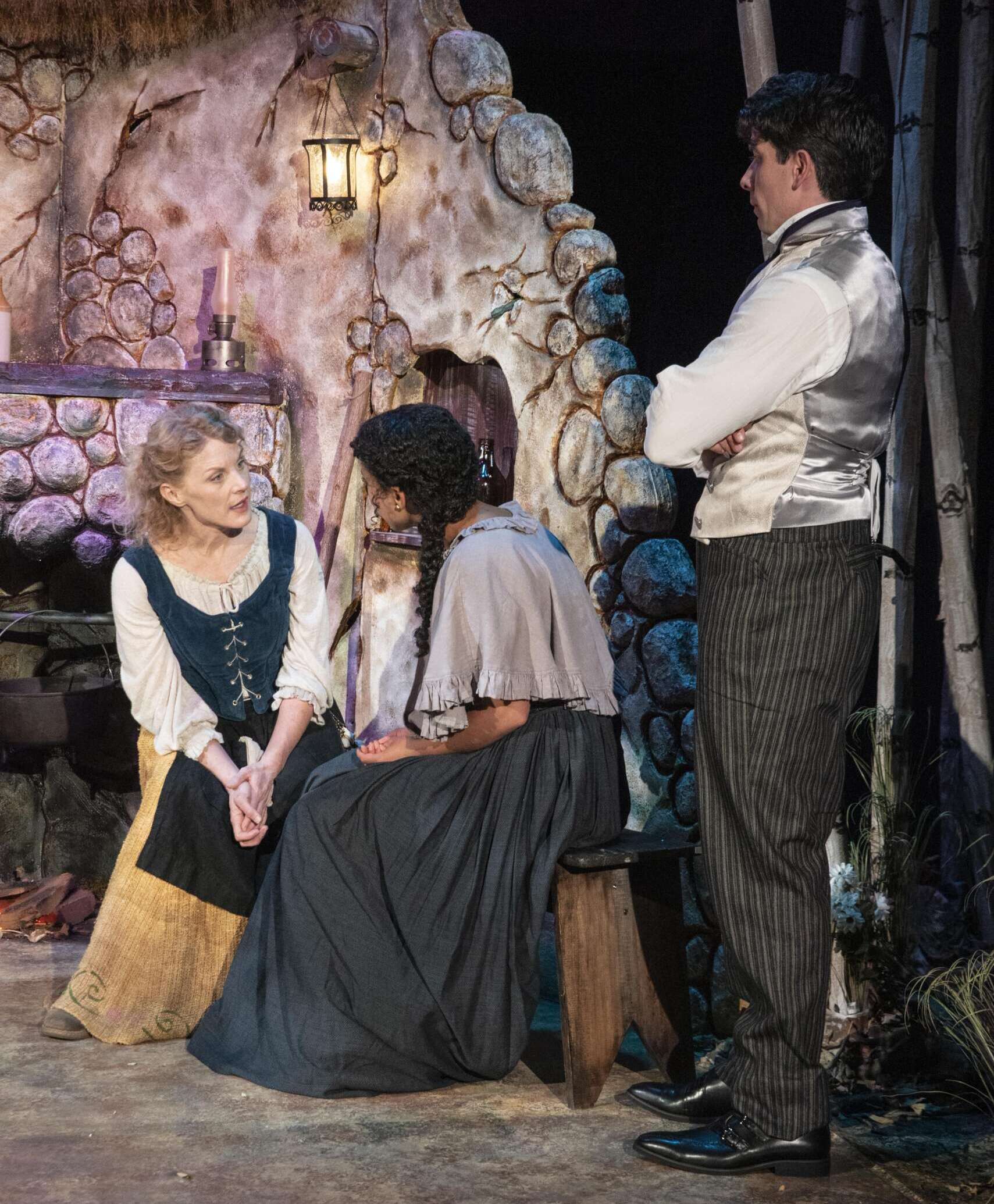
Jessica Robblee (Elizabeth Sawyer), Elizabeth Harlen (Winnifred) and Marco Alberto Robinson (Scratch) in Witch. | Photo: Michael Ensminger
A divided argument
The other half of Witch unfolds inside the prosperous home of Sir Arthur Banks, a widower seeking an heir. His son, Cuddy, loves Frank Thorney, the young man Arthur has begun treating as a replacement. Frank, meanwhile, has secretly married Winnifred, a servant pregnant with his child.
Hartwell and the cast embrace the story’s human drama. Torsten Hillhouse balances Arthur’s commanding affability with flashes of grief; Bryan J. Black finds hunger beneath Cuddy’s foppish behavior; Cam Davis makes Frank’s evasions increasingly troubling; and Elizabeth Harlen grounds Winnifred’s desperation in bruised urgency.
Silverman asks this household’s betrayals to substantiate Elizabeth’s bleak verdict on humanity. Yet Elizabeth barely intersects with the family and learns of its collapse secondhand. Because those failures remain private and specific, the play never transforms them convincingly into evidence of universal depravity. Its two stories remain adjacent when they need to coalesce.
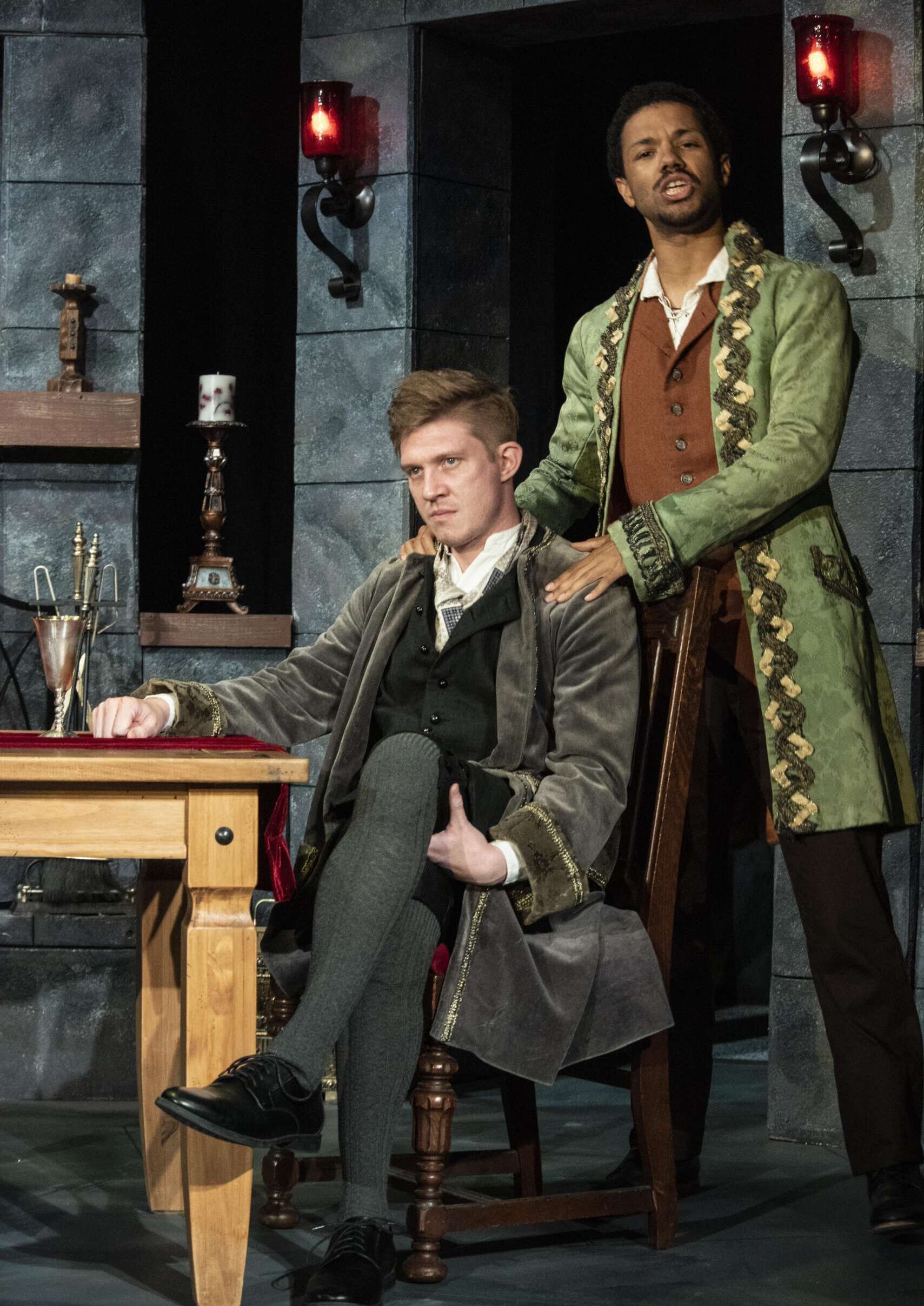
Bryan Black (Cuddy Banks) and Cameron Davis (Frank Thorney) in Witch. | Photo: Michael Ensminger
That disconnect irritates because the play’s larger warning has only gained urgency. Witch premiered at Writers Theatre in 2018, during Donald Trump’s first administration; BETC stages it in 2026, during his second. Silverman’s devilish bargains resonate as metaphors for what people surrender when fear and exhaustion make hope seem naïve: principles traded for security, validation or proximity to power.
Tina Anderson’s scenic design maps the play’s social hierarchy across the stage. Elizabeth’s rough cottage occupies one side; the Banks estate gleams opposite it with an imposing dining room table and a looming family portrait. Erin Thibodaux’s shadowy lighting visually unites spaces the script keeps apart, while Adara Baltazar’s sound design extends Silverman’s anachronistic humor with contemporary music.
BETC opens its 21st season with another handsome, thought-provoking production. Prior to opening night, all Denver and Boulder performances sold out, prompting the company to add two more shows, demonstrating the demand for the well-produced new and newish works, and there is much to love about Witch.
Even when Silverman’s split structure pulls attention away from the relationship that gives the evening its grip, whenever Elizabeth and Scratch sit beside the fire and speak honestly, Robblee and Robinson reveal what the play’s busier machinery obscures: being heard may be the smallest form hope can take.

An award-winning Colorado arts and culture reporter originally from Mineola, Texas. Tresca is the chief theatre critic for OnStage Colorado and managing editor of OnScreen Colorado. He’s the editor of Bucket List Community News, a contributor to Denver Westword and Estes Valley Voice, a resident storyteller for the Bonfils-Stanton Foundation and the co-host of the OnStage Colorado Podcast.

Leave A Comment