
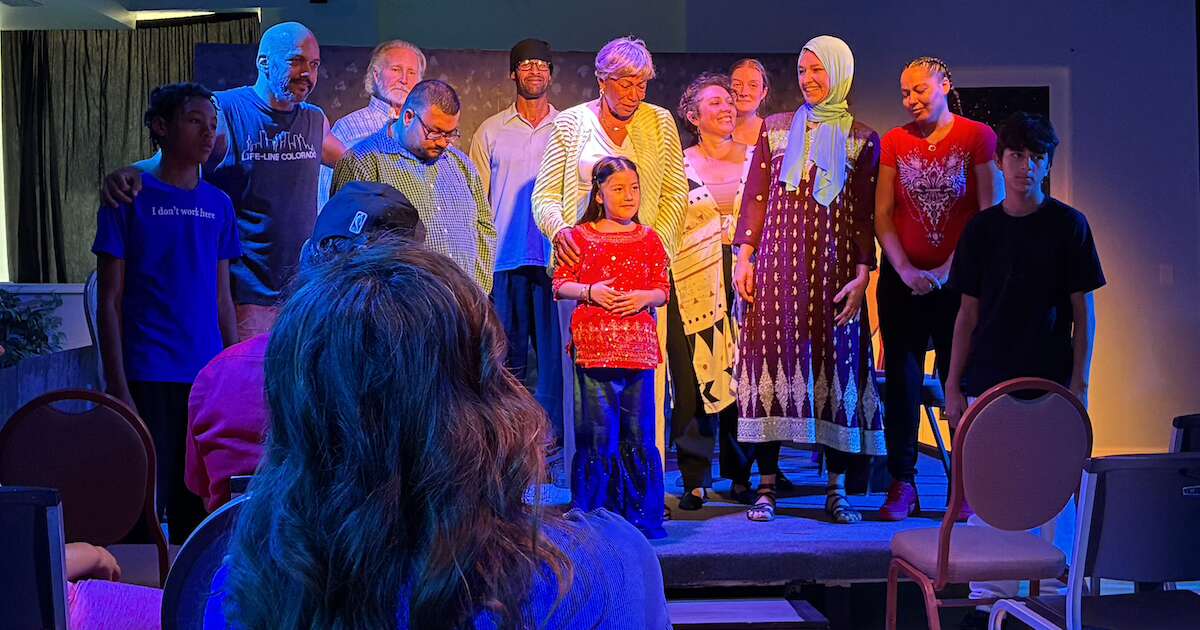
Roshni’s world premiere uses a bus route to tell the community’s stories, though the ride gets a little rough at times.
A bus ride offers a strange kind of community. People who might otherwise never meet share the same few feet of space, disappear at different stops and, occasionally, learn something about one another along the way.
Roshni Healing Arts Sanctuary in Aurora builds its world premiere Route 15 around that possibility. Written by Deepali and John Pacheco, with a monologue contribution from Ammon Underhill, the 90-minute piece turns the famously eventful Route 15 bus that runs from Union Station in Denver through Colfax Avenue and Billings Street in Aurora into a vessel for real stories gathered from people living along East Colfax.
Route 15 works as a kind of living archive, transforming testimony into monologues and movement while performers address and circulate among the audience to suggest the shared space of a bus. The company says its cast and crew represent 14 nationalities and include immigrants, refugees and people with disabilities.
As an act of witnessing, it can be moving. As theatre, it still needs work.
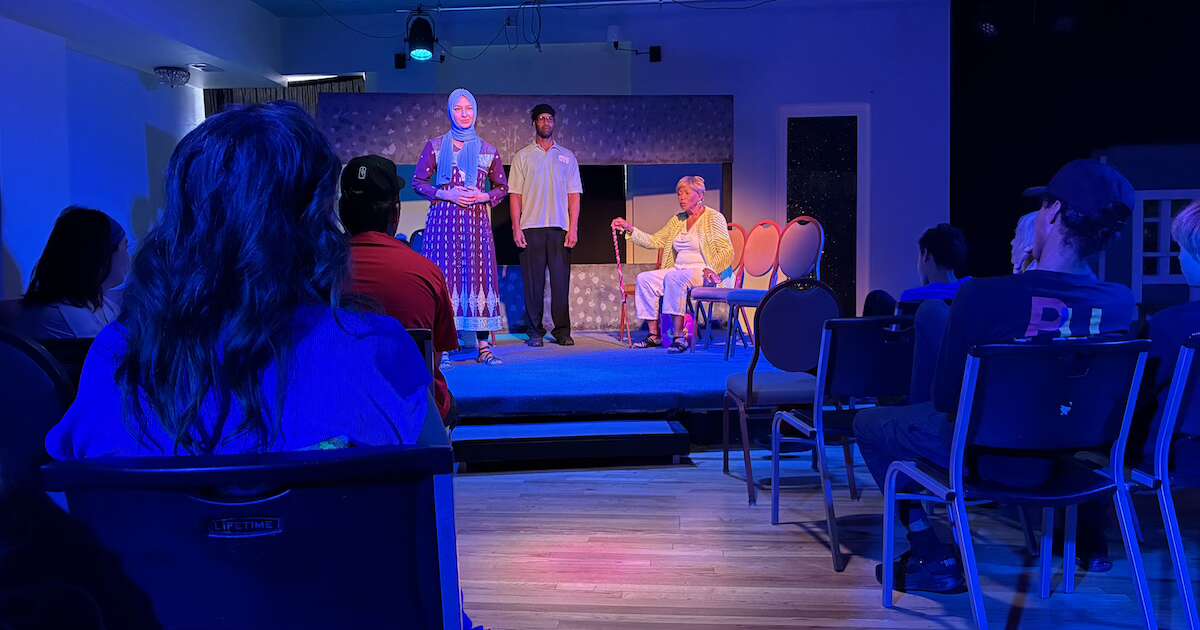
A scene from Route 15 at the Roshni Healing Arts Sanctuary in Aurora, Colo. | Photo: Toni Tresca
Local stories staged
Mike Mcgee plays Moe, a lyrical bus driver who ushers audiences into the studio and aboard the imaginary bus. Passengers arrive one by one, sharing experiences involving immigration, disability, war, mental health and survival while Deepali’s direction folds recorded testimony, video, music and dance around them.
The strongest sequence centers on Josephine (Dolly Turner), who recalls losing her sight and eventually helping others with disabilities. As Turner speaks, dancers gather around her holding a mirror. The image powerfully transforms her story of physical loss into one about reflection and rebuilding.
That is where Deepali and fellow choreographers Angela Gumieniak and Ben Harnish best justify dance’s place in the production. Rather than decorating the monologue, bodies extend its meaning.
Elsewhere, the connection is less precise. Contemporary movement accompanying stories involving gun violence and war sometimes feels grafted onto the testimony rather than organically emerging from it. Still, the willingness to combine dance, film, recorded interviews, music and live storytelling gives the production a distinctive theatrical vocabulary.
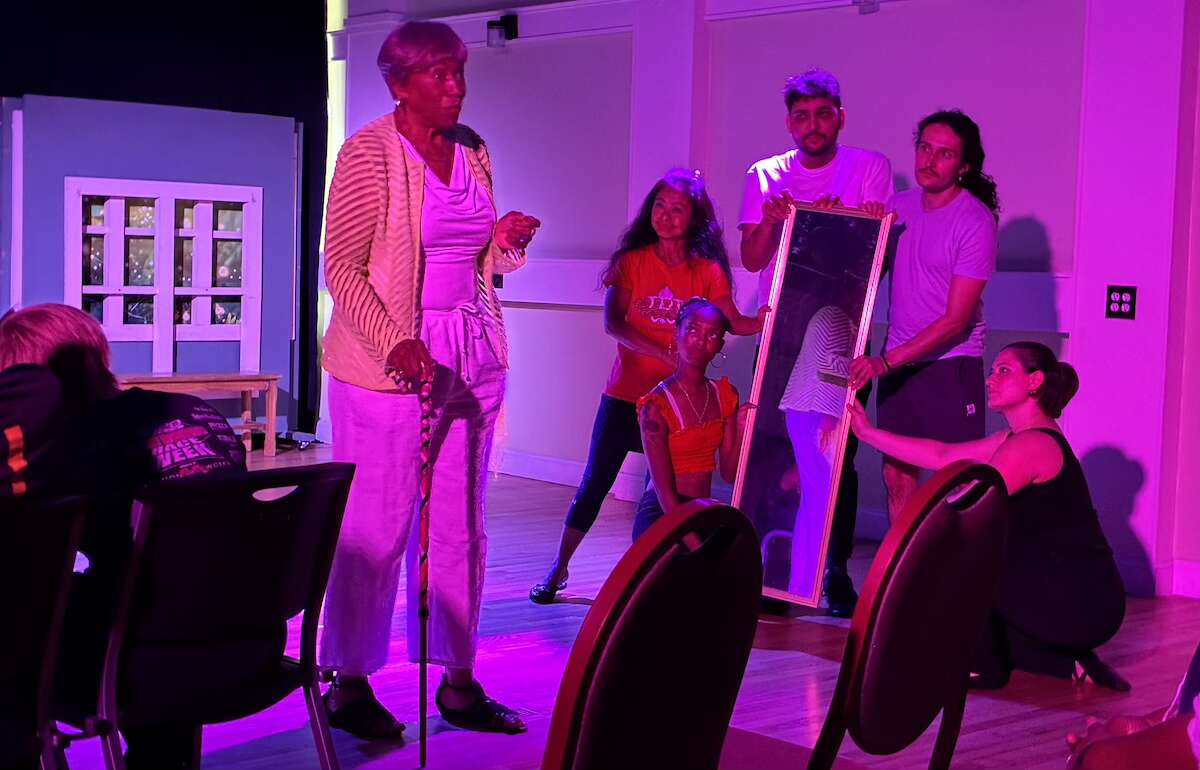
Dolly Turner as Josephine with dancers in Route 15. | Photo: Toni Tresca
A world premiere still taking shape
Roshni’s description of Route 15 as “immersive” is a bit generous. Audience members sit adjacent to the action, performers move through the aisles and characters address us directly, but this remains closer to environmental staging than a fully participatory experience. The premise feels ripe for a more fully immersive treatment, perhaps even one staged aboard a moving bus.
Opening-night execution also needed tightening. Lines were occasionally shaky, cues arrived late and one missed entrance before a sequence about protesters left an extended stretch of dead air. Video subtitles were difficult to read. Those details matter because a production built around intimate testimony depends on precision; every visible stumble pulls attention away from the people whose stories Roshni wants us to hear.
The larger dramaturgical problem arrives late, when one passenger’s trauma suddenly escalates into a crisis involving a firearm. Without spoiling the specifics, the sequence feels disproportionately melodramatic compared with the quieter, documentary-inspired storytelling surrounding it. The production has already established connection through the simple act of strangers sharing space. It does not need such an explosive device to prove its point.
That feels fixable, especially this early in the piece’s life. Route 15 has enough specificity and feeling to reward further development, particularly if its creators continue sharpening the relationship between testimony, movement and dramatic structure.
One passenger calls the bus “the best part of the city” because “you see life as it is.” Route 15 gets closest to its destination whenever it allows us to do exactly that.

An award-winning Colorado arts and culture reporter originally from Mineola, Texas. Tresca is the chief theatre critic for OnStage Colorado and managing editor of OnScreen Colorado. He’s the editor of Bucket List Community News, a contributor to Denver Westword and Estes Valley Voice, a resident storyteller for the Bonfils-Stanton Foundation and the co-host of the OnStage Colorado Podcast.

Leave A Comment