
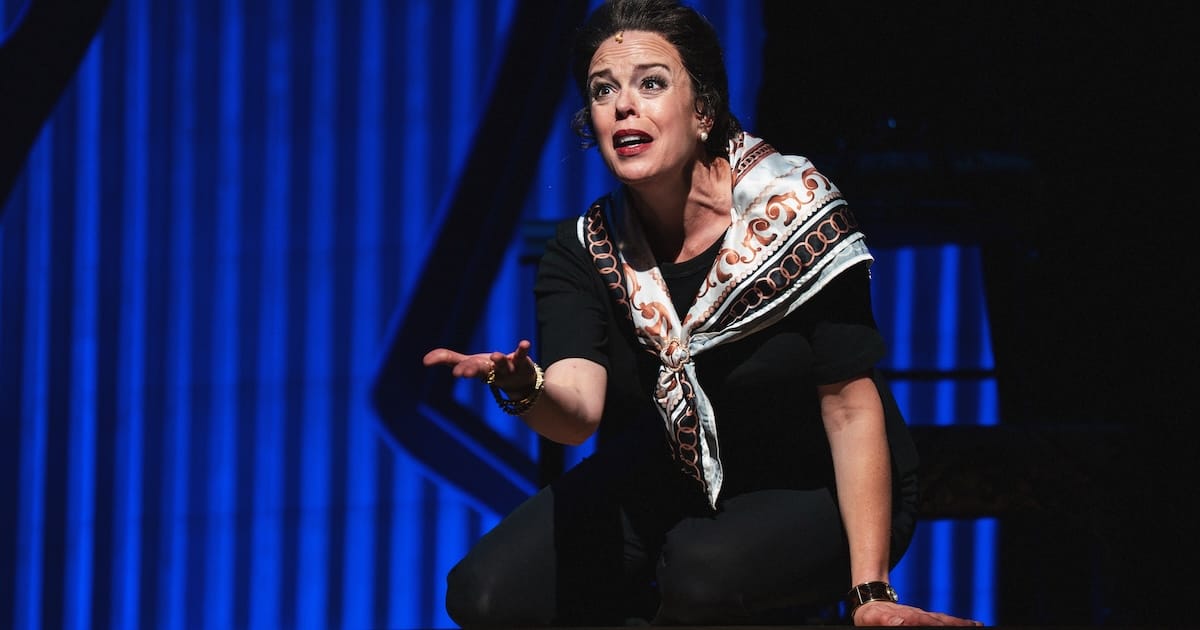
Terence McNally’s ‘Master Class’ digs into the story of the ultimate diva, Maria Callas.
Every year Central City Opera offers three productions during its summer season. Typically, these are two operas and one musical work, but this year the company has returned to an old tradition. In addition to The Marriage of Figaro and The Ballad of Baby Doe, the third show, which opened last Saturday night, is Terence McNally’s brilliant play Master Class. This production is as dazzling as the other two this season.
McNally, who died in 2020, was a devoted opera fan. In addition to his masterpiece Master Class, he wrote three other plays about opera and librettos for operas and musical theatre shows. Often referred to as “the bard of American theatre,” McNally’s works have won many awards, with Master Class winning the 1995 Tony Award for Best Play.
Master Class is McNally’s imagining of a master class in opera that Maria Callas gave at the Juilliard School in the 1970s. Although Callas did give 12 such classes, McNally’s play is not a literal depiction of any of those; rather, it is a blend of Callas’ explanations of the challenges and joys of performing opera along with her memories and reflections on her dramatic life and career.
The play shows us Callas critiquing three students (two sopranos and a tenor) as well as interacting with her accompanist and her master class audience. For those not familiar with a master class, this is a coaching session before a live audience. Callas’ Juilliard classes, given after she ended her relatively brief performing career in 1965, attracted audiences that included leading lights of opera among many others; here, McNally places us as her audience, breaking the fourth wall. This makes his Callas character real and, in the end, deeply tragic.
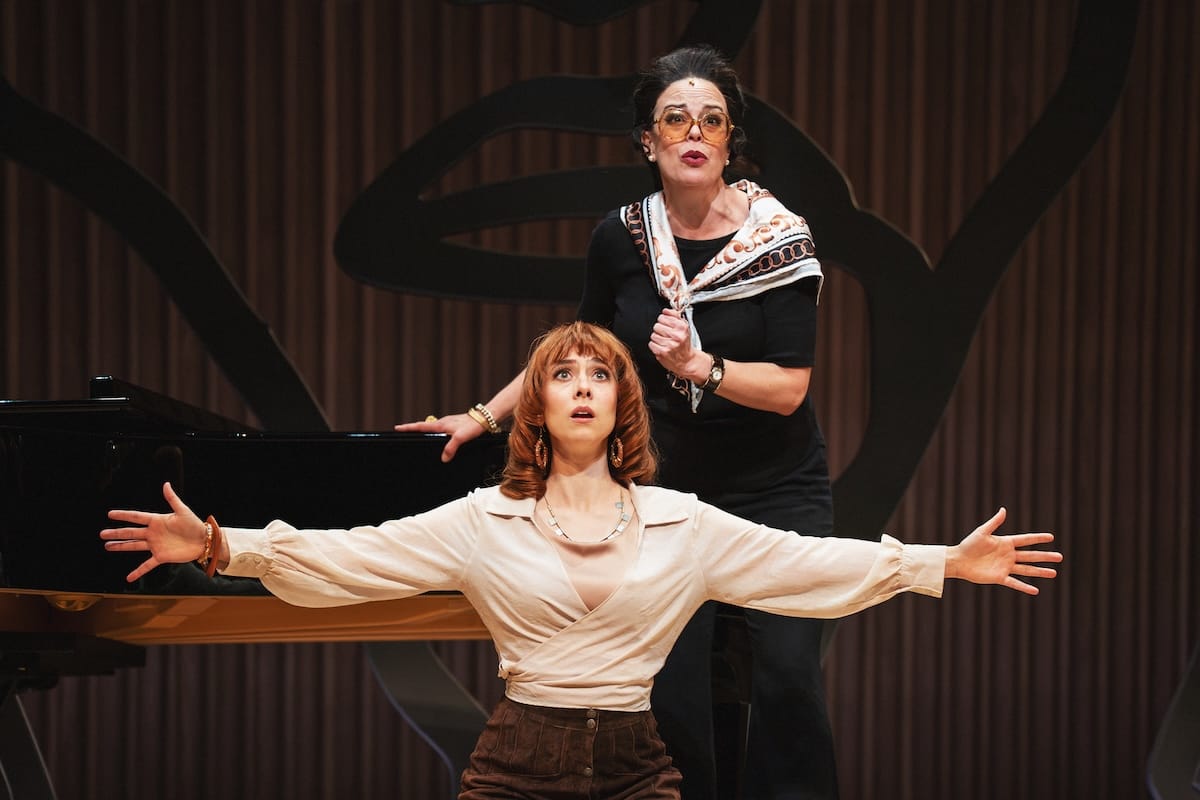
Jennifer DeDominici (top) and Sabina Balsamo in ‘Master Class.’ | Photo: Amanda Tipton Photography

The ultimate diva
Throughout her career, Callas was perceived as the ultimate diva, accused of throwing tantrums and even objects in rehearsals. Her personal life was as dramatic as the famous roles she performed, and in Master Class, McNally seamlessly melds her demanding teaching with descriptions of her total commitment to her art. Callas changed operatic performance for subsequent generations of singers. Even if one never saw her live, her recordings capture the powerful way she merged flawless singing with intense acting, changing the image of opera singers from stiff mannequins to true actors.
All of this becomes concrete and profoundly touching in McNally’s masterful script. Along with touches of humor, pathos and gorgeous singing and acting by Callas’ three “students,” Master Class keeps us rapt from the opening scene, as the teacher-diva makes her grand entrance, to her final moments, when she collapses in a heap of emotion. Breaking down in tears, she expresses how true art demands everything from an artist and how artists must believe their art feels like a matter of life and death.
The role of Callas is an extremely demanding one. The actor must dominate the stage without doing a cheap imitation of an iconic, larger-than-life real person about whom the world knew a great deal, both onstage and off. In McNally’s capable hands, the script requires an actor who can balance the diva’s sharp wit and deep emotional trauma while retaining her humanity.
Although the role is often performed by a non-singer (think Tyne Daly on Broadway), Central City has cast Jennifer DeDominici as Callas. Domenici is an actual opera singer, having appeared at Central City in The Pirates of Penzance and Amahl and the Night Visitors, as well as with other companies. Domenici easily balances diva and victim, cruelly dismissive of her students at moments but revealing her deep vulnerability at others. Her final monologue, which ends the play, is truly heartbreaking.
Domenici’s accent is perfect when using Italian terms and references. She also does a serviceable job of capturing the real Callas’ speaking accent (a mixture of standard English with slight Greek influences). In her all-black top and slacks, with a beautiful silk scarf around her neck, she also conveys the inherent elegance that Callas projected in all her public appearances, onstage and off.
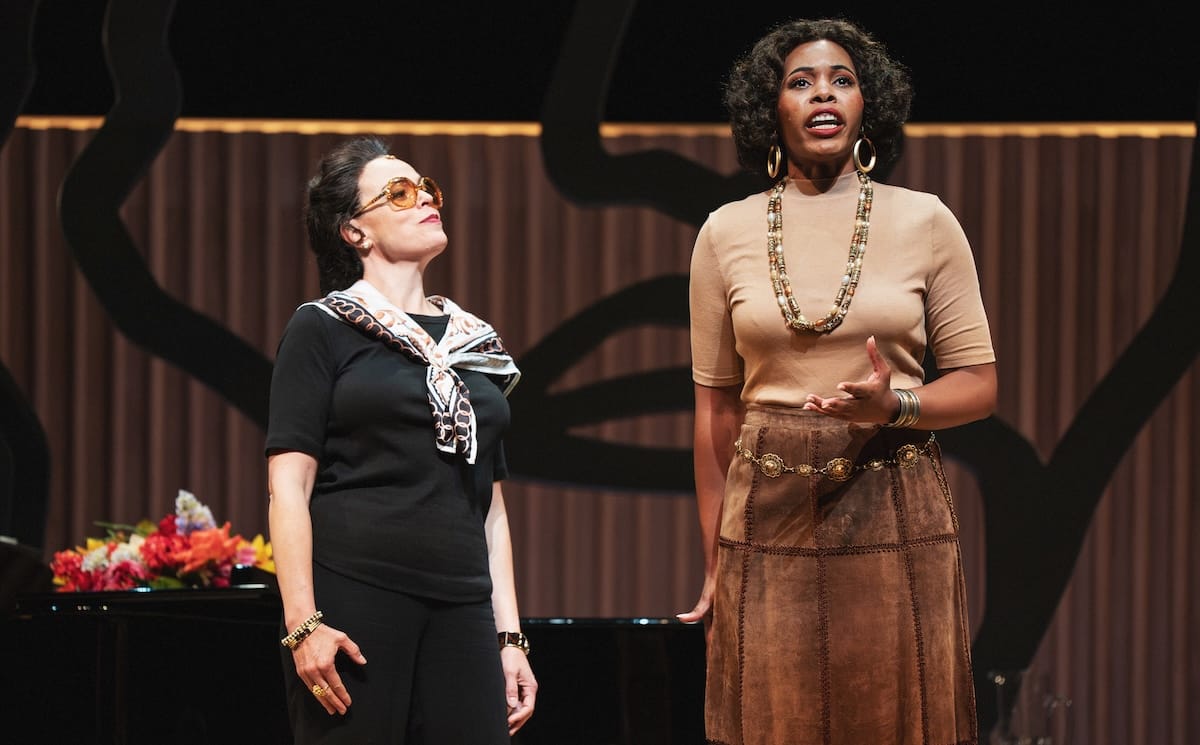
Jennifer DeDominici (left) as and Denique Isaac in ‘Master Class’ at Central City Opera. | Photo: Amanda Tipton Photography
Supporting cast
Domenici is supported by a stellar cast of three singers, each of whom has a powerful aria to perform as part of the master class. All are apprentice artists with Central City Opera and, based on their cameos here, have learned their lessons well as actors as well as singers. Tenor Levi Adkins justifiably nearly brought the house down on Saturday night with his aria; Denique Isaac was equally compelling as a feisty young soprano; and Sabina Balsamo was totally believable as an intimidated student who eventually finds her courage.
Fleshing out the cast is Arthur Bosage as the accompanist, in a small but essential role as Callas’ straight man; and Isiah Feken is pitch-perfect as the hilarious but silent stagehand who faithfully responds to Callas’ demands for a pillow, footstool and whatever else she considers appropriate to her stature.
Central City’s stage is dominated by a huge metal sculpture outlining Callas’ face. It is the perfect backdrop for a story about an outsized personality and is, on its own, a beautiful work of art by scenic designer Lawrence E. Moten III. As usual, the rest of Central City’s talented production team does its magic, from lighting designer Abigail Hoke-Brady to sound designer E. Martin Gimenez and virtually everyone else responsible for this production.
Special kudos must be given to director Dennis Robinson, Jr., who stepped in from rehearsals when the original director, who set the vision for the production, had withdrawn. Robinson is Chief Producing Officer for Opera Colorado and an experienced director.
Alice Kaderlan is a long-time dance and theatre critic and general arts writer. She has written for newspapers and online news sites in Seattle, Washington D.C., Pittsburgh and other cities for more than 40 years. She has also appeared on various public radio stations including WAMU-FM in D.C. and KUOW in Seattle and covered arts for NPR. She currently lives and writes in Denver.

Leave A Comment