
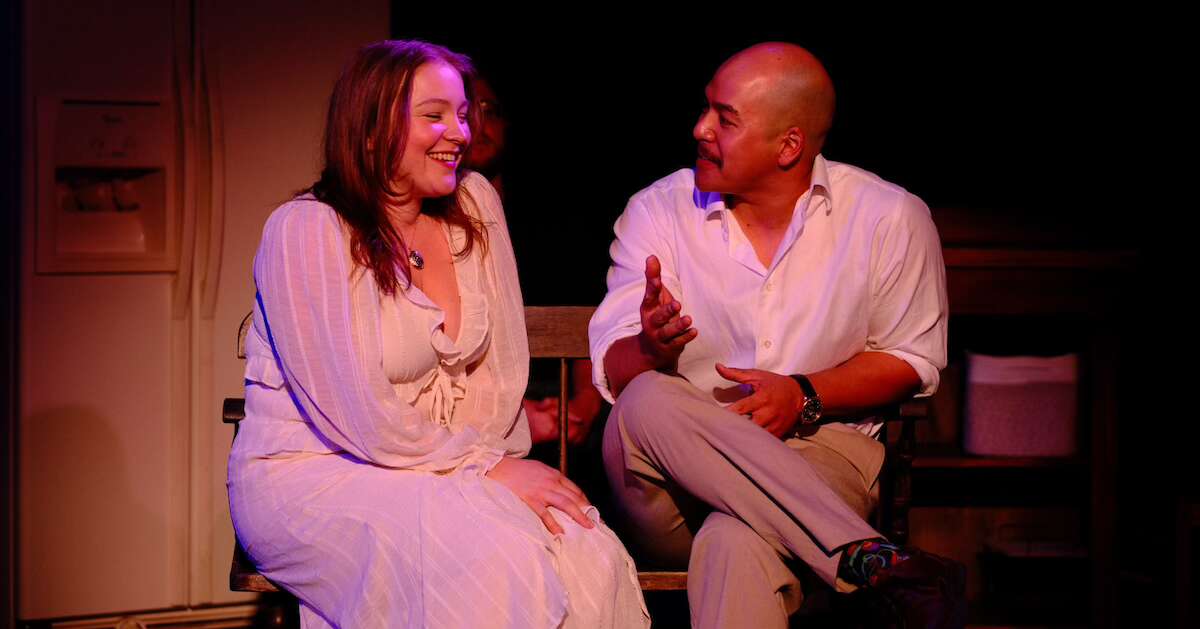
Impact Theatre Collective opens Aurora’s Storyteller Theater with an impassioned, inconsistent production.
Midway through the second act of Impact Theatre Collective’s Stupid Fucking Bird, four young lovers crowd the stage and passionately explain what they want. Conrad wants Nina. Mash wants Conrad. Dev wants Mash. Nina wants a life larger than the one available to her. Their declarations overlap until the language becomes an indistinguishable roar.
Then Sorn, the group’s weary elder statesman, enters, surveys the emotional wreckage and says, “So much feeling.”
The sequence neatly captures the spirit of co-directors Aspen McCart and Ethan Pierce’s production, the first show at Aurora’s new Storyteller Theater. Aaron Posner’s adaptation of Anton Chekhov’s The Seagull drags every buried resentment and desperate longing into the open.
Impact’s staging is most compelling when its performers surrender to that emotional excess. Yet the production cannot consistently sustain the urgency it creates, leaving an ambitious evening punctured by an uneven command of its many competing theatrical impulses.
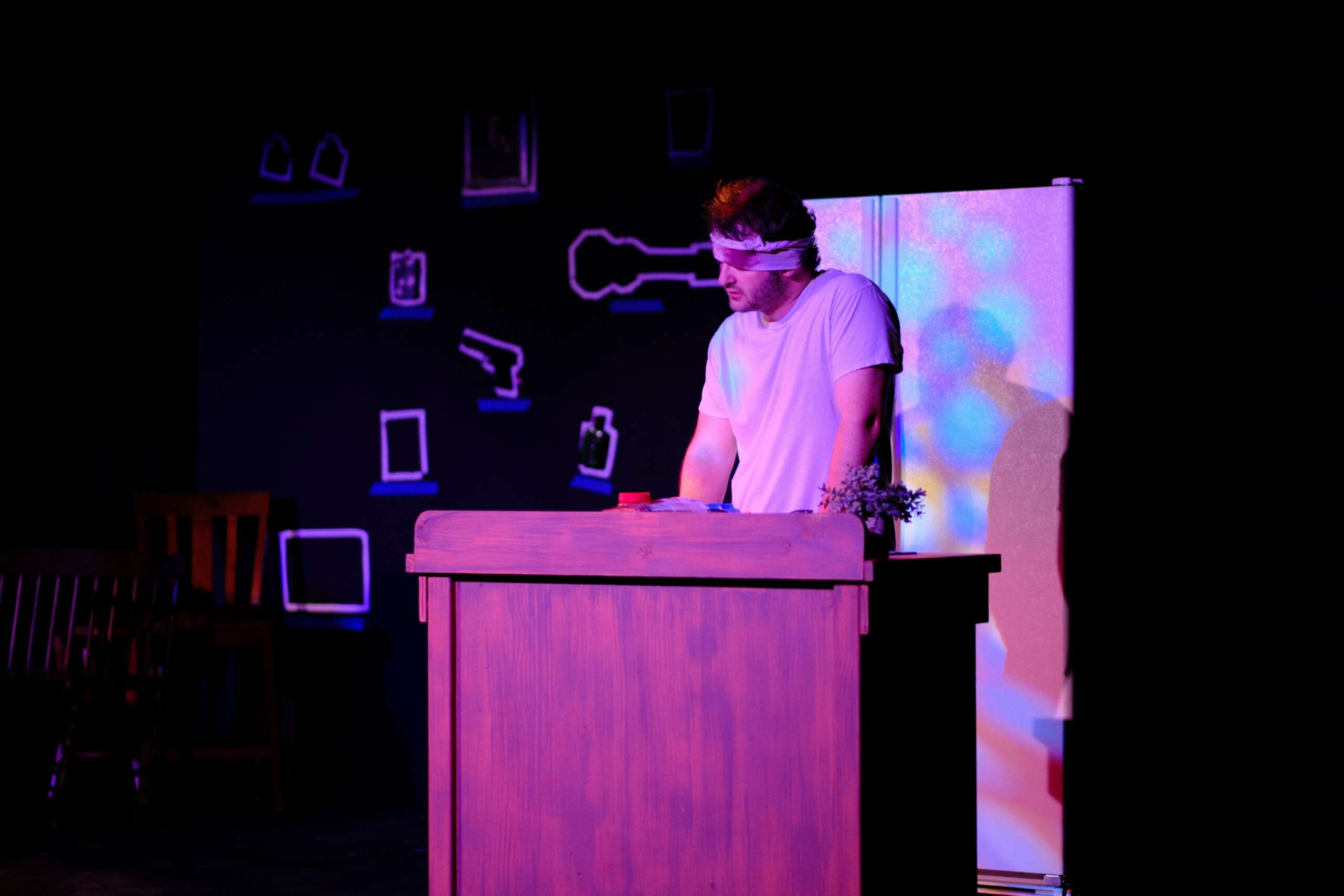
Ethan Pierce as Conrad in Stupid Fucking Bird. | Photo: Collin Sinclair
Chekhov with the subtext stripped away
The Seagull is famously built around the distance between what people say and what they desperately hope others will understand. Posner takes the opposite approach. His characters articulate that distance directly, explaining how their outward behavior fails to reflect the turmoil underneath. They confess through monologues, interrupt scenes to address the audience and openly acknowledge the theatrical machinery surrounding them.
McCart and Pierce embrace that exposed structure. Actors not involved in a scene frequently remain visible, watching the action alongside the audience and turning spectatorship itself into part of the drama. The sparse playing area contains a few benches, chairs and a refrigerator, while props are outlined and labeled in tape against the back wall. Above them hangs a portrait of Chekhov, with the inevitable gun mounted directly beneath him.
That stripped-down arrangement places the pressure on the performers, and Pierce, who also plays Conrad, throws himself fully into the character’s need to be taken seriously. His Conrad is neurotic, petulant and increasingly furious that the people around him refuse to follow the future he has imagined for them. Pierce is so physically invested in Conrad’s anguish that he frequently appears to sweat through the character’s breakdowns.
He also maintains control when Posner’s metatheatrical devices introduce genuine unpredictability. When Conrad asks the audience how to win Nina back, one patron advises him to accept that she is no longer interested. Pierce immediately rejects the sensible answer with an expletive and continues soliciting advice. Rather than derailing the scene, the exchange reveals a man asking for help while remaining incapable of hearing anything that challenges his desires.
Kate Hebert brings an easy warmth to Nina. She gives the aspiring performer an open, eager charisma that makes her attraction to Conrad convincing and her growing fascination with the celebrated writer Trigorin painful to watch. Hebert is especially affecting when Conrad presents Nina with the seagull he has killed. Her horror registers as the moment she recognizes that his devotion can become destructive: He would rather destroy the beautiful thing he admires than accept that it has a life beyond him.
As the play progresses and Nina’s ambitions fail to cohere into the artistic success she imagines, Hebert also begins to shade her performance with a mounting desperation and flightiness. Hebert captures the way Nina’s language starts to outrun her circumstances, as if she can will a different reality into being by speaking it quickly enough. The effect is most poignant in the production’s later moments, when Nina’s declarations of endurance feel less like conviction than survival strategy, a young woman grasping at identity even as each attempt to define it slips further out of reach.
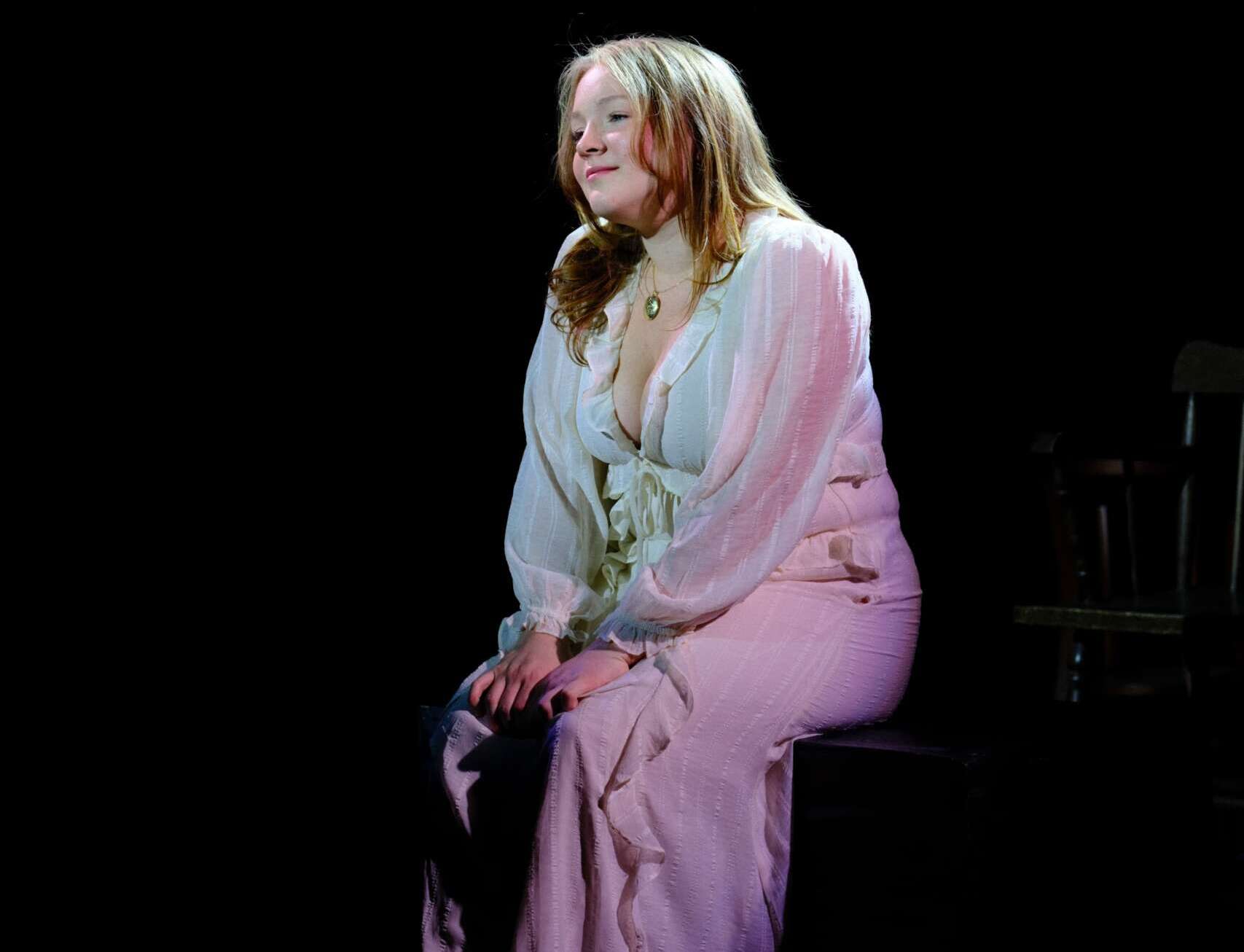
Kate Hebert as Nina in Stupid Fucking Bird. | Photo: Collin Sinclair
A young company reaching for more
Elsewhere, the emotional temperature fluctuates. Kevin Chung’s Trigorin never acquires the effortless magnetism that should explain Nina’s infatuation or Conrad’s jealousy. He frequently paces while delivering his lines, creating restless movement where the character requires the ease of a man accustomed to admiration. Hebert plays Nina’s attraction earnestly, but Chung seldom appears fully present in their intimacy.
Kathy Trageser nails Emma’s high-strung narcissism, presenting Conrad’s famous-actress mother as someone who instinctively redirects every crisis toward herself. The performance does not deepen when Emma confronts her son after his suicide attempt, however. A scene that should expose the conflict between her love for Conrad and her resentment of the demands motherhood places on her remains at the same brittle emotional pitch established earlier.
Desiree Slaughter is sharper in Mash’s dramatic scenes, particularly during her cutting confrontation with Nina, than in the character’s musical interludes. Her ukulele playing and singing appear tentative, and at the performance reviewed, one number had to be stopped and restarted. The interruption briefly dissolved Mash’s carefully maintained bitterness and exposed the performer’s uncertainty rather than the character’s vulnerability.
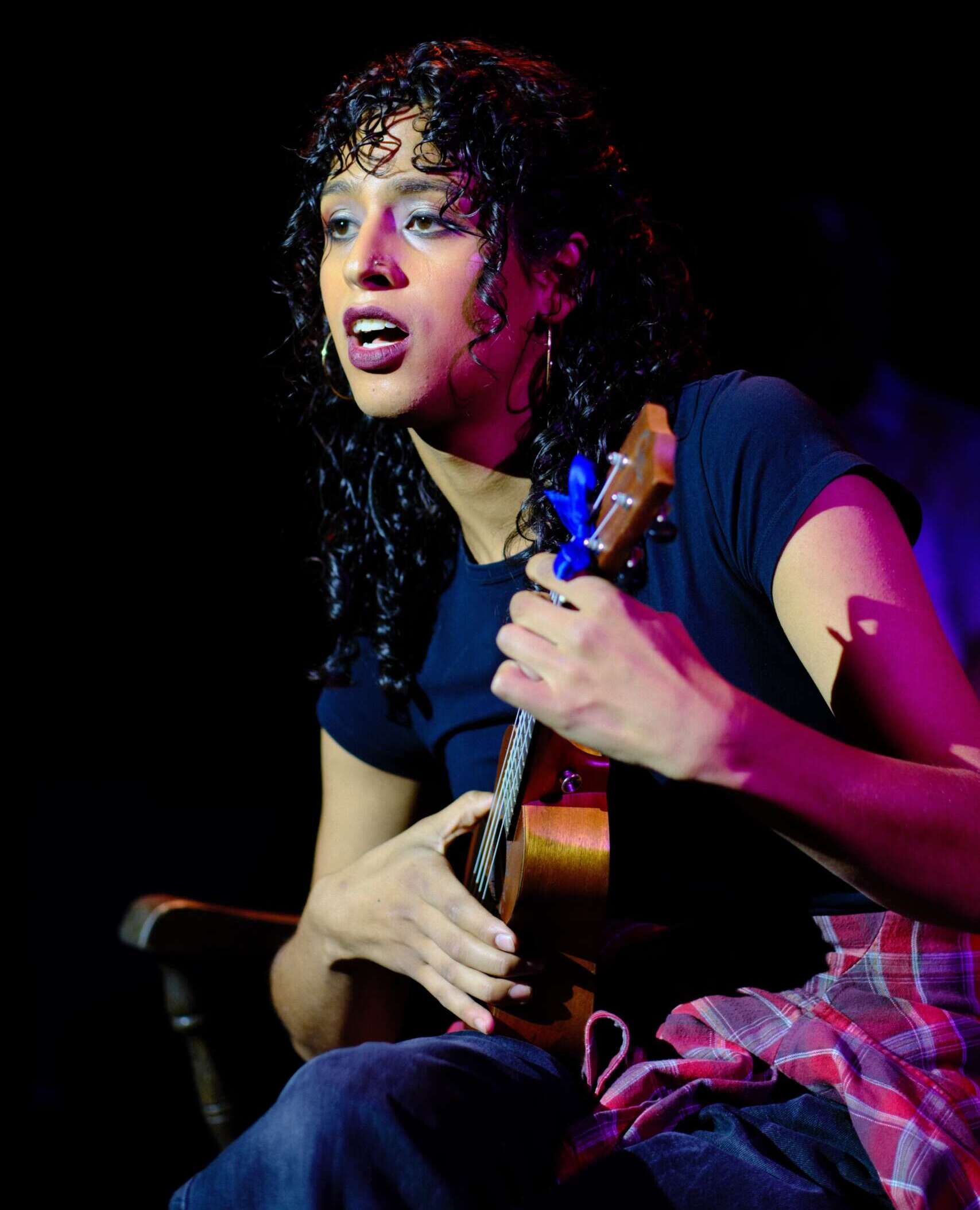
Desiree Slaughter as Mash in Stupid Fucking Bird. | Photo: Collin Sinclair
That unevenness extends to the production’s larger rhythm. The first act’s climactic sequence, in which the characters step forward one after another to declare what they want, should gather force as it progresses, but instead it remains largely static, never building the sense of mounting pressure it seems to aim for before Conrad’s suicide attempt. After intermission, the second act begins with a prolonged scenic reset performed in full view, draining the urgency that the production then has to rebuild.
These lapses frustrate because so much of the production reaches the searing intensity it seeks. When Pierce and Hebert lock into a scene, or when the ensemble’s competing desires collide, McCart and Pierce create the sense that someone could rupture at any moment. A tentative song, an underdeveloped performance or a sluggish transition then breaks that spell, forcing the production to rebuild pressure it had already earned.
Still, Stupid Fucking Bird is a sharp choice for Impact’s second Denver-area production and for the opening of a new theater. Posner’s characters keep asking whether art can become more immediate, honest and alive. At a precarious moment for local theater, that question carries force.
Impact has the appetite to push the form forward. What it needs now is the discipline to sustain the intensity it already knows how to create.

An award-winning Colorado arts and culture reporter originally from Mineola, Texas. Tresca is the chief theatre critic for OnStage Colorado and managing editor of OnScreen Colorado. He’s the editor of Bucket List Community News, a contributor to Denver Westword and Estes Valley Voice, a resident storyteller for the Bonfils-Stanton Foundation and the co-host of the OnStage Colorado Podcast.

Leave A Comment