
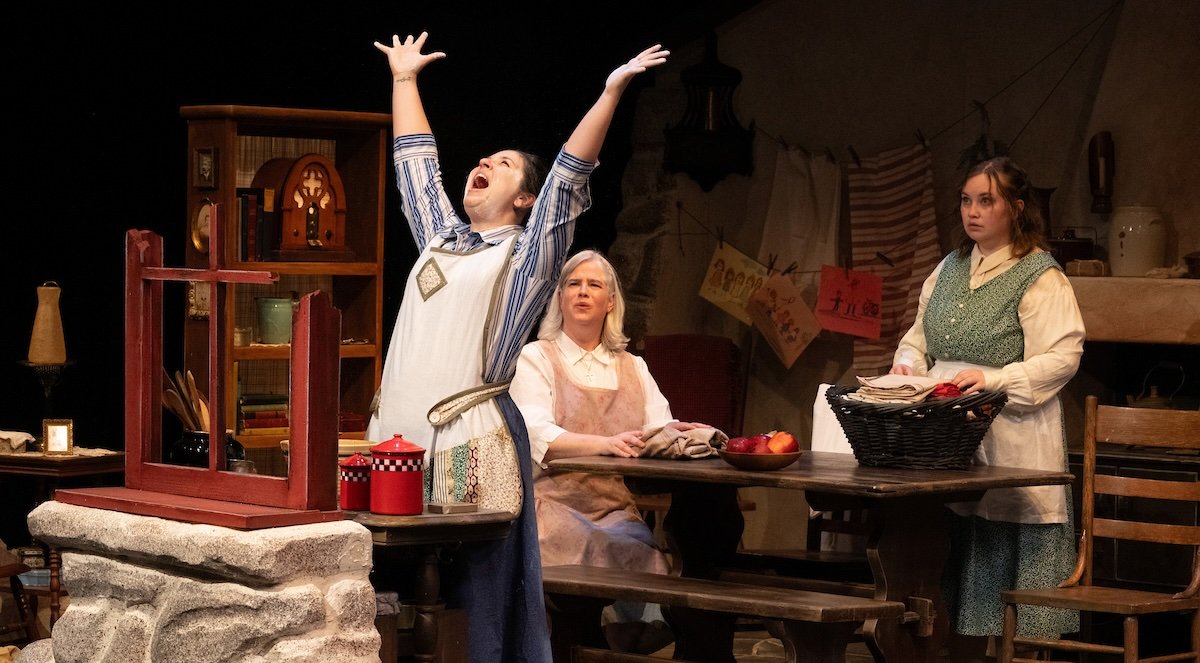
Steve Keim’s polished staging gives Brian Friel’s languid memory play moments of real joy, led by Jeffrey Bigger and Karis Elliott, even as a talky script holds it back.
Many years ago, I saw a production of Dancing at Lughnasa by Brian Friel at Berkeley Repertory Theatre. I remember none of it. Alas, Bas Bleu’s production, directed by Steve Keim, which opened Nov. 14, likely will have the same fate — a well-acted and well-directed production that just isn’t all that memorable.
Dancing at Lughnasa is a memory play centered on five Mundy sisters in Donegal, Ireland, dealing with changing social and economic times in 1936. It is the time of Lughnasa, a pagan celebration. The play is told by an adult Michael (Jeffrey Bigger), the son of one sister, Chris (Maggie Gammonley), looking back on a summer when he was 7.
Memory plays are tricky because the person recounting what happened did not necessarily see everything that is being depicted. Character motivations may not be clear because the narrator does not have the information.
Michael also reveals the fates of characters early and often, which could either increase interest in the how and why or reduce it because the ending is known. Too often, Dancing at Lughnasa does not explain the how or why, leaving the audience confused and not caring about the characters. Dramatic tension is interrupted, rather than created, by long expositions.
Five sisters
The five sisters — Kate (Esther Goldman), Maggie (Karis Elliott), Agnes (Trisha Gillin), Chris and Rose (Anika Reiner) — live together and are all unwed for reasons the play does not attempt to explain. The sisters have little money and struggle to survive. Kate is a schoolteacher and the most religious, concerned with social image. She assumes the role of matriarch, which the sisters tolerate.

Maggie takes care of the house and is in constant motion, full of glee and optimism, singing and dancing. Chris is focused on raising Michael and is the most like Maggie in temperament. She is still enamored with Michael’s father, Gerry (Brett Darling), even though he rarely visits and provides no financial support. Agnes is surly and withdrawn and either had a relationship with Gerry or harbors only an unrequited crush.
Last is Rose, who has some form of developmental disability — what some then would have called “simple.” Rose is fascinated by an unseen man of some wealth, with whom she may be having a dalliance. The sisters are protective of Rose.
Into this world comes their brother Jack (John Kissingford), returning after decades of service as a Catholic missionary in Uganda. He is ill and a challenge to the sisters’ finances and beliefs. Although he is a missionary, he admires and misses some of the Ugandan religious traditions and teachings. Jack’s stories connect thematically to the Lughnasa festival.
Faulty memory itself is a constant theme. The sisters have only fond memories of attending the Lughnasa festival, but it has been some time, and their memories seem untrustworthy. Jack has to remember how to speak English and is consumed by memories of his time in Uganda. Adult Michael comments that his own memory of Uncle Jack does not line up with reality.

The cast of “Dancing at Lughansa.” | Photo: William A. Cotton Photography
Staging and casting issues
Keim’s staging doesn’t let the play drag, even with the long exposition sequences. He got the cast to capture and share Friel’s lyricism and melancholy. There is real joy in the rare moments of happiness, generally when the actors get to literally dance.
The exquisite unit set by James Brookman is brought to life by prop designers and set dressers Carla Brookman and Jan Harlan. The set is divided between the exposed interior of a kitchen and an exterior yard with a swing. Drapes are used to trigger audience imagination of offstage action. There is only a suggestion of a wall and window. As a result, Keim’s direction too often leaves actors onstage in static positions on one part of the set when the focus is on the other. Grant Putney’s lighting could have emphasized the separation better.
Bigger is excellent as Michael, capturing an adult who is forlorn over the losses his family experienced yet is also called on to interact as a joyful 7-year-old. He holds our interest through several long monologues and almost had me in tears with his description of Agnes and Rose’s fates. Elliott has a clear vision of Maggie and, rising above the other sisters, becomes the emotional center of the show.
The script leaves the other sisters and Gerry as mostly one-dimensional characters. The actors, with varying degrees of success, have to create and project backstory to explain their motivations and actions. Kissingford grabs some attention in his description of Ugandan tribal practices but otherwise meanders. All have strong, consistent Irish accents.
Casting is an issue as the actors’ ages appear inconsistent with their characters. Gerry looks old enough to be Chris’s father. The five sisters’ ages seem to span decades, making it difficult to see them as sisters. Some seem too old. Some seem too young.
Dancing at Lughnasa is a lengthy, languid, lyrical play rooted in a sense of loss and lacking optimism. Keim and his cast do right by the material, but the script gives them too little to work with. This is a well-made production of a play that does not stay with you.



Garth Gersten is an attorney and lifelong theatre lover. In Champaign, Illinois, he directed shows with Champaign-Urbana Theatre Company, Rantoul Theatre Company, Bright Lights Theatre Company and Twin City Theatre Company, which he founded. He now lives in Boulder with his wife who is a professor at CU.

Leave A Comment