
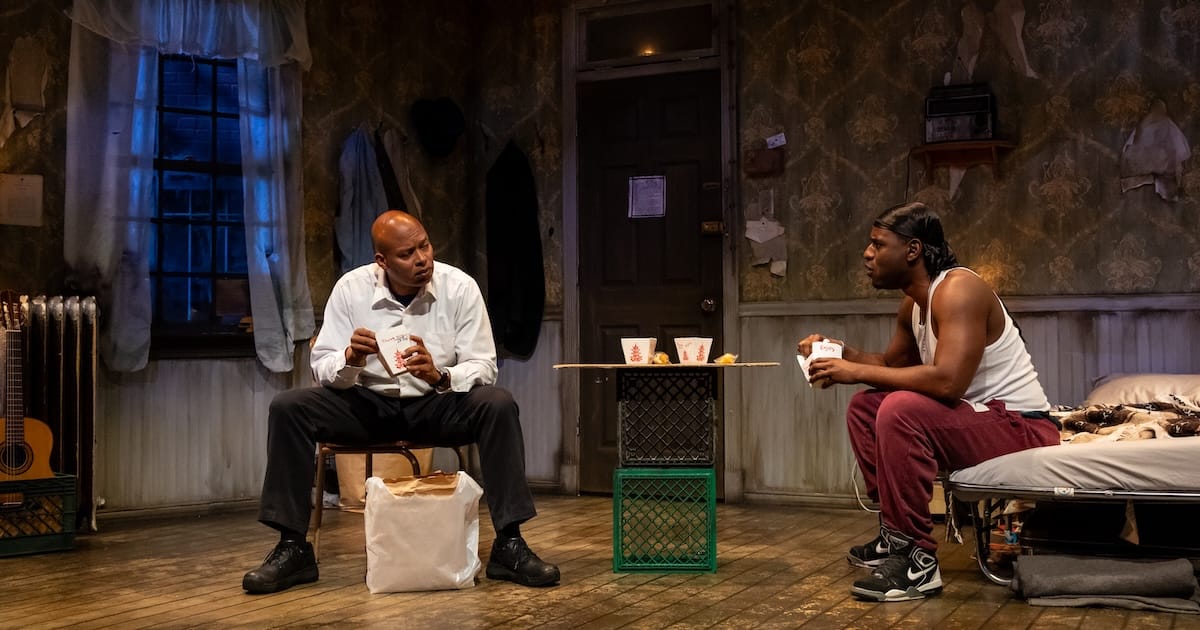
Sharp script, direction and performances need no sleight of hand.
In the first few minutes of Topdog/Underdog, the Pulitzer Prize-winning play by Suzan-Lori Parks at Curious Theatre Company, Booth (Rakeem Lawrence) is practicing three-card monte. The game is a method of separating a person from their money through skill, deception, fast talking and encouraging hope. Parks uses the game as the base to explore the relationship of two brothers, where life has taken them and where they hope to be. Steven Sapp’s direction uses those same methods to create a taut, compelling drama that holds your attention until its explosive ending.
Clinging to hope in a bleak life
In Topdog/Underdog, two African American brothers, Lincoln, played by Curious company member Cajardo Lindsey, and the younger Booth are barely getting by, if that. Their situation is bleak. Lincoln has been thrown out of his house and is sharing a room with his unemployed small-time thief brother. The perfectly crafted room, designed by Tina Anderson, has no stove, no bathroom and no running water. The walls are peeling paint and wallpaper. The only furniture is a broken twin bed and a recliner. Plastic crates are used to create a table. Traffic sounds and street lighting infuse the room.
Lincoln used to hustle three-card monte, making $1,000 a day, until a member of his team was killed several years ago. Now, he has a low-paying job to dress up as Abraham Lincoln in an arcade and get shot by cap guns all day. He is portrayed as accepting his life, if not content with it.
Booth has dropped out of school and lives by stealing things, which he attributes to skill, but the thefts are small-scale. He aspires to become skilled at three-card monte, thinking that will provide him with the income and lifestyle he desires. But his requests for Lincoln to train him are rebuffed.
The brothers verbally fight, support each other, relive and revisit their youth and provoke each other as only siblings can. Booth is jealous and constantly tries to tear down Lincoln to feel superior. Lincoln just wants to quietly live his life, resisting and parrying Booth’s challenges.

Race is lightly touched upon as Lincoln is using whiteface to play Abraham Lincoln. This creates several humorous moments, so necessary in an otherwise bleak story. As in three-cardmonte, they know the game of life offers them only false hope.
Lincoln is resigned to it. Booth is not.
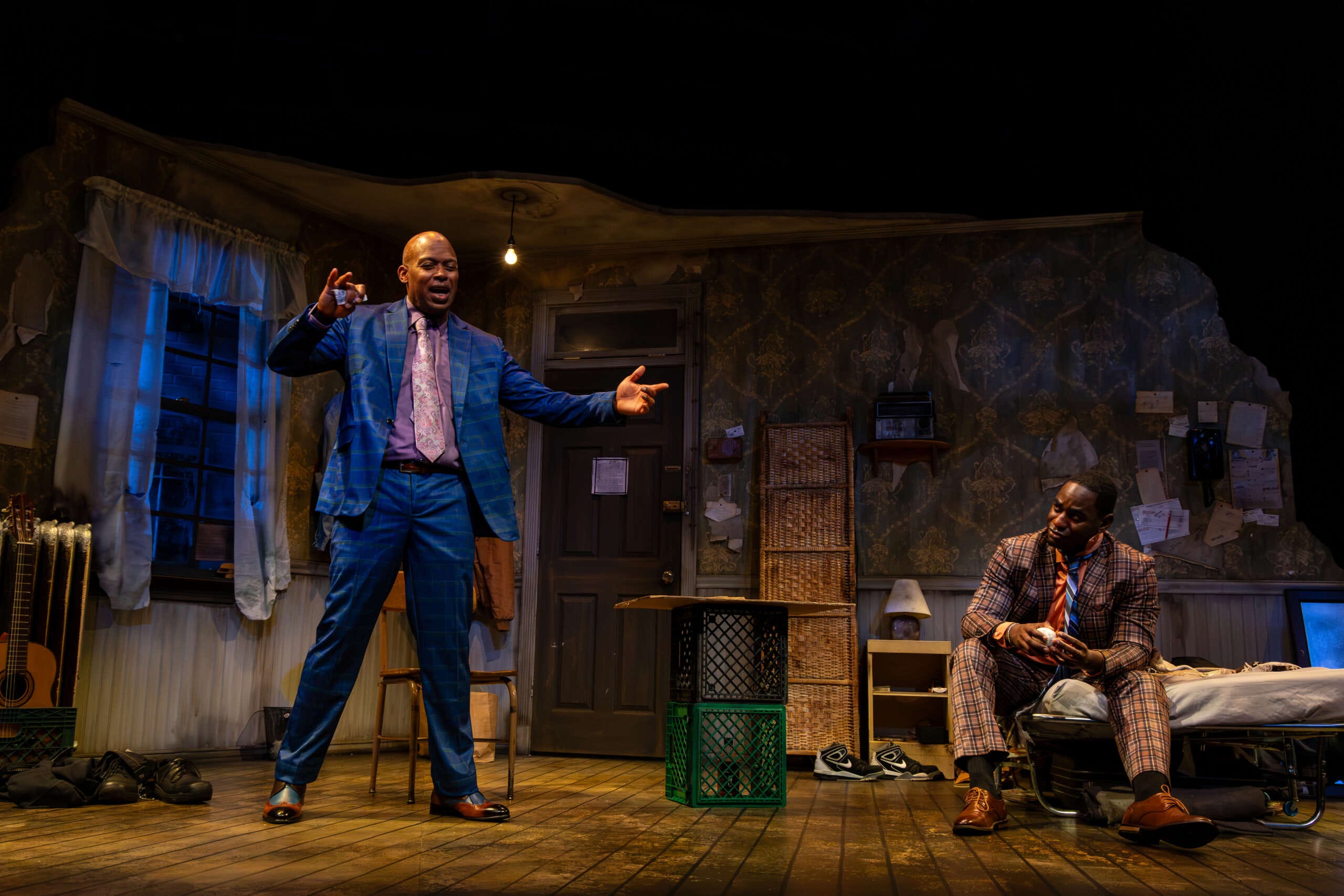
Cajardo Lindsey, left, and Rakeem Lawrence in Topdog/Underdog. | Photo: RDGPhotography
Two compelling performances
Topdog/Underdog is not a plot-driven show. It is about two characters struggling with life, and Lindsey and Lawrence fully inhabit their characters. They keep the audience on edge wondering what will happen. When they laugh, we laugh. When they yell and threaten, we cringe. As in the card game, you need to watch closely to catch every nuance of their performances.
Lindsey is in complete control as Lincoln, carrying himself with resignation and acceptance. Lindsey’s Lincoln is not an optimist. While a realist, he sees an attainable future. As good as Lindsey is at verbally expressing Lincoln’s thoughts, his non-verbal communication skills really sell the character and lead the audience to understanding and sympathizing with him. We wish he could find the happiness he seeks. Lindsey’s silent pantomime moments speak volumes.
Lawrence’s Booth is a stark contrast to the quiet Lincoln. He is loud, cocky and emphatic from the first moments of the play. He shows us that Booth does not have the physical skills at three-card monte, even as he practices the patter that he thinks is key. His Booth thinks that he can be on top by force, by deception and by any means necessary. But inwardly he fears he will fail. Lawrence’s body reacts to Booth’s setbacks, especially with his unseen girlfriend, to reveal his verbal bravado is facile.
While compelling, Lawrence’s performance could have been more modulated. Always at a high-energy emotional level, we rarely see him build to a moment since he’s already there. Booth’s façade rarely slips, which slightly diminishes the denouement of some of the shock and power it might have.
A world in a room
Sapp’s creative team had the task of making the move from the theatrical stage at Curious Theatre’s home, now under renovation, to the performance stage at Cleo Parker Robinson Dance’s Historic Shorter AME Building. The entire play takes place in Booth’s one-room apartment. It is designed and feels as poor as Lincoln and Booth are. The outside is referenced, but never seen, as Booth and Lincoln are trapped by their environs.
The stage seems wider than at Curious’s prior home, so creating a constricting one-room set was a challenge not fully met. Large end swaths of the stage are empty to focus on the room. Even so, too frequently, I was unable to see both Booth and Lincoln at one time as they were physically far apart.
The original music and sound design by Max Silverman enhanced the mood for each scene, especially the low street and car noises that permeated the play.
The room is meant to be dark as much of the show takes place at night. For the most part, as designed by Jonathan Spencer, the lighting is enough to see the characters’ actions. Lighting through the solitary window emphasized the environment in which Lincoln and Booth lived.
Erin Carignan seems to have had fun designing the costumes Booth and Lincoln wear. There are constant sequences for clothes to come on and off, and Lindsey and Lawrence seemed to have little trouble navigating the transformations. Annette Westerby’s properties design filled the room with necessary items, including a rotary wall phone and the important three playing cards used through the show.
A worthwhile wait
The first act felt long even as it held my interest. Parks’ script shifts perspective constantly as Booth and Lincoln switch who is dominating the other — who is the top dog. In three-card monte, the card handler shows you the cards as they are shuffled and moved, leading you to think you know what’s where. Sapp’s direction expertly keeps you watching and surprising you with a reveal and ending you may not have expected — but ends up being a winner.


Garth Gersten is an attorney and lifelong theatre lover. In Champaign, Illinois, he directed shows with Champaign-Urbana Theatre Company, Rantoul Theatre Company, Bright Lights Theatre Company and Twin City Theatre Company, which he founded. He now lives in Boulder with his wife who is a professor at CU.

Leave A Comment