

This circus-set stoner take on Lear boldly reimagines Shakespeare’s tragedy to mixed results.
What do you do when your company’s specialty is stoned Shakespeare and you decide to tackle one of the darkest plays ever written? If you are Bowls with the Bard, you turn King Lear into a circus, pass around some cannabis and see what survives the storm.
Presented by Denver’s stoned Shakespeare company, this King Lear is a step in the right direction for Bowls with the Bard’s experiments with tragedy. It is also, at times, a bewildering watch.
The company’s signature format, in which actors ingest cannabis alongside audience members before attempting Shakespeare, has generally worked best in its comic productions. In past outings like A Midsummer Night’s Dream, Twelfth Night and As You Like It, the looseness of the format complemented the plays’ mistaken identities and romantic chaos. Lear, with its eye gouging, parental betrayal and slow collapse into madness, is a tougher strain.

For those unfamiliar with the original plot, King Lear follows an aging ruler who decides to divide his kingdom among his three daughters based on how extravagantly they profess their love for him. The two eldest, Goneril and Regan, flatter him and are rewarded. The youngest, Cordelia, refuses to perform affection on command and is disowned. Lear quickly discovers he has handed power to the wrong people, while a parallel tragedy unfolds involving another noble family led by Gloucester and his sons Edgar and Edmund.
That complexity is worth keeping in mind before attending this production. Bowls with the Bard provides a study guide that outlines both Shakespeare’s original plot and the adaptation’s conceptual framework, and it is genuinely helpful. Even audience members familiar with Lear may benefit from reading it beforehand, as it clarifies several of the production’s more ambitious choices.
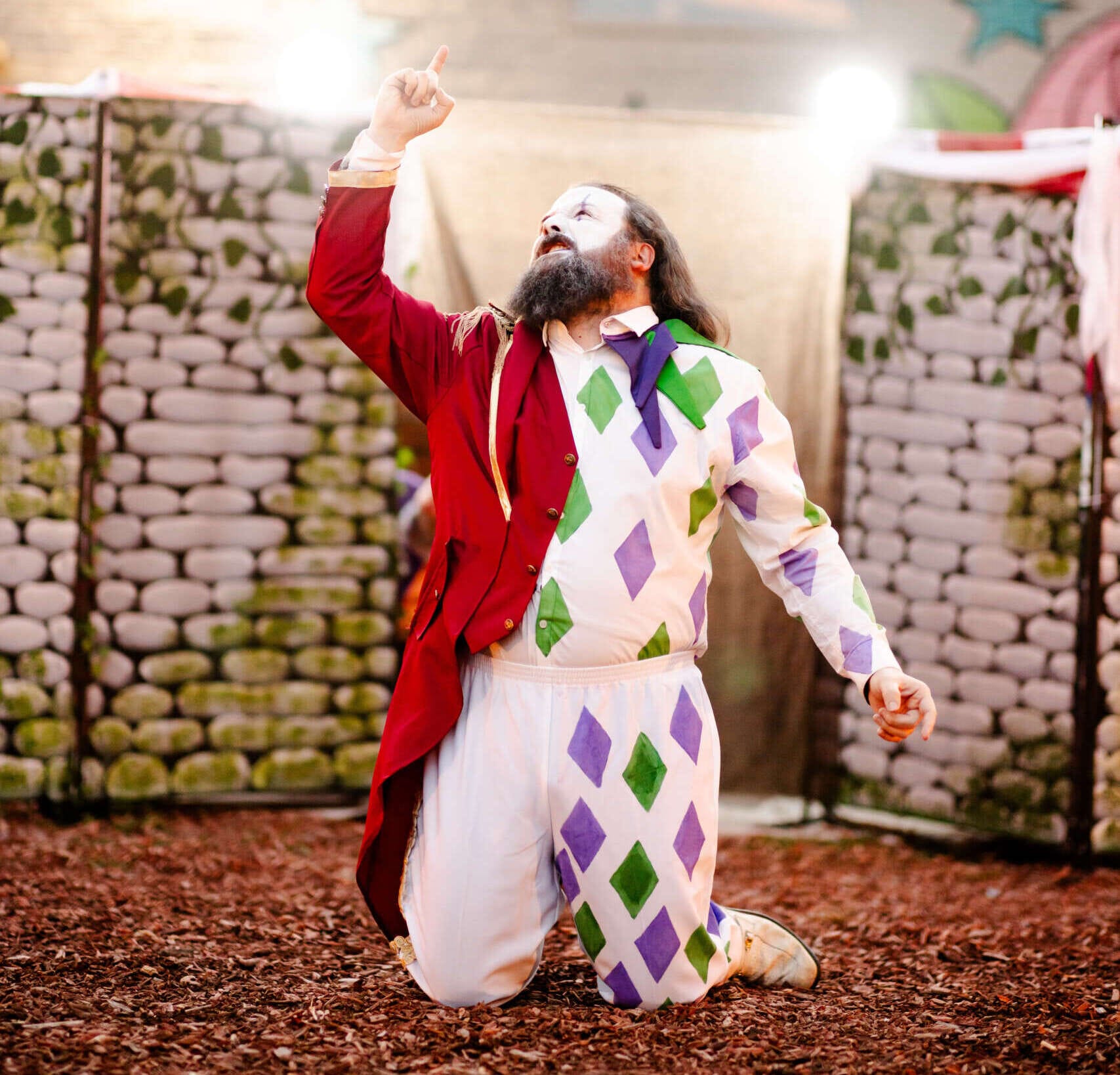
Daniel Mothershed in Bowls with the Bard’s King Lear. | Photo: Jermaine Amado
A kingdom under the big top
To director and sound designer Clove Love’s credit, this is not simply King Lear with some people kind of stoned. Love’s adaptation has a real point of view.
The royal court becomes a circus, with Lear recast as the ringmaster of a dynastic enterprise. His daughters become circus performers: Goneril (Andrea Mérida) is a magician, Regan (Erin Banthoff) is a knife thrower and Cordelia (Adrianna DelPercio) is a human cannonball. Lear has always been about power, flattery and the dangerous need to be adored, so setting the story inside show business makes intuitive sense. Here, the old king is not just dividing a kingdom but dividing up the show.
Love also builds the adaptation around duality, with actors playing paired characters who function as foils. Daniel Mothershed plays both Lear and the Fool. Banthoff plays both Regan and Edgar. DelPercio plays both Cordelia and Gloucester. Mérida plays both Goneril and Edmund.
On paper, the conceit is fascinating. Lear and Gloucester’s mirrored failures as parents become more explicit, and the production’s study guide smartly frames the story as a family business drama, closer to Succession under the big top than a distant lesson about monarchy. In performance, all the switching makes the story tough to get your hands around, despite some solid individual performances.
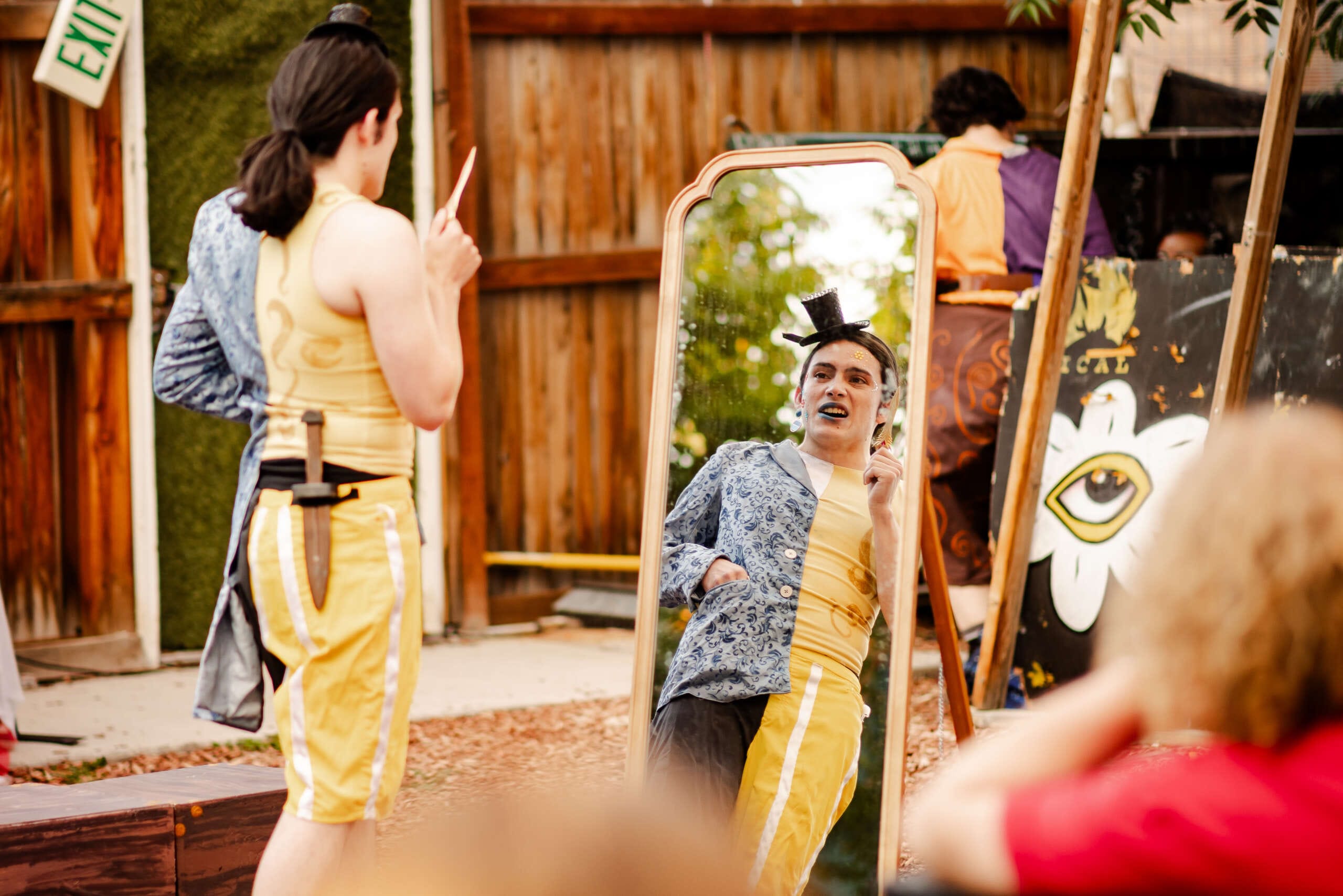
Andrea Mérida in King Lear. | Photo: Jermaine Amado
Mothershed brings a poised, almost ceremonial dignity to Lear, even as the character’s command begins to crack. His Fool, by contrast, has a loose, shaggy, faintly Zach Galifianakis-like energy, giving Lear’s inner contradiction a visible body. The idea that the Fool may be an extension of Lear’s unraveling mind is one of the production’s strongest choices, and Mothershed’s quick shifts between the two roles provide some of the evening’s clearest flashes of purpose.
Mérida deserves equal recognition for one of the evening’s most technically demanding pairings. As Goneril and Edmund, Shakespeare’s two most calculating opportunists, they navigate rapid shifts between characters with impressive clarity. While all performers are tasked with embodying multiple roles, Mérida is particularly adept at signaling which character is present at any given moment, even when switching onstage.
Banthoff also makes a strong impression in a particularly revealing double assignment. Her Regan is cold, clever and cruel. As Edgar, she moves to the opposite side of the play’s moral universe, giving shape to a discarded child forced into exile and madness. DelPercio’s Cordelia and Gloucester pairing is similarly rich in theory: one character tells a painful truth and is punished for it, while the other is deceived because he cannot see the truth in front of him.
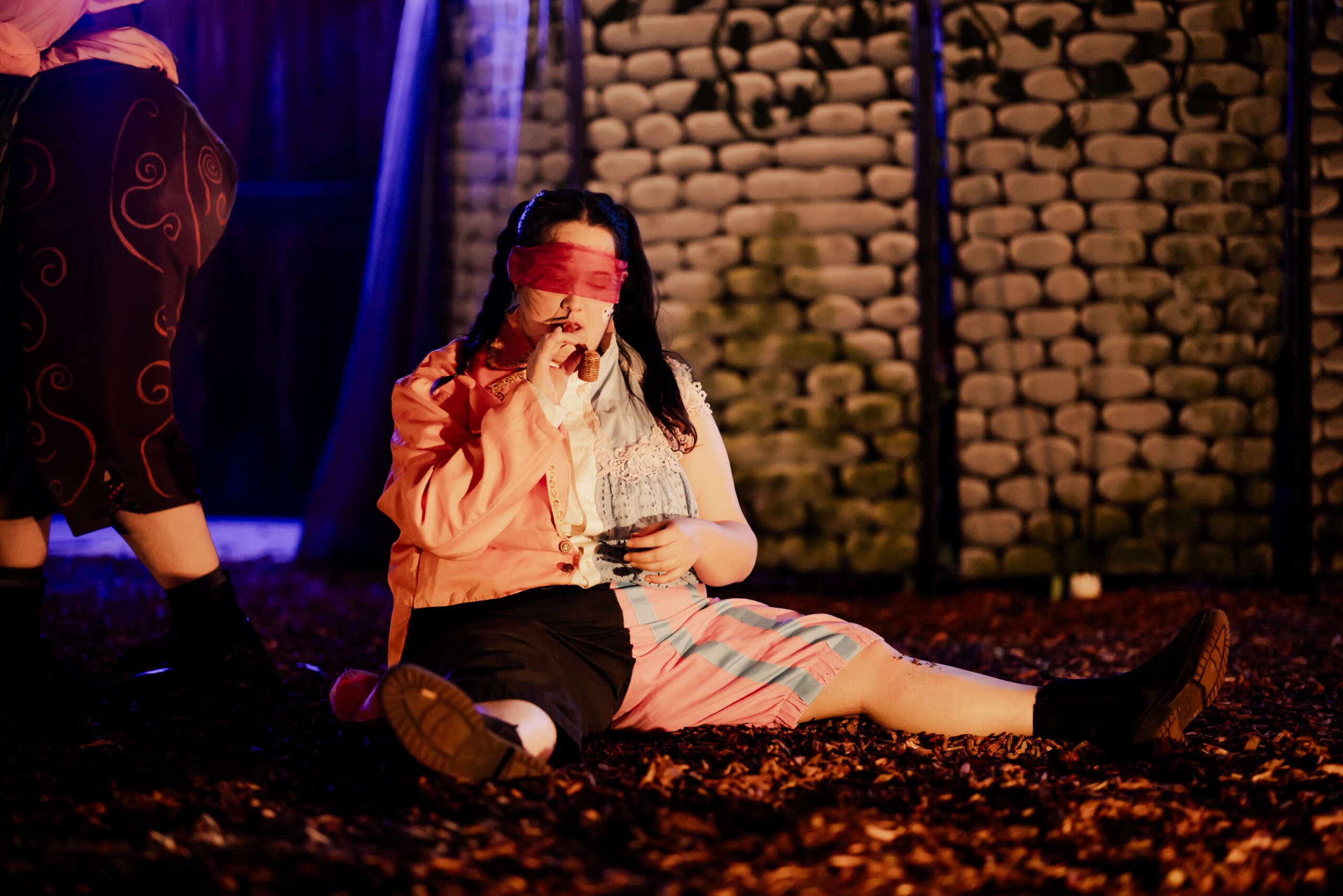
Bowls with the Bard’s King Lear at Tetra Private Lounge & Garden. | Photo: Jermaine Amado
Too many acts in one ring
As previously alluded to, the main issue is that the production frequently obscures its most interesting ideas. Ayden Armstrong’s split costumes and face paint are visually striking, dividing many performers down the center to represent their doubled roles. As a design image, the choice is memorable. As storytelling, it muddies the water.
King Lear already has a large cast, overlapping family structures and multiple betrayals. This adaptation runs about 105 minutes, which means it is also compressing major plotlines at speed. Add the doubling, the circus overlay and costumes that show two identities at once, and even a viewer familiar with Lear can spend too much time simply trying to figure out who is speaking.
Oddly, the production’s swing tradition helps solve that problem. As in other Bowls with the Bard shows, audience members are given noisemakers (here, clown horns), and when a flag is raised, the audience make noise and a swing performer jumps into the scene. Here, those performers enter wearing clear character names, which makes their appearances easier to follow than some of the main action. It is a fun company ritual, and it gives the swings moments to shine. It also suggests a solution the production could have used more broadly: in a concept this layered, there is no shame in labeling the characters.
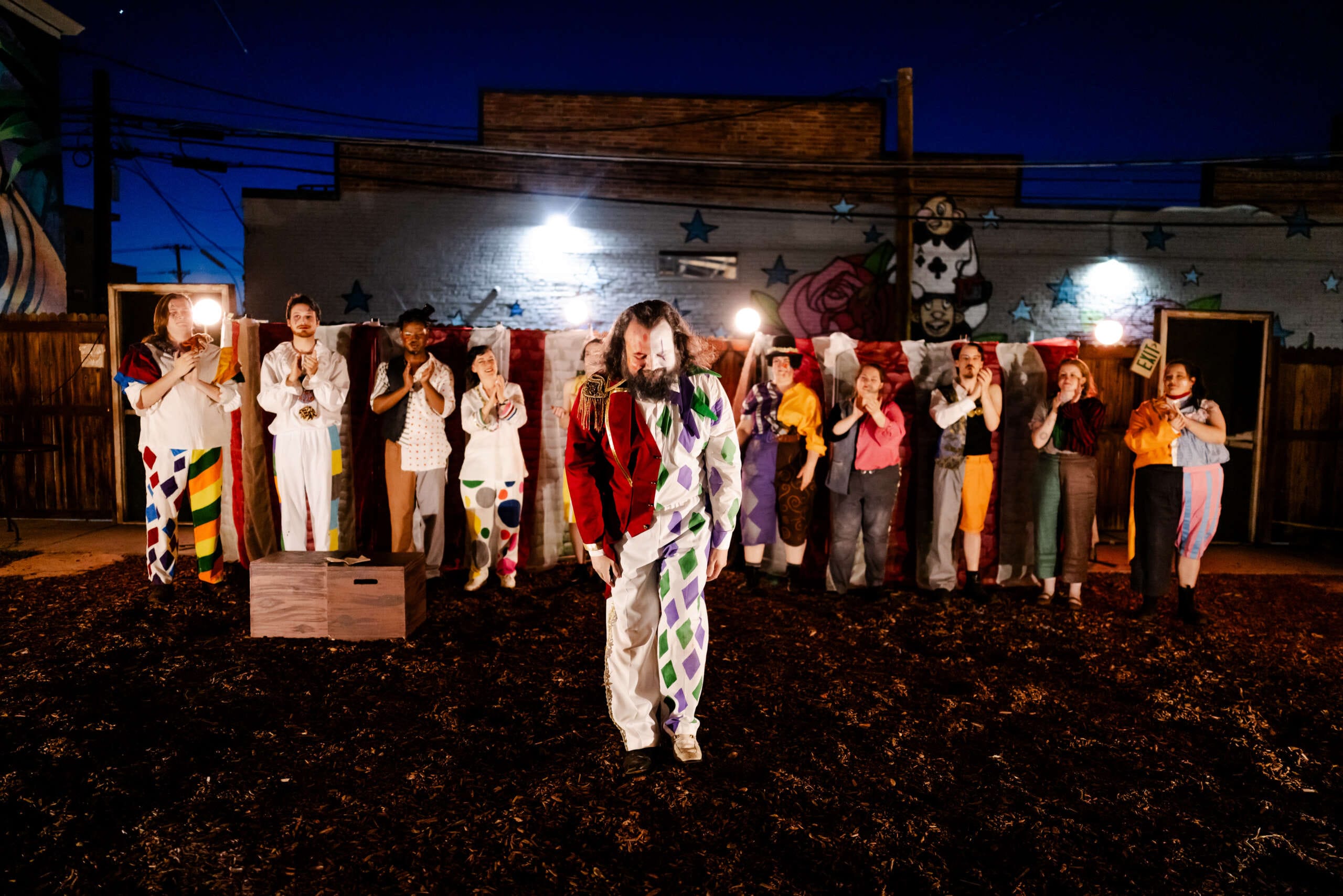
Bowls with the Bard’s King Lear at Tetra Private Lounge & Garden. | Photo: Jermaine Amado
The move outside at Tetra Lounge and Garden serves the show better than the indoor setup did for Bowls with the Bard’s Romeo and Juliet. The outdoor space gives the production a looser, Shakespeare-in-the-park energy, and the simple circus ring helps orient the action. Still, the circus idea often feels more decorative than structural. Beyond the ring, the costumes, the music cues and a few gestures toward lion taming and spectacle, the setting does not always deepen the drama as much as the dramaturgical framing promises.
And yet, Stoned King Lear is not without its pleasures. The cast is committed to Love’s ambitious vision, and the production is never lazy. If anything, it has too many ideas competing for space inside one tent. Bowls with the Bard deserves credit for taking a real swing at Lear rather than settling for an easier joke. If this production is any indication, the company’s experiments with tragedy are only getting more interesting as they continue to reach for higher ground.

An award-winning Colorado arts and culture reporter originally from Mineola, Texas. Tresca is the chief theatre critic for OnStage Colorado and managing editor of OnScreen Colorado. He’s the editor of Bucket List Community News, a contributor to Denver Westword and Estes Valley Voice, a resident storyteller for the Bonfils-Stanton Foundation and the co-host of the OnStage Colorado Podcast.

Good afternoon, Mr. Tresca! I’m glad you enjoyed any of your time with this show and am thrilled you could see how committed we all were to the vision. I did have to inform that, while I appreciate you’d think I have such a keen eye for photography, proper credit should be given to J. Amado, who did an amazing job capturing our work at Tetra and Three Leaches. Hopefully a quick edit may be possible to properly credit the man who captured our work. Thank you!
Hi Andrea! It’s great to hear from you. Thank you for pointing out my mistake. I have updated the article to give Jermaine Amado photo credit throughout.
Rock on, and thank you for seeing the show!