
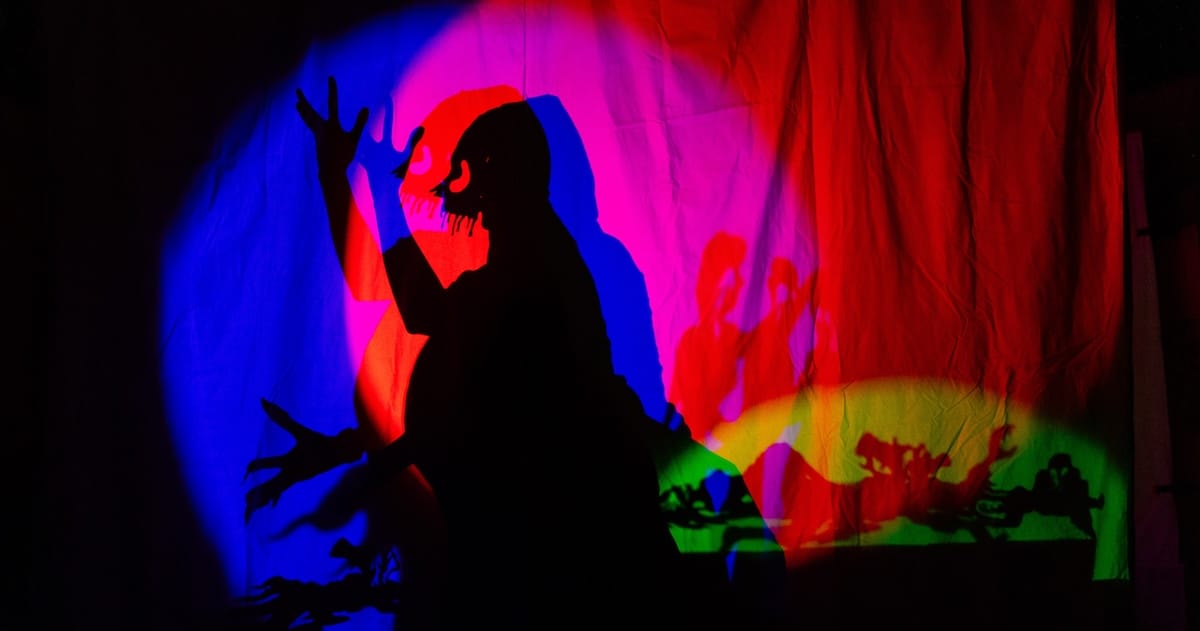
Colorado puppeteer Katy Williams on her self-taught path, why practical beats CGI and what to expect from Saturday’s late-night slam
For one night during the Denver Fringe Festival, the puppets will take over. On Saturday, June 6, puppeteer and designer Katy Williams brings the Rocky Mountain Puppet Slam back to The People’s Building in Aurora for its third year at the festival. It’s a late-night, drink-in-hand variety show of short-form puppetry and object theatre. Expect roughly a dozen five-minute acts spanning shadow puppetry, contact puppetry, stop-motion film and more, capped by a hands-on Puppet Lab where audiences can get up close with the puppets.
Williams, a self-taught puppet artist based in Colorado Springs, created and produces the slam — this will be her 17th — and has spent the better part of a decade making the case that puppetry is a far broader, weirder and more grown-up art form than most people assume. We caught up with her ahead of the show. Some answers have been edited for length and clarity.
The slam
For people who’ve never been, how do you describe a puppet slam?
It’s part cabaret, part variety show, part poetry slam. The one constant is that every act has to involve some kind of puppetry or object theatre — and that’s a wide, wide net. You sit down, grab a drink and watch these five-minute vignettes in totally different styles. I saw my first slam in 2015 at a national puppetry festival and it kind of blew my mind. I’d fallen into the trap of thinking, well, if it’s not a full-length show, why do it? The slam taught me that short-form work is just as beautiful as long-form — and it’s a great place to workshop ideas. You never really know what you’re going to get, but it’s going to be weird and wild and entertaining.
What kinds of acts show up?

Anything, in the best way. This slam has 12 acts — shadow sand painting, shadow puppetry, contact puppetry, hand-and-rod work, stop-motion animation. We’ve got quite a few local films this time, which is exciting. Some people just want to practice lip-syncing with their puppet to Madonna — great, that counts. Some build a whole immersive show in five minutes. That counts too.
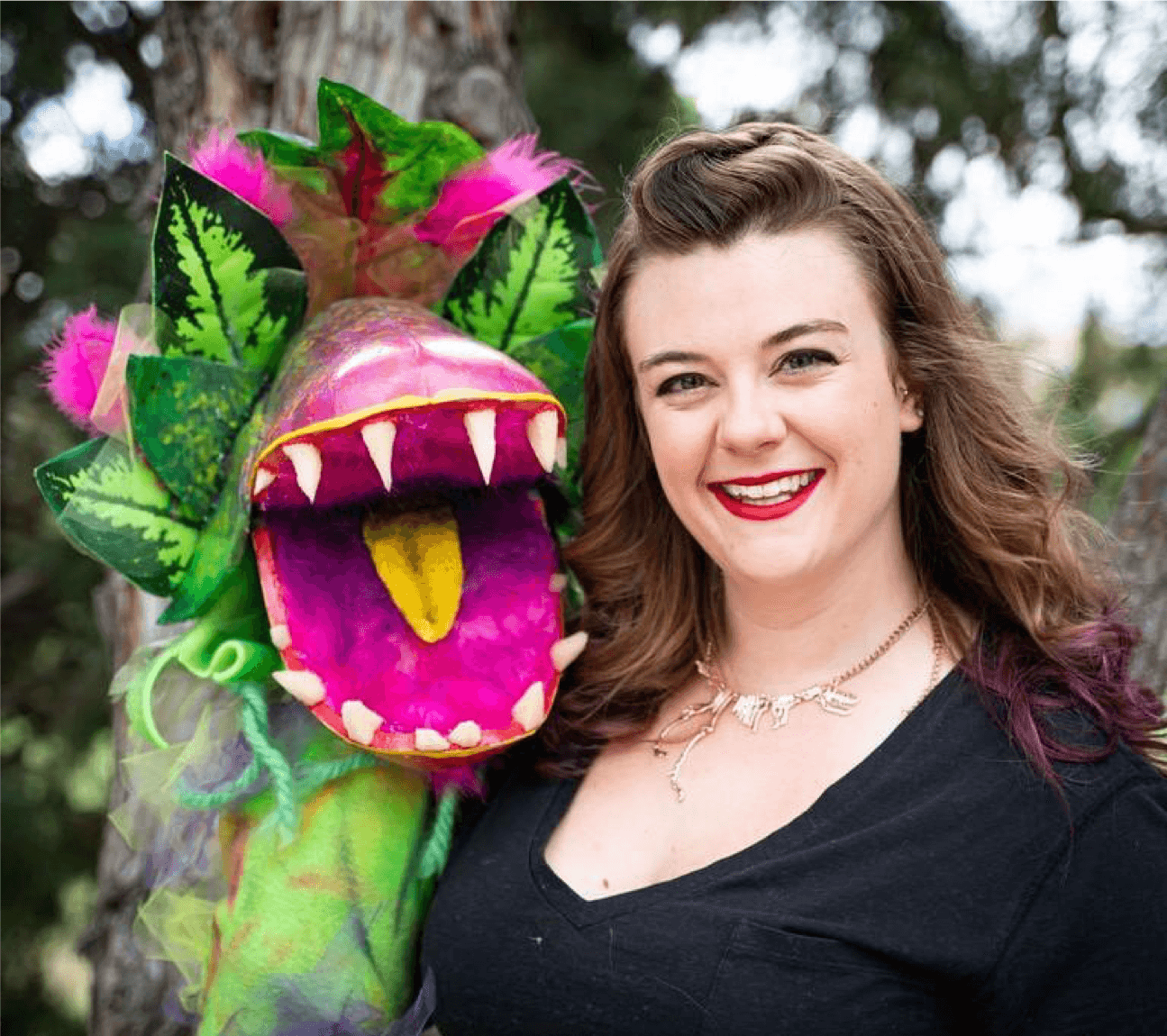
Katy Williams with her ‘Little Shop’ Audrey II puppet. | Photo: Martha Wirth
This is your third year at Denver Fringe. Why is it a good fit?
Fringe has that on-the-edge, funny, avant-garde quality, and puppetry has always had a home there — it’s huge at the Edinburgh Fringe. The slam has the same spirit: We don’t know exactly what we’re going to see, so we grab a beer and find out. There’s a built-in audience drawn to the nitty-gritty, bohemian, artistic stuff rather than the flashy Broadway style, and the slam has all of that.
There’s a Puppet Lab afterward. What is that?
Every slam ends with one. It’s informal — the puppeteers who are willing bring their puppets out into the lobby and let people get up close, ask questions, take pictures, see how a mechanism works. Most puppeteers aren’t precious about their craft and they’re thrilled to tell you about the wild new material they found or how they built a crazy mechanism. The whole mission of the slam is to make puppetry accessible and welcoming, and the lab is a big part of that.
What do you hope someone walks out with — and where do you want to take the slam from here?
My biggest hope is that people realize puppetry is more than what they think it is. When I say I’m a puppeteer, people assume I only do kids’ stuff — I do, but I do a lot more. I want them to see how diverse and how problem-solving an art form it can be: There’s something you can’t physically do on stage, so could a puppet do it? And at the end of the day, just have fun. As for the future, I think it’s right where it needs to be. I’ve run slams for 20 people and slams for 350 in Denver — it morphs to fit the community. It’s less about getting huge and more about being a consistent, safe, welcoming space for the art form to exist.
Katy’s craft
You call yourself self-taught. How did you find your way into puppetry?
I was never a Sesame Street kid, but I was always someone who wanted to bring things to life. In high school I performed a number from Avenue Q — my first time putting a puppet on — and there was something fascinating about being an actor but having to give that energy to something else. I studied theatre and neuroscience at the University of Denver, and any time I had to pick a subject to research, I’d pick puppetry. It culminated in my senior capstone: a giant puppet show with a seven-foot Pegasus and a chimera. I had no idea what I was doing, but it was a blast. A local puppeteer, Cory Gilstrap, gave me a ton of early tips and is still a friend. After that I just absorbed everything I could and started going to the Puppeteers of America national festivals — that was huge. The work I saw there showed me what puppetry can really do as a storytelling device, far beyond Avenue Q or Little Shop.
You’re both a performer and a designer. How do those roles feed each other?
At its core, puppetry is acting — people forget that. To be a good puppeteer you have to be a good actor, and then take everything in your face and body and give that energy to something else. Not everyone can, and that’s fine. It’s also intensely physical, like dancing, with its own warmups and stretches.
On the design side, the first thing I ask a director is: why do you want puppets? There has to be a good why. Is it a gimmick — which is a legit reason — or are you doing something you can’t do with humans, something surreal or bigger than life? Their answer tells me how to design it, and it shapes everything from a rehearsal-heavy shadow piece to a two-month build like The Little Prince.
Is there a style or scale you’re drawn to most?
My favorites are large-scale contact puppetry — what’s traditionally called Bunraku in Japan, where more than one person operates a single creature and you have to work together to bring it to life — and shadow puppetry of all kinds. I love making something built out of foam feel real and tactile, like it has breath. The two things I haven’t done are ventriloquism and marionettes; I just haven’t found a marionette mentor yet.
What’s it like teaching actors to puppeteer? Do some just not get it?
Both. You can have the best actor in the world, but if they’re missing that instinct to give their energy to something else, it can be tricky — though it can be learned, and that’s a big part of my job as a puppet director and consultant. I strongly recommend companies hold a puppetry call at callbacks. If there’s puppetry in the show, why wouldn’t you, the same way you’d hold a dance call? You can spot the spark quickly. People who are very movement-based tend to take to it fastest.
It feels like puppetry is having a moment. How healthy is the community?
It’s growing. When I started the slam in 2018, people came out of the woodwork — a lot of them didn’t realize there was a community. In 2020 we re-chartered the Rocky Mountain Puppetry Guild under Puppeteers of America, which gave people a Google-able home, a website, a place to find resources. There’s also been a real rise in puppetry in the cultural zeitgeist. It started with Baby Yoda — people lost their minds and couldn’t explain why they loved him so much. Part of the reason is that he was a real puppet, not CGI, and you can feel that. We’d been in CGI land so long that coming back to practical effects hit people. The original Jurassic Park holds up because it blended practical puppetry — that sick triceratops is entirely a puppet — with brand-new CGI. The later films lean all-CGI, and you feel the difference.
Does that give you hope about AI?
It does. You can’t fake a puppet performance happening live in front of you. You can’t fake live theatre, period. Puppetry needs humanity in order to exist — it’s what we’ve done at the fireside forever, telling stories with our hands and our shadows. The technology shifts around it, but that human element isn’t going away. That’s my anti-AI platform.

Alex Miller is editor and publisher of OnStage Colorado. He has a long background in journalism, including stints as the top editor at the Vail Daily, Summit Daily News, Summit County Journal, Vail Trail and others. He’s also been an actor, director, playwright, artistic director and theatre board member and has been covering theatre in Colorado since 1995.

Leave A Comment