
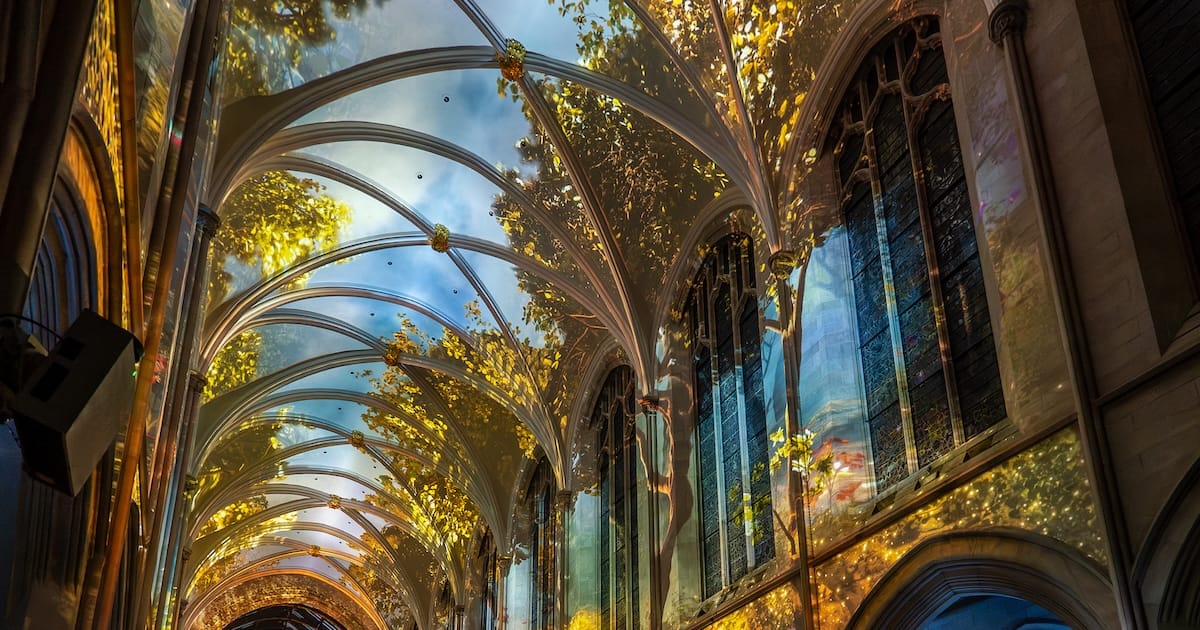
A music, light and projection spectacle from Paquin Entertainment Group and Montreal’s Normal Studio transforms the historic cathedral into an immersive canvas
If churches had this kind of thing going on during the offering, they’d never want for money again.
I’m talking about Celestia, the music, light and mapped projection show now up at Denver’s St. John’s Cathedral. It’s an inspired idea: Find an impressive interior space like a cathedral, mount a bunch of lights and projectors on the towering columns and invite people in to see the show accompanied by ethereal music and a live chorus.
Slightly reminiscent of those laser light shows once staged at every observatory, Celestia ups the ante tenfold with the use of much more sophisticated tech to paint complex 3D pictures. They’re also projecting it all onto the uneven surfaces of the walls and ceiling and somehow coming away without any of the detail getting distended or lost on this living canvas. In fact, the whole thing was mapped specifically for St. John’s — designed by architects Tracy & Swartwout and built at the start of the 20th century — with lights running up and down the crisscrossing vaulting and arches of the ceiling and down the towers.
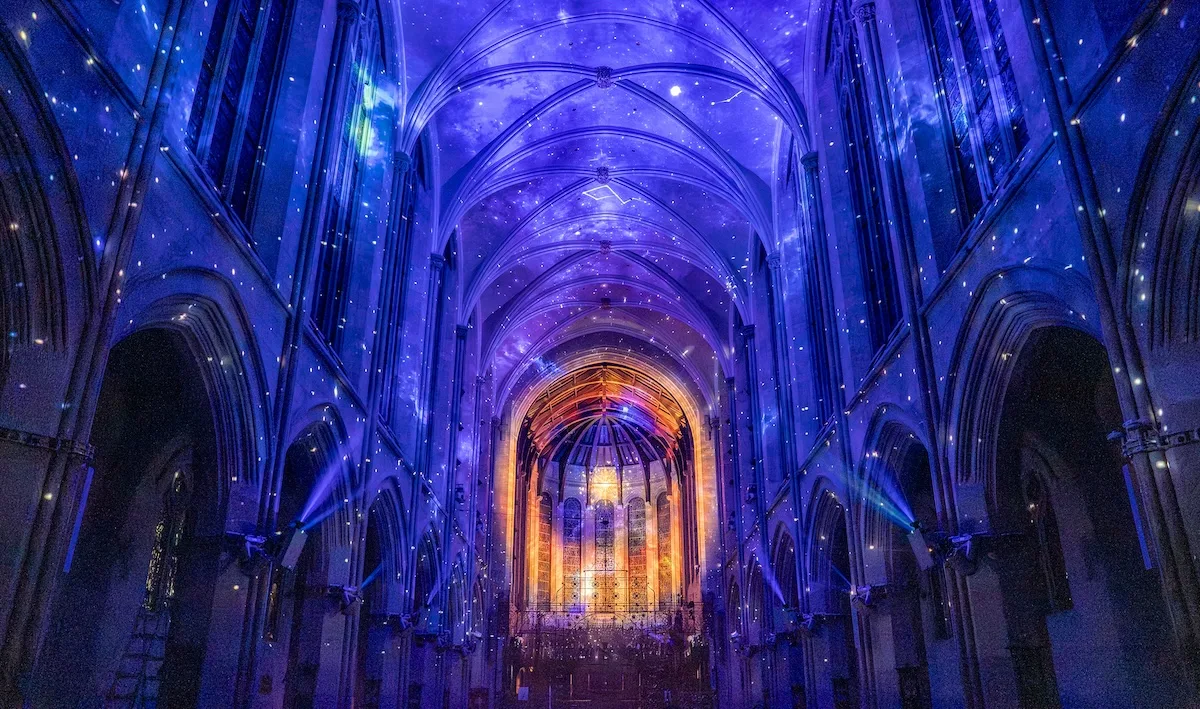
‘Celestia’ uses the interior of the cathedral as a canvas. | Photo: Brent Andeck
Overwhelming the senses
Celestia is a lot to take in over its 45-minute runtime. The experience is divided into five parts: “Awakening,” “Becoming,” “Transformation,” “Belonging” and “Radiance.” On the website they’re associated with some kind of storyline, but you’ll be forgiven if the meaning eludes you as you’re wowed by the content.
At one point the audience is made to feel like they’re at the bottom of a lake, and an enormous animal pushes its snout through the surface above to get a drink. Flocks of birds fly overhead, a cascade of enormous jewels descends the walls and the space transforms from a starry night to a wooded glen. At times the projections are more abstract, often “painted” with thematic colors. In general the theme is aimed at being universal and uplifting, and on that note it succeeds nicely.
One of the most striking images to me was how the phalanx of carvings behind the altar were repeatedly lit up in different colors. Though a modest effect tech-wise compared to many of the others, it gave an eerie dimension to the otherwise upbeat program.
Meanwhile, the recorded orchestral music is paired with the action — sometimes accompanied by an eight-member choir singing live. (Note that the live singers perform only on Friday and Saturday nights.)
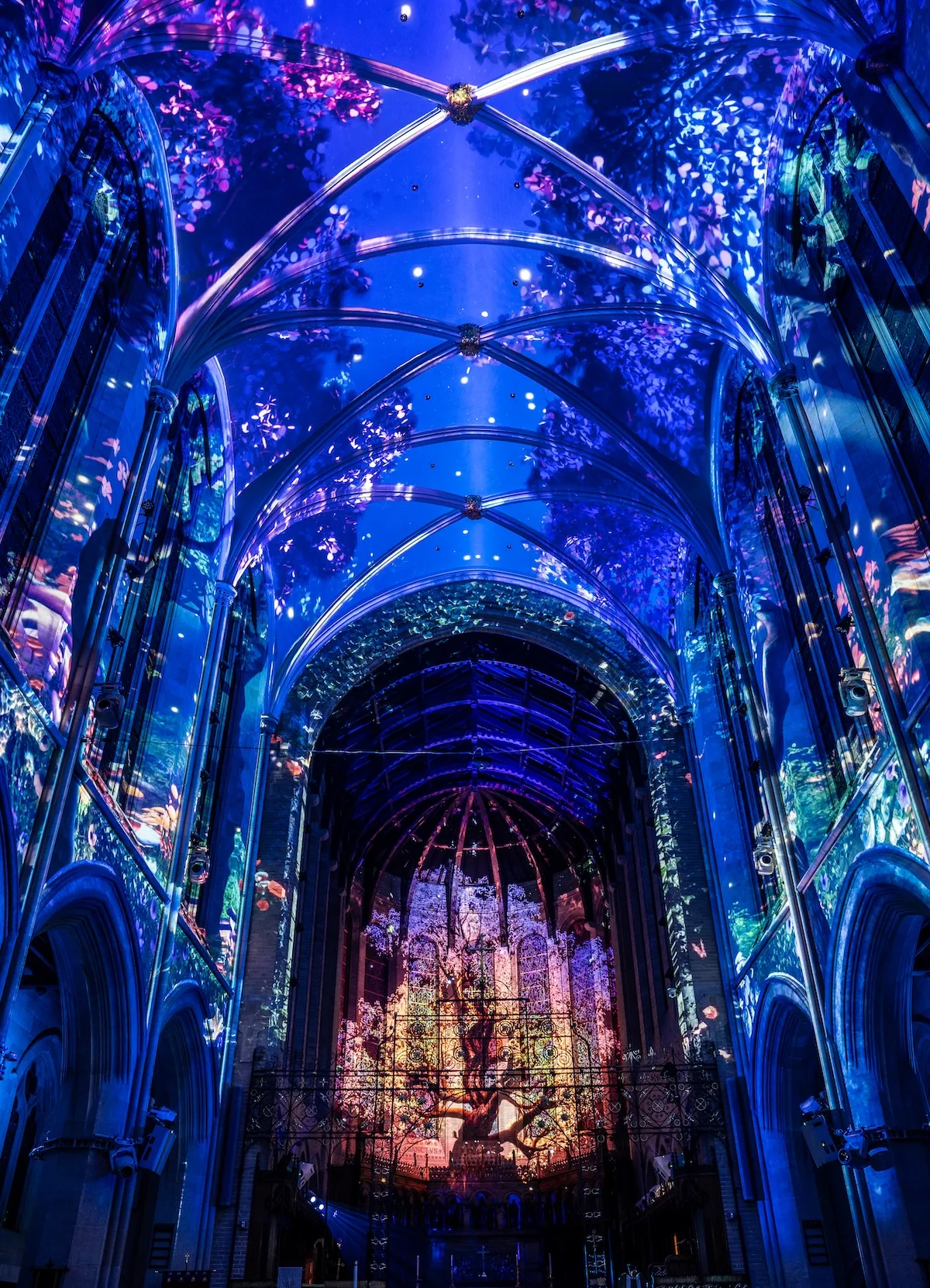
Photo: Brent Andeck
The experience
Celestia is highly immersive but not interactive. Audience members are seated in chairs in the main nave area of the cathedral, and you’ll likely find yourself looking up at a 45-degree angle. The best seats are near the middle, where you can better see everything blossoming from the apse at the front. (You won’t need to turn around — anything behind you has already passed overhead.)
By virtue of the somewhat mystical realm of the 1911 cathedral, the lights and music, some might feel the experience to be on the spiritual side, although there’s no hint of religion in the program. Others may spend a lot of time wondering “how’d they do that?” as some seemingly impossible images appear overhead and on the walls. While suitable for all ages, I’d guess children would be especially impressed by the effects, and the short showtime will keep the wiggling to a minimum.
Celestia only runs about 45 minutes, and the ending seemed a bit abrupt. That led audience members on the night we attended to look around wondering “is it over?” General admission tickets for adults are $29 ($44 for the premium reserved seats), which raises the question of whether it’s worth it.
It’s hard to say, given how unique the experience is, although I did feel the absence of any other kind of attraction or activity that might’ve made it into a more well-rounded event or destination. The runtime, though, seemed appropriate given the neck craning and the fact that, despite the whiz-bang effects, it can start to feel like you’ve seen the full bag of tricks after the 30-minute mark.
Billed as a world premiere for Denver, Celestia was created by Paquin Entertainment Group and Normal Studio, a creative studio based in Montreal. It seems like a great idea for big, often-empty spaces like cathedrals to see some activity and revenue. Presumably the show will move on to other cities after the Denver run ends in September. While it’s here in Colorado, it’s worth checking out — a novel experience the whole family should enjoy.

Alex Miller is editor and publisher of OnStage Colorado. He has a long background in journalism, including stints as the top editor at the Vail Daily, Summit Daily News, Summit County Journal, Vail Trail and others. He’s also been an actor, director, playwright, artistic director and theatre board member and has been covering theatre in Colorado since 1995.

I’m a bit confuse So is their a choice. Of different kind of music style. Like candlelight ? Or don’t matter what day. It’s always the same. Knowing. That on weekend. The eir is a choir. And during the week. No choire. But maybe a sound track. ?