
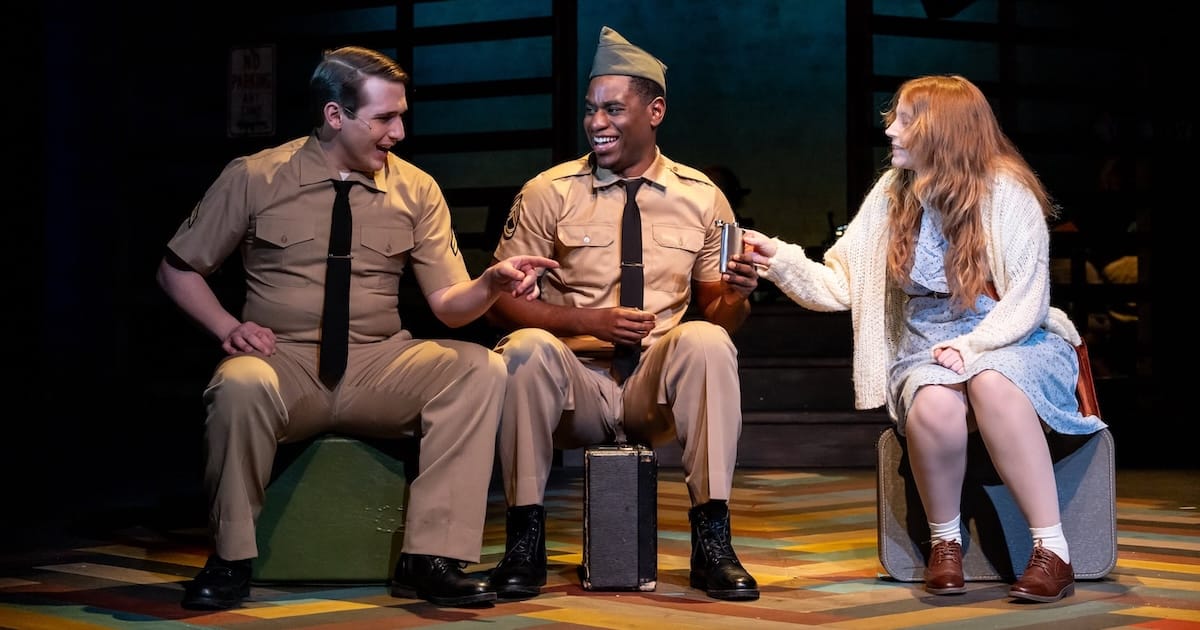
Aurora Fox and Phamaly bring vocal power and nuance to a messy, moving Violet.
The musical Violet is an imperfect story about the peril of believing that perfection will save you.
That makes it a fascinating choice for Phamaly Theatre Company, the disability-affirmative company co-producing the show with the Aurora Fox Arts Center. Based on Doris Betts’ short story “The Ugliest Pilgrim,” the musical follows Violet (Katelyn Kendrick), a young North Carolina woman traveling by bus across the American South in 1964 to reach a televangelist she believes can heal the facial scar left by a childhood ax accident.
This production, directed by Ben Raanan, does not turn Violet’s scar into a visual spectacle; rather, like all major productions of Violet since its debut off-Broadway in 1997, it focuses on the character’s internalized shame rather than the grotesqueness of a physical scar. In Phamaly’s hands, that choice takes on additional resonance. The question is not whether Violet looks scarred enough to justify her pain. The question is what happens when someone has been taught to experience their own body as something that needs to be fixed.

Aurora Fox and Phamaly do not solve all of Violet’s problems as a musical. The show’s treatment of race can feel simplistic, and its characters are often thinner than Jeanine Tesori’s gorgeous score deserves. Yet the production approaches the material with enough care and vocal prowess to make this unusual, rarely staged musical feel worth the trip.
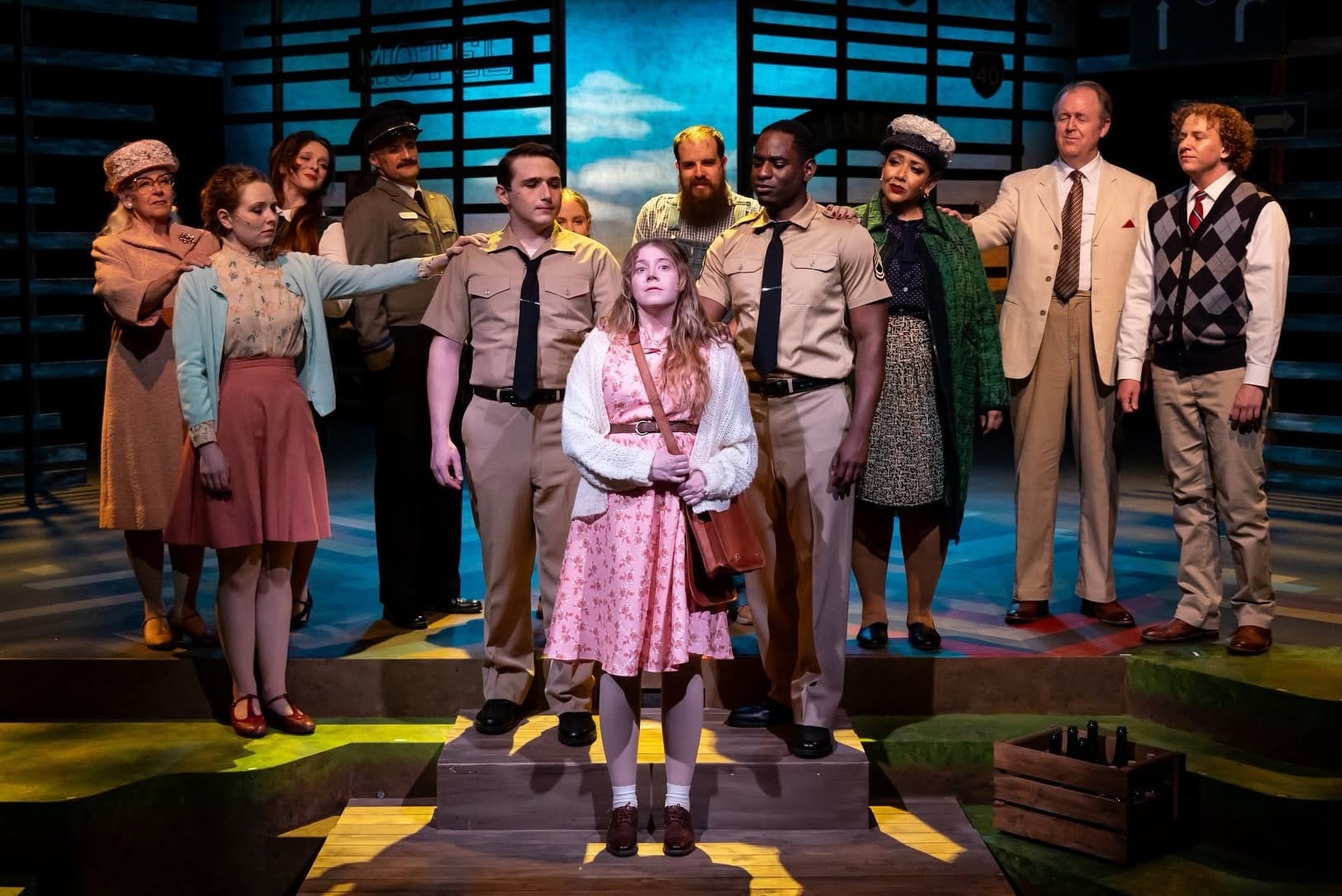
The cast of Violet at the Aurora Fox Arts Center. | Photo: RDGPhotography
Rarely staged show
Violet is not one of the better-known titles in the modern musical theatre canon, though its pedigree is substantial. It premiered Off-Broadway in 1997, winning the Drama Critics’ Circle Award and Lucille Lortel Award for Best Musical, before receiving a revised Broadway production in 2014. In Colorado, the musical made its regional premiere at the Arvada Center in 2000 and was last produced locally by Town Hall Arts Center in 2016.
Jeanine Tesori’s score blends folk, gospel, blues and American roots music, while Brian Crawley’s book and lyrics move between Violet’s present-day bus trip and memories of her childhood with her father. Along the way, Violet befriends two soldiers: Monty (Adam Johnson), a white serviceman whose flirtation is immediate and uncomplicated, and Flick (Rakeem Lawrence), a Black soldier whose connection with Violet develops more slowly.
As the three travel through the segregated South, the musical weaves Violet’s search for healing with a tentative love triangle and flashbacks, which Raanan stages with exceptional clarity. The strongest of these moments allow adult Violet and Young Vi (Meika Qutub) to occupy the same emotional space without overexplaining their connection.
“Luck of the Draw,” which pairs a poker game between Violet, Flick and Monty with Young Vi learning cards from her father, is one of the production’s sharpest sequences. The parallel action gives the number momentum while deepening the sense that Violet’s past is never really past.
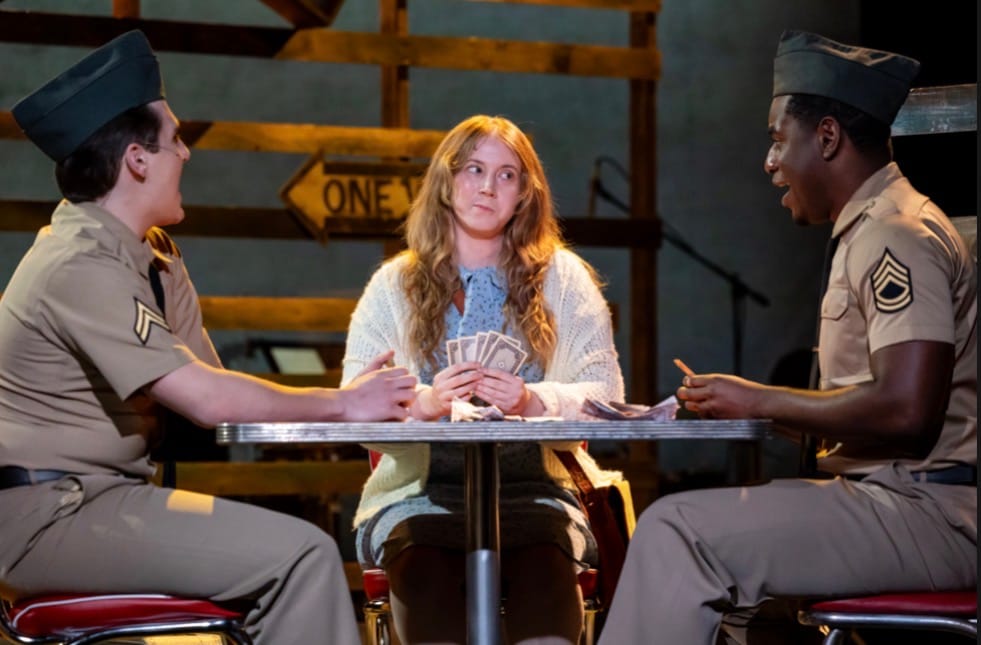
Adam Johnson, Katelyn Kendrick and Rakeem Lawrence in Violet. | Photo: RDGPhotography
Nick Renaud’s scenic design gives that journey a sturdy, evocative frame. License plates line the edges of the playing space, highway signs mark the route and neon diner and motel signs flicker to life as Violet moves from one stop to the next. A changing rest stop sign aids in navigation, and captions are integrated into the upper left of the set, serving as a reminder that accessibility is built into the production’s design.
Kendrick gives Violet an emotionally messy, guarded and often searing center. Their Violet is not simply wounded or wistful; she is prickly, impatient and so trapped inside her own shame that she often misses what is happening directly in front of her. Kendrick’s voice is lovely and expressive, especially in “Water in the Well,” “Surprised” and the aching “All to Pieces.” In “Look at Me,” Violet’s confrontation with the father who could never fully face what happened to her becomes one of the evening’s most gut-wrenching moments.
Trenton J. Schindele is also excellent as Father, playing him as a damaged, grieving man whose love and failure have become dangerously entangled. Qutub portrays Young Vi with a clear voice and open vulnerability, making the childhood scenes feel specific and grounded rather than merely symbolic.
Johnson brings charm and a lovely voice to Monty, the swaggering white soldier whose interest in Violet never fully grows beyond desire and ego. Lawrence’s Flick is charismatic, cool and collected, especially when handling the racist slights he encounters along the way. Vocally, his solo moments in “Let It Sing” and parts of “Hard to Say Goodbye” were less confident than the rest of the ensemble, which stood out due to the production’s overall high musical standard.

Adam Johnson, Rakeem Lawrence and Katelyn Kendrick in Violet. | Photo: RDGPhotography
Compelling cast inside a strange musical
The difficulty with Violet is not the production so much as the musical itself. Crawley and Tesori give the show several terrific numbers, and Raanan’s cast delivers many of them with conviction. “On My Way” makes a lively early case for the score’s traveling spirit, while “Anyone Would Do” gives the Memphis sequence a welcome jolt of humor and heat. Anna Maria High, as Lula, nearly walks away with the show during “Raise Me Up,” backed by a gospel choir that gives the production some of its most thrilling vocal moments.
The characters, however, are often thinner than the songs they sing. Characters on the bus and at the church are stereotypically rendered. Monty and Flick function largely as competing possibilities in Violet’s journey rather than fully realized people with lives that extend beyond it. Even Violet herself can feel constrained by the musical’s focus on her wound. We learn a great deal about how the scar has shaped her self-image, but less about who she is when she is not measuring herself against it.
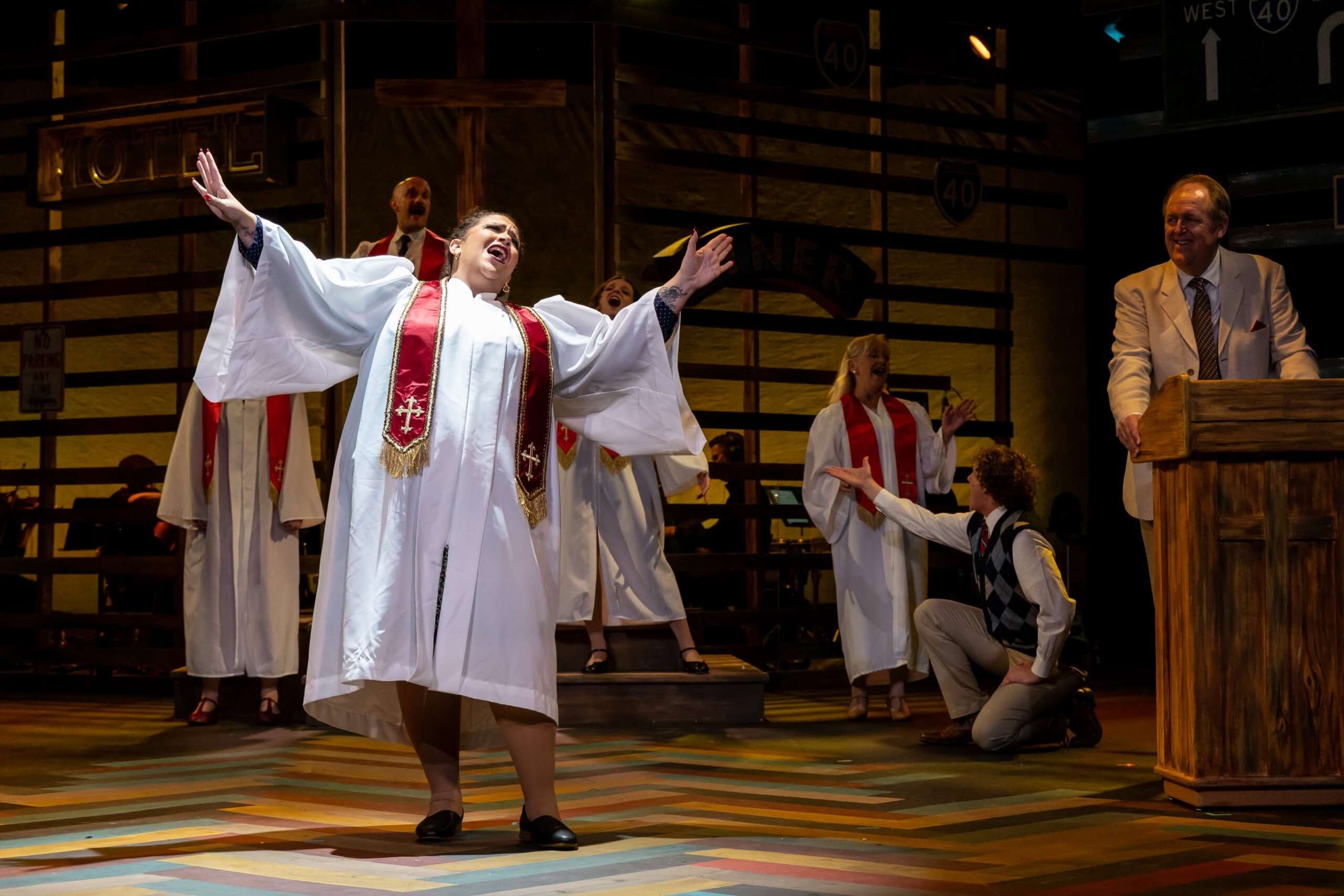
Violet at the Aurora Fox Arts Center. | Photo: RDGPhotography
The show’s treatment of race is also one of its more awkward elements. Violet sees her own ostracism as parallel to Flick’s experience as a Black man in America, and while the script allows Monty to call out that comparison, the musical still ultimately depends on the idea that Violet and Flick recognize each other as fellow outcasts. There is truth in the way different forms of exclusion can create unexpected intimacy. Yet in 2026, the show’s attempt to place a white woman’s facial disfigurement alongside the realities of anti-Black racism feels a little too neat and underexamined.
That discomfort is not something the Aurora Fox and Phamaly production can entirely solve. What it can do, and often does, is stage the material with enough care that the audience can sit with the messiness rather than pretend it is not there.
The production’s biggest structural misstep is the intermission. Many productions of Violet are performed in one act, and this staging might benefit from that uninterrupted momentum. Here, the break comes after the “Anyone Would Do” reprise, following Violet and Monty’s encounter at the motel. It is an awkward place to stop, partly because the scene is already slipping between fantasy, memory and literal action. Rather than heightening the moment, the pause highlights the flaws in the show’s script.
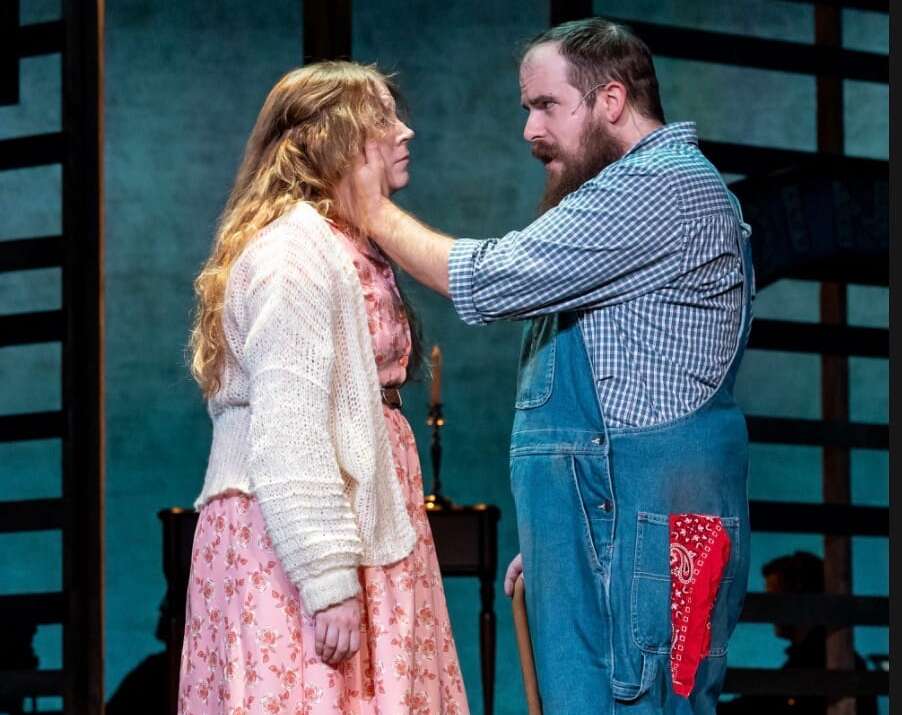
Katelyn Kendrick and Trenton J. Schindele in Violet. | Photo: RDGPhotography
Still, this is a handsome, thoughtfully staged and vocally strong production of a musical that rarely gets produced locally. Brett Maughan’s lighting moves fluidly between bus depots, diners, memory and revival spectacle, while Alexandra Ligh’s period costumes are dashing. Curt Behm’s sound design supports the score cleanly, and Heather Iris Holt’s music direction gives the ensemble a strong, cohesive sound.
Violet is still a slightly off-kilter musical, but despite its flaws, this production lands with surprising force. Aurora Fox and Phamaly understand that the musical works best when it leans into its messiness, trusting its emotional core, committed cast and Tesori’s score to carry the journey.

An award-winning Colorado arts and culture reporter originally from Mineola, Texas. Tresca is the chief theatre critic for OnStage Colorado and managing editor of OnScreen Colorado. He’s the editor of Bucket List Community News, a contributor to Denver Westword and Estes Valley Voice, a resident storyteller for the Bonfils-Stanton Foundation and the co-host of the OnStage Colorado Podcast.

Flick was always off key, or flat. he was the weak point of the show. He should have just spoken the songs, When he sang solo, it brought down the quality of the show.