
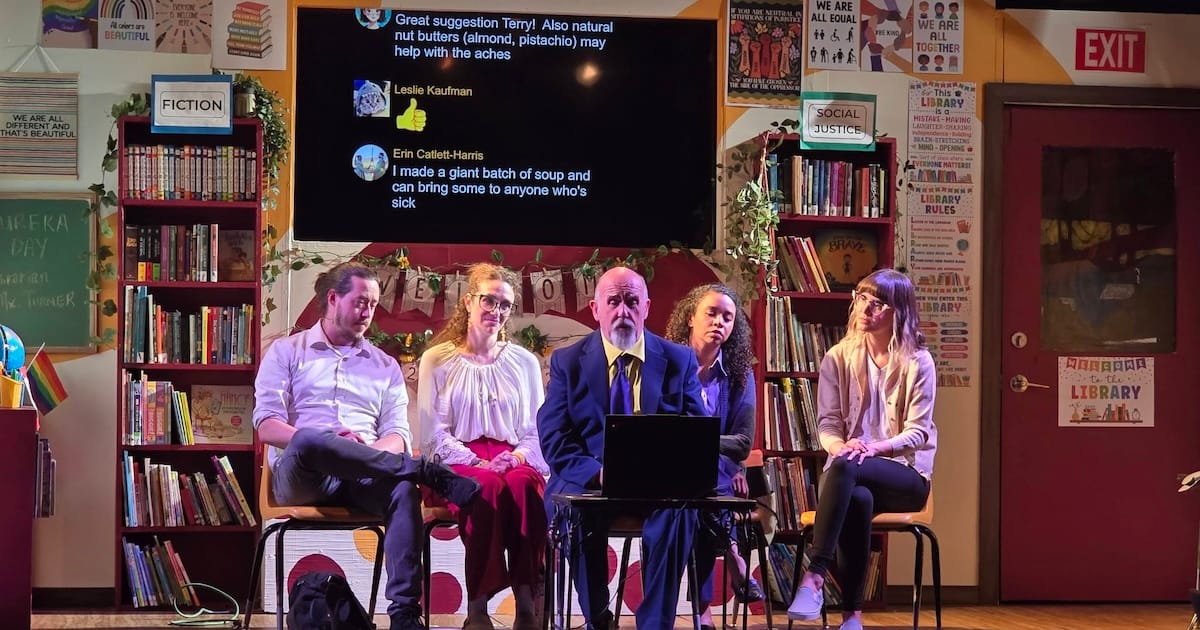
Jonathan Spector’s school-board satire thrives in The Fifty-Niner’s close quarters.
As Springs Ensemble Theatre opens Eureka Day, national political conversations are once again circling the excesses of the “Woke 1” era: that late-2010s-through-pandemic period when progressive language could make complicated questions feel as though they had morally obvious answers.
Jonathan Spector’s 2018 comedy lives squarely inside that world. At Eureka Day, a progressive private school in Berkeley, CA, inclusion is bedrock policy and every decision is made by consensus. Then a mumps outbreak forces the board to reconsider its permissive vaccination policy, and the language its members use to avoid excluding anyone begins to buckle under a problem that may actually require exclusion.
That tension makes Eureka Day feel remarkably fresh in 2026, and director Jodi Papproth’s up-close, sharply acted production at the Fifty-Niner Speakeasy is a damn good argument for revisiting it now.
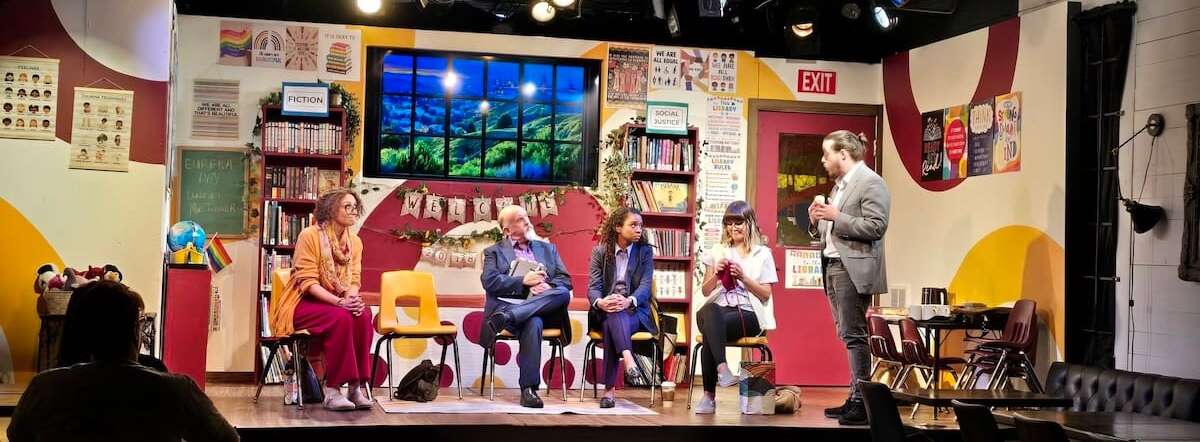
A scene from SET’s Eureka Day in The Fifty-Niner. | Photo: Jodi Papproth

A library with nowhere to hide
The Fifty-Niner, hidden inside the Dice Guys Game Store in Old Colorado City, provides Papproth with a tight, slightly elevated playing space. Creston Cooper’s scenic design believably depicts a school library filled with cheery educational posters, a fiction and social-justice section and those unmistakable plastic classroom chairs. Audience members sit only feet away, effectively completing the room.
Curious Theatre Company’s Denver staging last year had enough room to build out a fuller library, making the institution itself loom larger. SET — arguably Colorado Springs’ closest counterpart to Curious in its appetite for provocative contemporary writing — produces a different sensation. Here, it feels as though somebody pulled up an extra chair and made the audience part of the board.
Papproth builds the production around a remarkably balanced five-person ensemble. No single personality overwhelms the room; instead, each actor brings a specific temperament, physicality and relationship to the school’s values. That balance becomes increasingly important as the debate escalates, allowing sympathies to shift and keeping Spector’s argument from hardening into an easy ideological binary.
Stephen Alan Carver gives principal Don a twitchy geniality, forever reaching for a joke, a bylaw or a procedural maneuver that might keep the room from detonating. Carla Brown’s Carina, the newest board member, initially absorbs the group’s well-intended micro-aggressions with restrained reactions before gradually taking up more space. Brown makes that transition persuasive without sanding down Carina’s own capacity for cruelty.
Ali Burrow faces the hardest assignment as Suzanne, whose mistrust of immunizations could easily be flattened into a punchline. Instead, Burrow makes her sincere and recognizable. When challenged, Suzanne seems to fold slightly inward before gathering herself to continue. Her second-act account of the experience that shaped her beliefs succeeds because Burrow never asks us to agree with Suzanne, but rather forces us to recognize the human being making the argument.
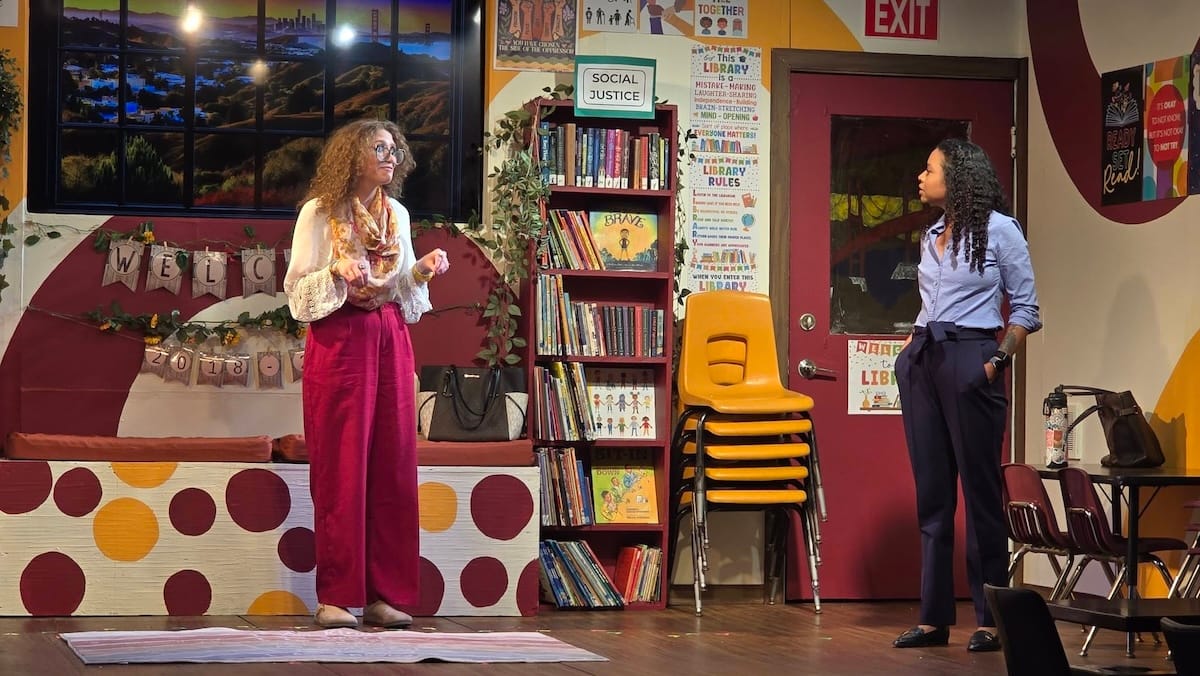
Ali Burrow and Carla Brown in SET’s Eureka Day. | Photo: Jodi Papproth
When certainty starts cracking
Kegan Pike and Lachlan Bentley supply the production’s messier emotional current as Eli and Meiko, parents whose affair becomes harder to compartmentalize as their children get sick.
Pike initially gives Eli the buoyancy of a wealthy tech guy accustomed to problems having solutions. Once his child lands in the hospital, that confidence evaporates. Bentley, meanwhile, gets one of Spector’s most clarifying passages when Meiko finally wonders whether everyone might need enough humility to consider the possibility that they are wrong. Her outburst feels spontaneous, almost embarrassing in its vulnerability, before she realizes how much she has revealed and bolts.
Papproth’s production does have a few clumsy edges. The opening meeting feels slightly too nervy for people who should be thoroughly acquainted with one another, tipping the coming discord early.
A few transitions also drag. The most conspicuous arrives late, when the stage-management team removes Suzanne’s donated books from the library. The image makes sense: someone who helped build this community is being erased from its physical environment. Yet the blackout lasts so long that the symbolism lands, waits around and then explains itself again.
Those moments stand out largely because the rest moves so well once the outbreak takes hold.
The first-act video meeting is the obvious high point. Kitty Robbins’ projections filling the screen with increasingly hostile parent comments while the actors press onward through the laughter. The timing is precise, and the scene lets Spector’s central contradiction explode: a community built around hearing every voice discovers that listening to everyone can become its own form of paralysis.
That scene gets at what makes Spector’s writing worth reviving now. He does not construct an easy villain or hand one side the moral victory. People behave cruelly. Good intentions curdle. Even appeals to compassion can become weapons. Papproth and her actors preserve that complexity by making each position feel lived in.
By the end, the most uncomfortable seat in the school library belongs to anyone still convinced they know exactly who was right.

An award-winning Colorado arts and culture reporter originally from Mineola, Texas. Tresca is the chief theatre critic for OnStage Colorado and managing editor of OnScreen Colorado. He’s the editor of Bucket List Community News, a contributor to Denver Westword and Estes Valley Voice, a resident storyteller for the Bonfils-Stanton Foundation and the co-host of the OnStage Colorado Podcast.

Leave A Comment