
Bekah Brunstetter’s dramedy about queer love and faith receives a stimulating staging in Denver.
As Pride celebrations begin across the country this June, Firehouse Theater Company’s production of The Cake offers a sharp reminder of why Pride remains necessary in the first place.
Bekah Brunstetter’s play, which received its regional premiere at Curious Theatre Company in 2018 during another contentious moment for LGBTQ+ rights, returns to Denver at a time when the central argument no longer feels safely historical. According to Gallup’s most recent polling, 29% of Americans still say marriages between same-sex couples should not be recognized by the law as valid, with the same rights as traditional marriages. The Cake takes that number out of the abstract and places it inside a bakery.
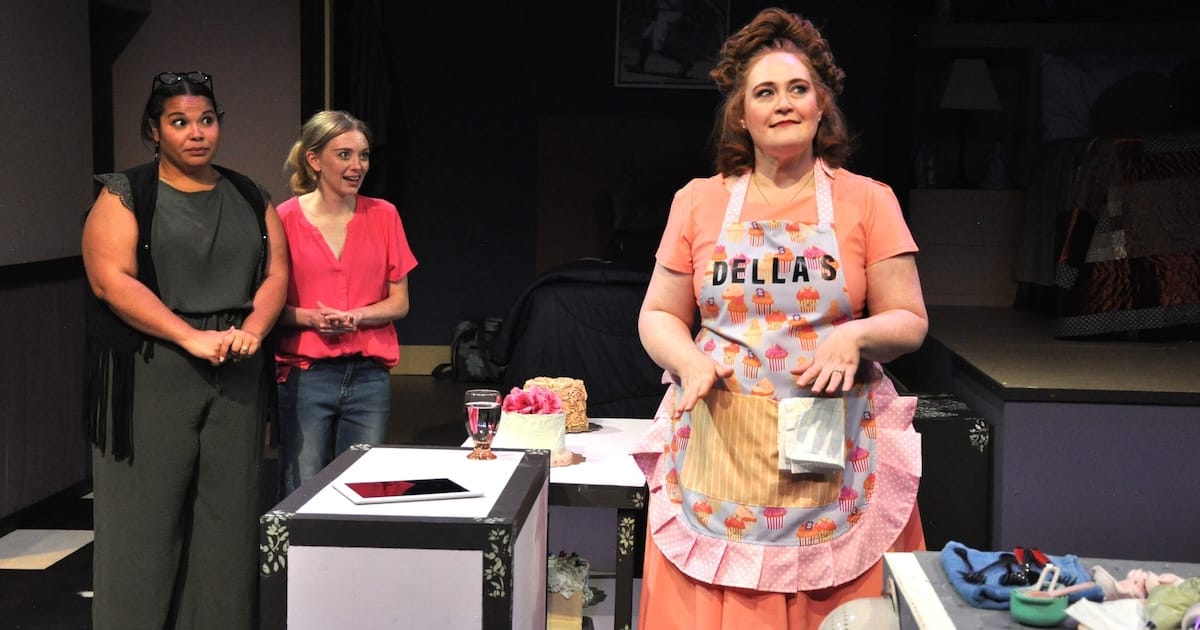
Directed by Troy Lakey, Firehouse’s production is a provocative, often devastating four-hander that resists turning any of its characters into easy symbols. At first glance, the premise sounds almost too neat. Della (Kelly Uhlenhopp), a conservative North Carolina baker, is asked to make a wedding cake for Jen (Nicole Kaiser), the daughter of her late best friend. The complication is that Jen is marrying Macy (Jessica Eckenrod), a Black journalist from New York who has little patience for Southern niceties or Della’s refusal to say directly what she believes.
That refusal is baked into the play from its opening moments. Della begins with what appears to be a cheerful monologue about the importance of following directions. If you want a cake to turn out right, she insists, you should follow the recipe. Only gradually does it become clear that Macy has been standing there the whole time, listening to Della talk at her rather than to her. It is a canny introduction to a woman whose sweetness is just as real as her rigidity.
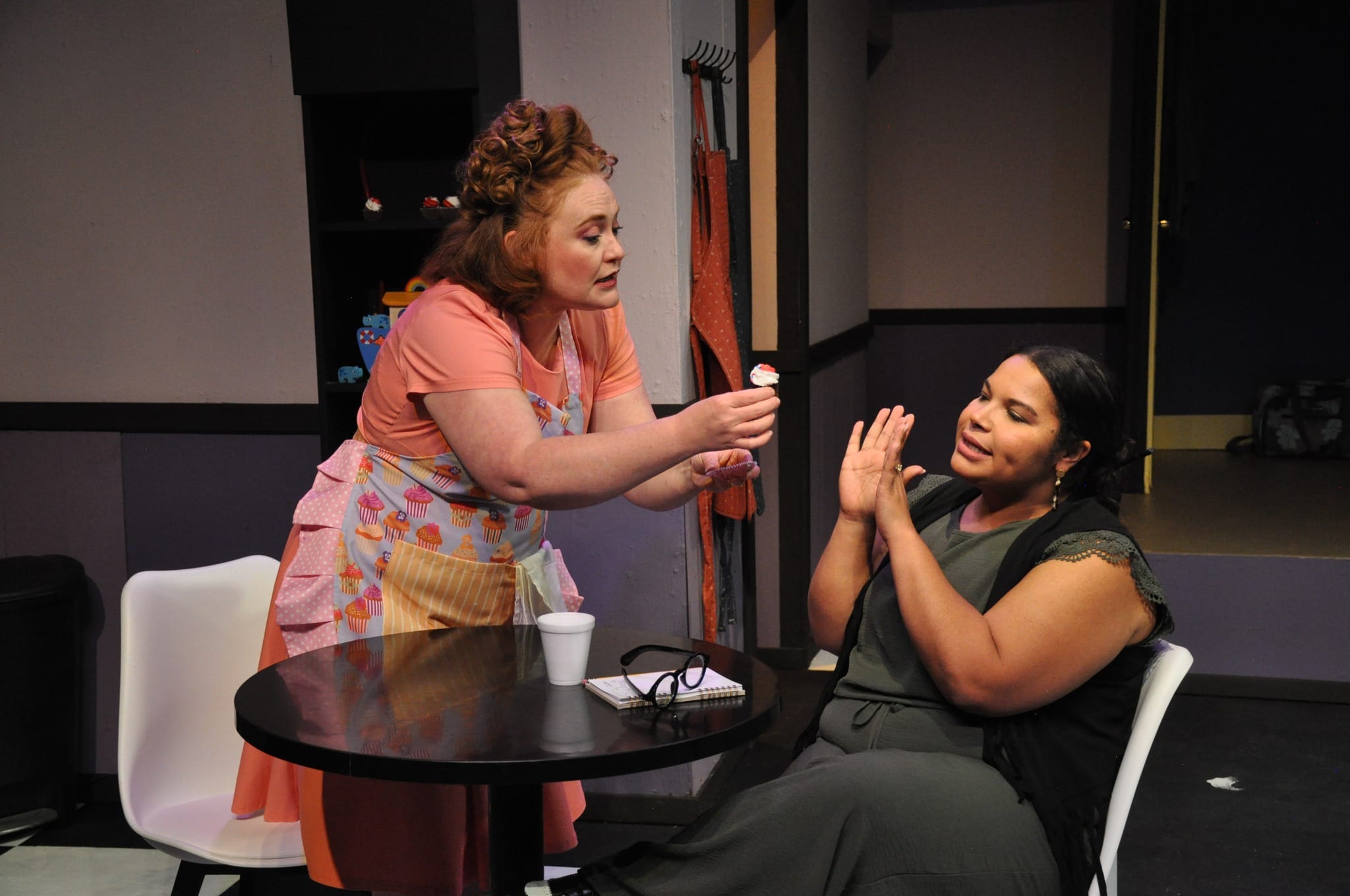
Kelly Uhlenhopp and Jessica Eckenrod in The Cake. | Photo: Soular Radiant Photography
A recipe for discomfort
Uhlenhopp is excellent at playing that contradiction. Her Della is not a cartoon bigot or a joke about red-state conservatism. She is warm, fussy, funny, devout and maddening. When she realizes Jen’s fiancé is actually a fiancée, Uhlenhopp lets the panic creep in slowly. Della does not explode. Instead, she smiles and says October is a very busy month. Uhlenhopp’s performance precisely captures a particular kind of polished cruelty, the kind that insists it is only being polite while making its rejection unmistakable.
Brunstetter’s play is smarter than its logline suggests because it refuses to let Della’s refusal remain the only wound. The Cake is about same-sex marriage, certainly, but it is also about religious guilt, grief, bodily shame, sexual loneliness and the stories people tell themselves to survive inside belief systems that are hurting them.
Kaiser is at the center of much of the play’s dramatic action, as Jen has returned home with the memory of her mother and the hope that some part of her previous life will bless her new one. Her scenes with Uhlenhopp are brutal because both actors understand the depth of the relationship being broken. Della is not a stranger refusing service. She is someone connected to her mother whose approval should not matter anymore but clearly does.
That history makes one confrontation especially hard to watch. When Della tells Jen that she believes her marriage to a woman “would break [her mother’s] heart,” the line lands like a sucker punch right to the heart. Uhlenhopp delivers it with horrifying conviction, and Kaiser’s reaction is shattering. Jen has spent years trying to outrun the religious guilt planted by people like Della, only to find it waiting for her in the one place she hoped might still feel like home.
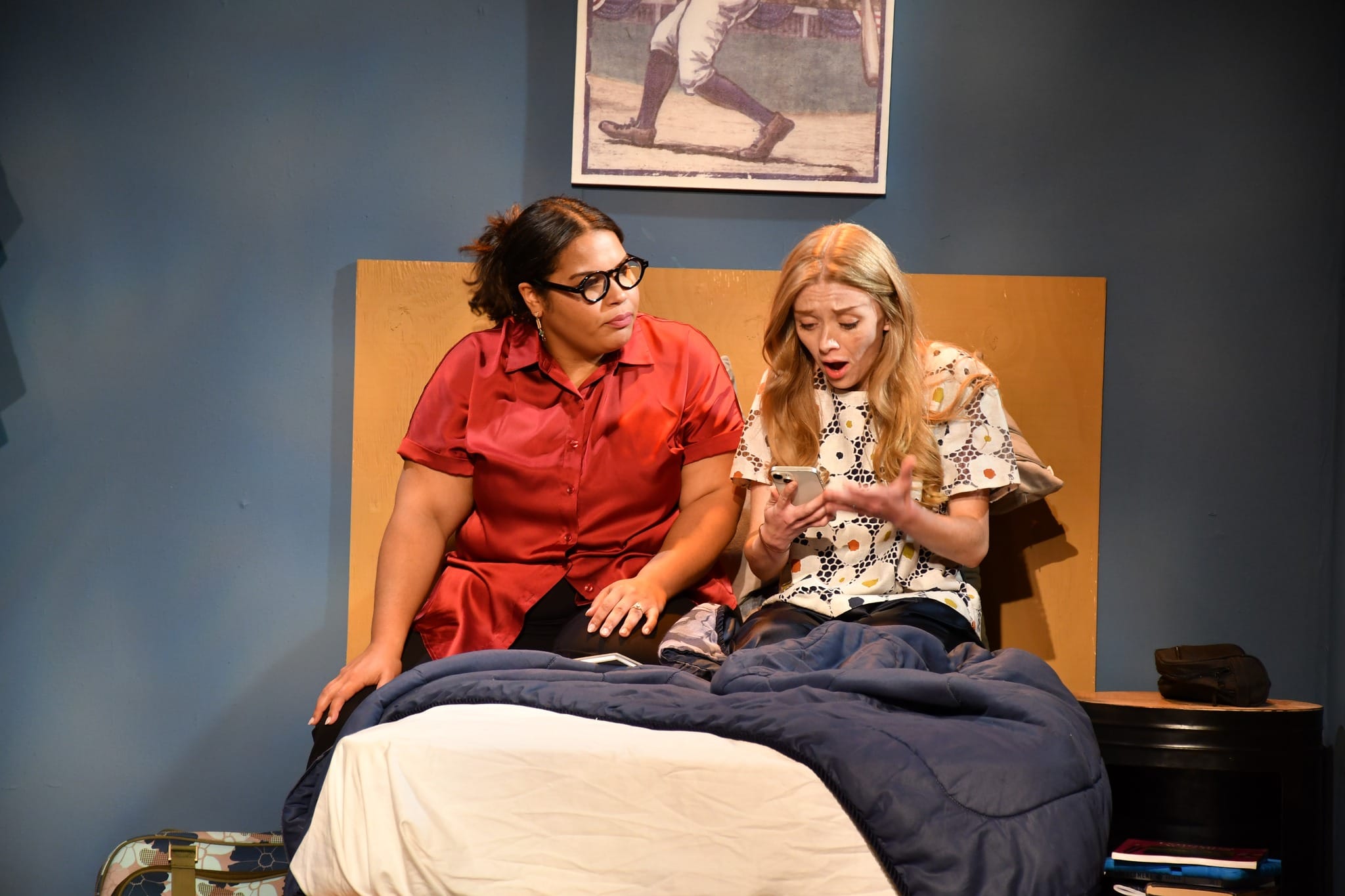
Jessica Eckenrod and Nicole Kaiser in The Cake. | Photo: Soular Radiant Photography
Eckenrod does strong, layered work as Macy, a character who could easily be reduced to a simple liberal mouthpiece. Instead, Macy is principled, wounded, defensive and sometimes cruel in her own right. She is quick to judge Della and Tim’s world, even as she bristles at being reduced by them. Although an article Macy writes about Della does not name her directly, it includes enough detail to cost Della her shot on a baking competition show.
The play does not ask us to pretend that consequence is equivalent to refusing to make a wedding cake. It does ask us to sit with the fact that everyone here knows how to wound.
Jeffer Jesmer rounds out the quartet as Tim, Della’s husband, and George, the exaggerated British judge on the baking show Della dreams of joining. As Tim, Jesmer is both comic relief and a colder presence than he first appears. He immediately supports Della’s refusal to make the cake, not because he has struggled with the question, but because the answer is obvious to him due to their religion. His marriage to Della is loving in some ways and deeply constrained in others, shaped by traditional gender roles, infertility and a sexual distance neither of them fully knows how to name.
The play’s most surprising scenes belong to that marriage. In one, Della tries to seduce Tim in the bakery while wearing frosting on her naked body; however, he turns her down, leaving her covered in sugar and embarrassment. Jesmer plays Tim’s rejection with a bluntness that hurts, while Uhlenhopp makes you feel every ounce of Della’s desperation. A later reconciliation involving mashed potatoes is absurd and oddly tender, one of several moments where the production finds real feeling inside ridiculous theatrical business.
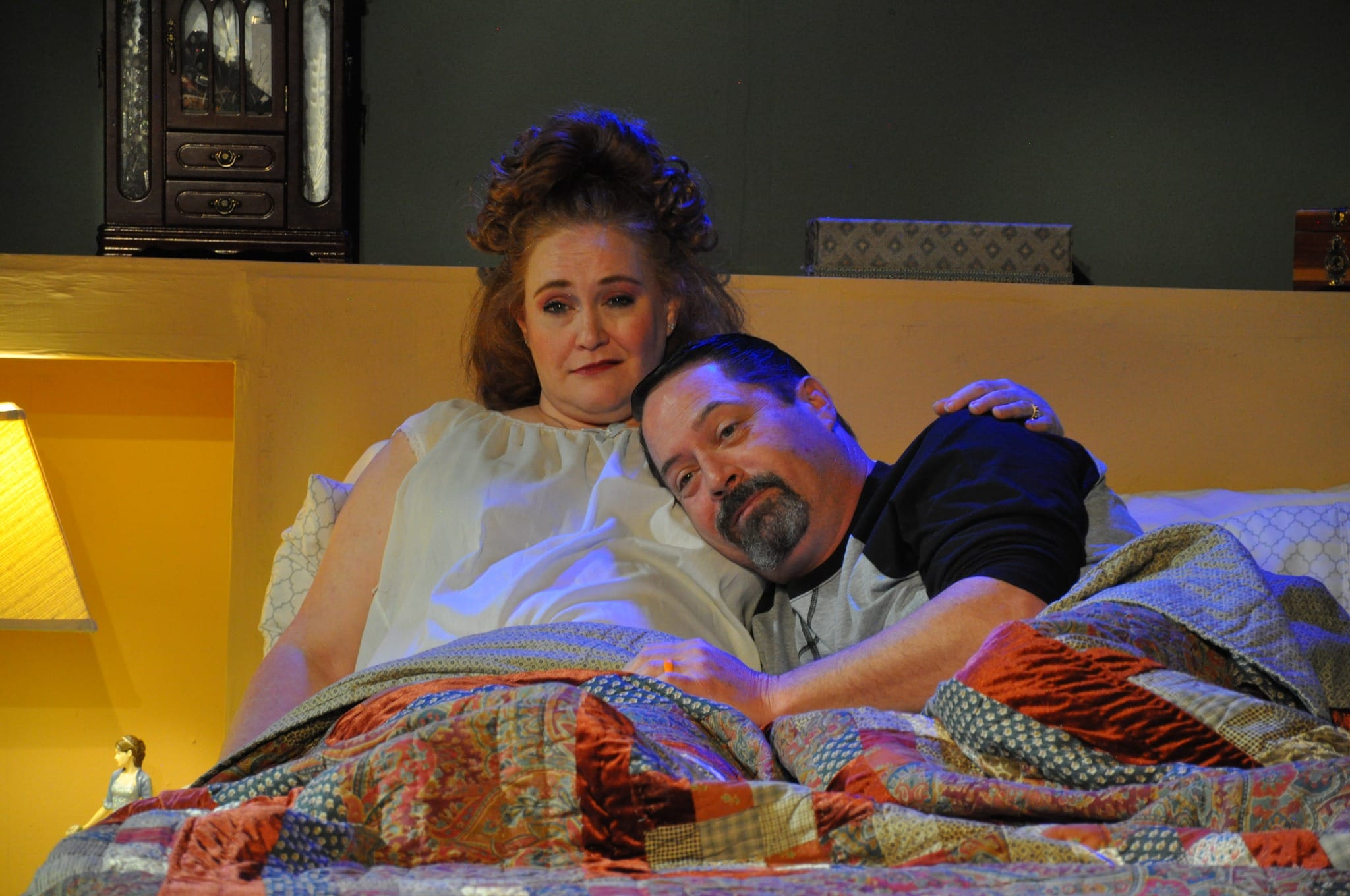
Kelly Uhlenhopp and Jeff Jesmer in The Cake. | Photo: Soular Radiant Photography
No easy sweetness
Lakey’s direction is strongest in these volatile actor-to-actor exchanges. The production trusts silence, discomfort and the danger of people saying exactly the wrong thing. It also handles the play’s dreamlike baking-show sequences with a nice sense of escalation, as Della’s imagined conversations with George begin to expose the doubts she cannot yet admit aloud. Those scenes could easily feel like sketch comedy intrusions, but here they become a window into Della’s unraveling conscience.
The production is less successful in some of its technical execution. The transitions between scenes are long enough to slow the pace, particularly in a 110-minute play with no intermission. A few minutes could likely be shaved simply by tightening the movement between scenes.
Emily Maddox’s lighting design is generally solid, though some of the upstage bedroom scenes, particularly those between Jen and Macy, leave faces caught in distracting shadow. The scenic design by Lakey, Jesmer and Megan Davis is well executed, centered on Della’s bakery with its checkered floor, work station, coffee machine and display of cakes, with two bedrooms on raised platforms in the back. Some of the baking props are less convincing up close, though the individual slices of cake that appear throughout look appropriately tempting.
But none of these minor problems sink the production, because the acting is so strong. Uhlenhopp, Kaiser, Eckenrod and Jesmer make a compelling ensemble, and Lakey keeps the play from becoming either a didactic lecture or a facile plea for easy reconciliation. The Cake does not end by magically transforming Della into someone who fully accepts Jen and Macy’s marriage. Nor does it pretend that one kind gesture can repair years of shame.
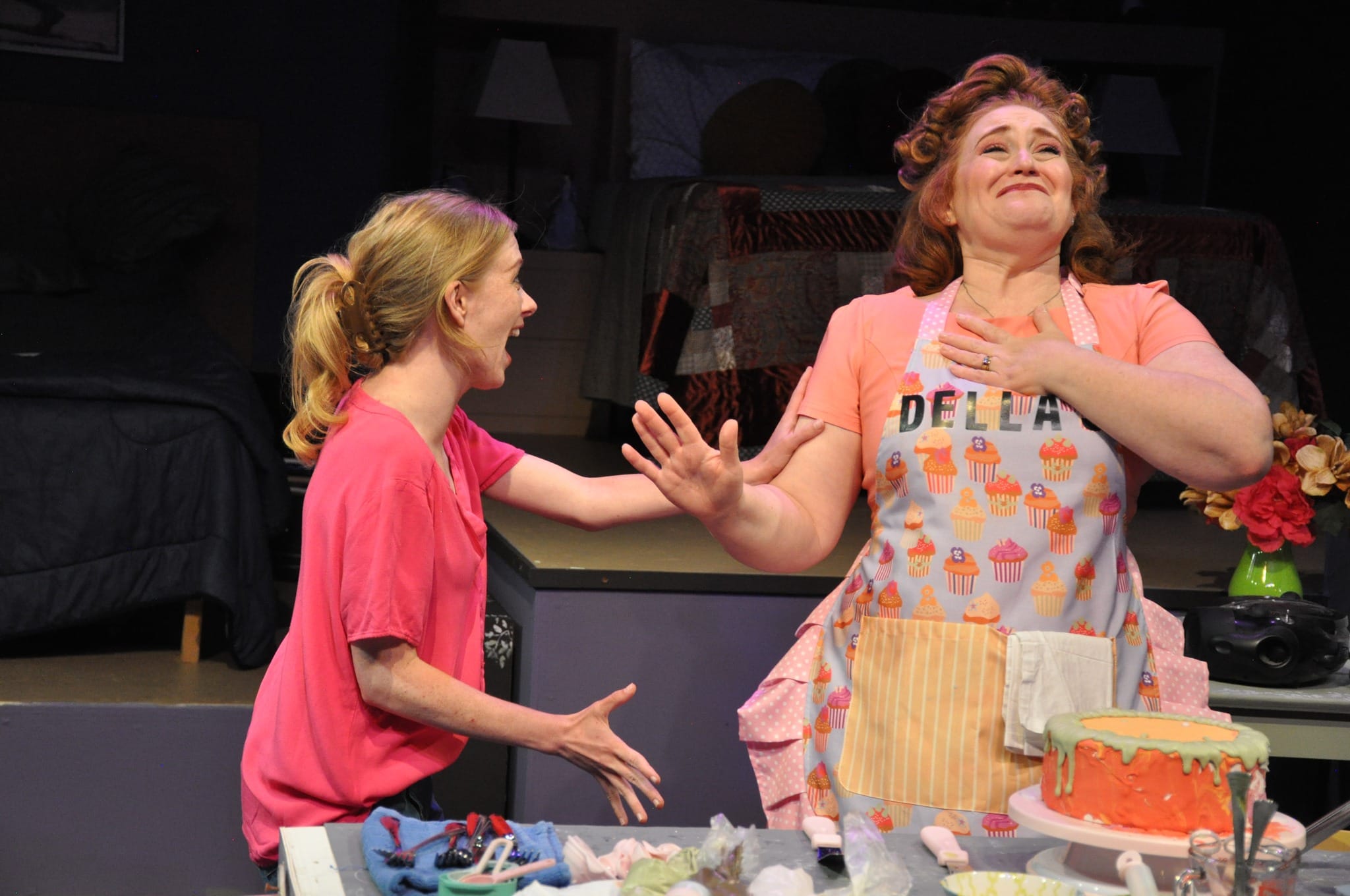
Nicole Kaiser and Kelly Uhlenhopp in The Cake. | Photo: Soular Radiant Photography
By the final scene, Della has made the cake after all, though she still cannot bring herself to enter the wedding. Macy brings her a slice, and the two women share a moment of fragile, temporary grace. Macy, who has spent the play refusing sweets because of her own history with shame and food, takes a bite. Della has compromised one part of herself by making the cake. Macy compromises another by eating it. For a moment, change seems possible.
The play is wise enough not to confuse that moment with healing. Jen and Della’s relationship may never recover. Della’s faith has not disappeared. Macy’s anger has not been neatly resolved. The cake may be, as Macy suggests, Della’s legacy: one good thing offered too late, or perhaps it could be the beginning of something more complicated and messy.
That unresolved ache is what makes Firehouse’s The Cake so effective. It asks what happens when people who genuinely love each other hold beliefs that make that love unsafe. Then it leaves us with something sweeter and more bitter than catharsis: the possibility that change can happen, even when it does not happen quickly enough to spare the people already hurt.

An award-winning Colorado arts and culture reporter originally from Mineola, Texas. Tresca is the chief theatre critic for OnStage Colorado and managing editor of OnScreen Colorado. He’s the editor of Bucket List Community News, a contributor to Denver Westword and Estes Valley Voice, a resident storyteller for the Bonfils-Stanton Foundation and the co-host of the OnStage Colorado Podcast.

Leave A Comment