
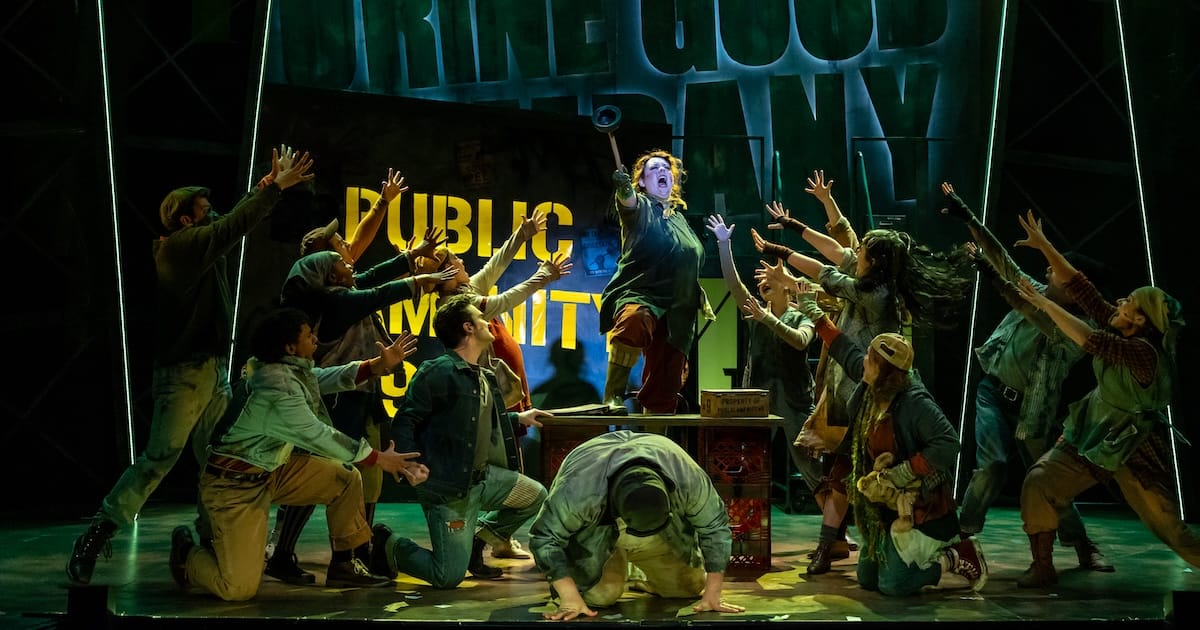
Suzanna Champion’s slick staging leans so hard into the jokes that it dilutes the musical’s dark, timely satire.
A musical about rationing water should hit differently in Colorado this summer.
The state is currently experiencing a widespread drought. In June, after a historically poor snow season, Gov. Jared Polis declared a statewide drought emergency. In Grand County, where Rocky Mountain Repertory Theatre performs, Lake Granby is currently sitting at 30+ feet below normal
That makes Urinetown — Mark Hollmann and Greg Kotis’ Tony Award-winning musical about a 20-year drought that forces citizens to pay a corporation for access to public toilets — sound considerably less ridiculous than its title suggests.
And therein lies the opportunity of Rocky Mountain Rep’s production, running through August 27 in Grand Lake. Director Suzanna Champion has a darkly funny musical about resource scarcity and corporate profiteering at precisely the moment Colorado audiences might be most receptive to its warnings.
Instead, she mostly mines the script for exaggerated jokes.
Champion’s handsome, energetic production pushes nearly every character, gesture and punchline to the extreme. The approach produces scattered laughs, but it misunderstands the tension that makes Urinetown such a durable satire.
The cast of Urinetown in Grand Lake at Rocky Mountain Repertory Theatre. | Photo: RDGPhotography
When comedy becomes cartoonish
Urinetown is plenty silly on its own. Hollmann and Kotis lampoon political musicals and theatrical convention while telling a genuinely grim story about people whose basic bodily functions have been monetized by the Urine Good Company.
Its humor works best when the characters don’t realize how funny things are. Champion largely takes the opposite approach.
Wedler Lordeus’ Officer Lockstock establishes the tone immediately, bounding into the role as a fast-talking, smiling emcee. Lordeus has plenty of charisma, but Lockstock is also an agent of a regime that murders dissidents by throwing them off buildings; his performance loses the menace that lies beneath Lockstock’s jokes.
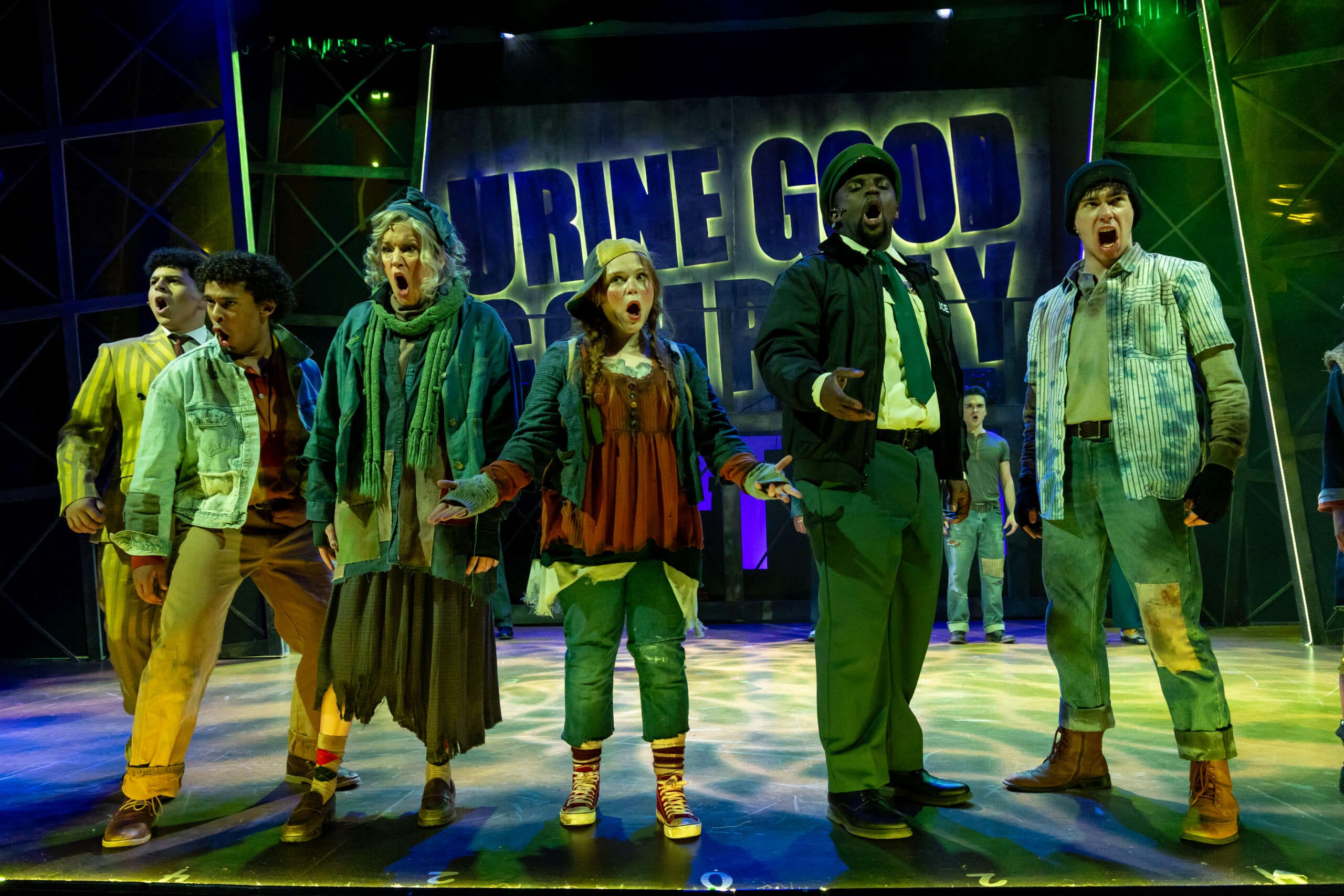
The ensemble follows suit. Impoverished citizens snarl and hunch in exaggerated rags, while Urine Good Company’s wealthy operators announce their villainy through similarly oversized behavior. Brecken Hummer’s Senator Fipp practically folds himself into a Grinch-like conspiratorial pose.
There is intentionality to all of this. Champion notes in the program that Urinetown knows it is a musical and refuses to behave like one.
Yet self-awareness does not require every character to be in on the joke. Satire is sharper when absurd systems are populated by recognizable people who take their circumstances seriously. Here, so many performers appear to be playing comedy that there is little reality left for the comedy to puncture.
Urinetown at Rocky Mountain Repertory Theatre. | Photo: RDGPhotography
The heightened character voices also create a practical problem: clarity. Hollmann and Kotis pack jokes into rapid passages of dialogue and lyrics, so diction is essential. Lines from Lordeus, Brooklynn Stanley’s Little Sally and Tori Kocher’s Penelope Pennywise frequently blur as speed, volume and extreme vocal choices pile on top of one another.
Josh Kellman finds a more productive balance as Caldwell B. Cladwell. During “Don’t Be the Bunny,” he gleefully demonstrates the predatory worldview that built his empire, yet Kellman also finds flickers of paternal warmth opposite Sophia Campagna’s Hope. Those moments make Cladwell more interesting because his argument contains an uncomfortable sliver of logic: The drought is real, and resources are finite, even if his solution enriches him while brutalizing everyone else.
Campagna likewise makes Hope’s sheltered naïveté playful. She and Mitchell Lewis as Bobby Strong, however, establish little romantic spark, making the stakes of their romance feel low. Lewis sings “Look at the Sky” and “Run, Freedom, Run” with power, but Champion directs him less as an ordinary man pushed toward rebellion than as a square-jawed action hero already prepared to lead one. That strong posturing from the outset provides little room for Bobby to transform.
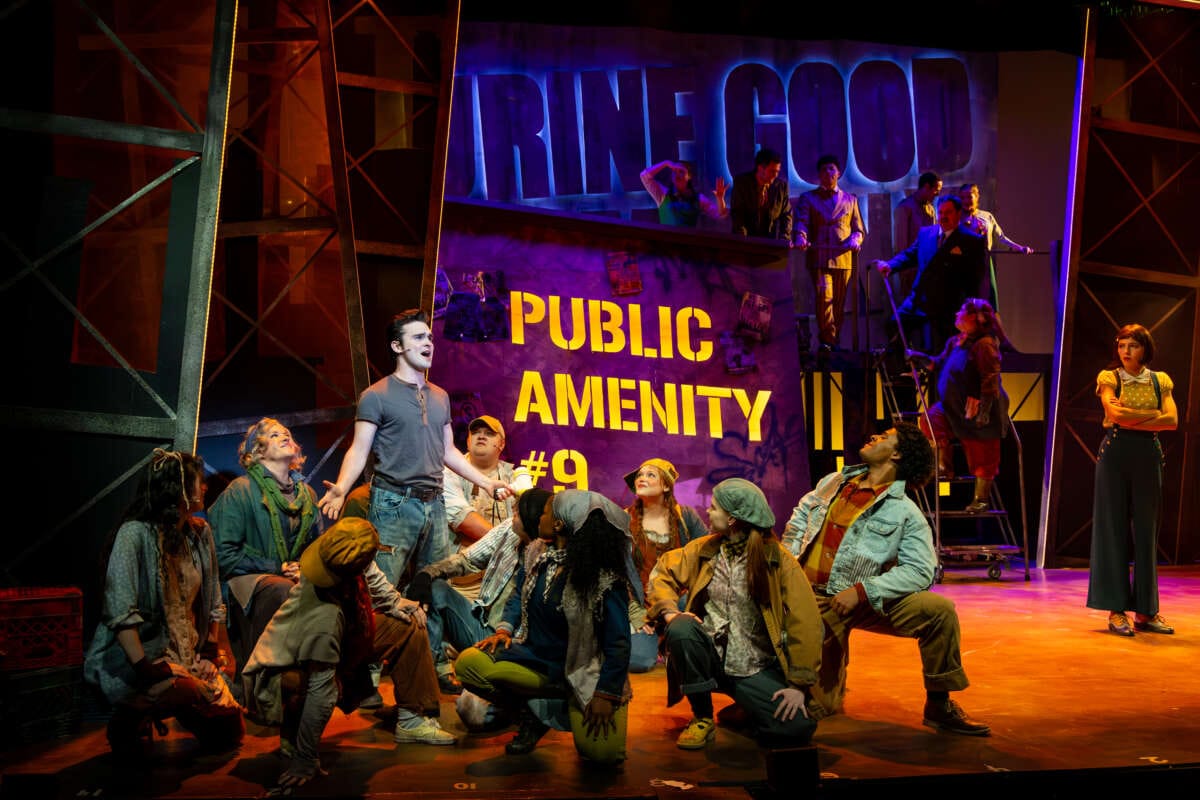
Urinetown at Rocky Mountain Repertory Theatre in 2026. | Photo: RDGPhotography
Movement tells the joke better
Stephanie Hansen’s choreography fares considerably better because it understands how to exaggerate without killing the stakes.
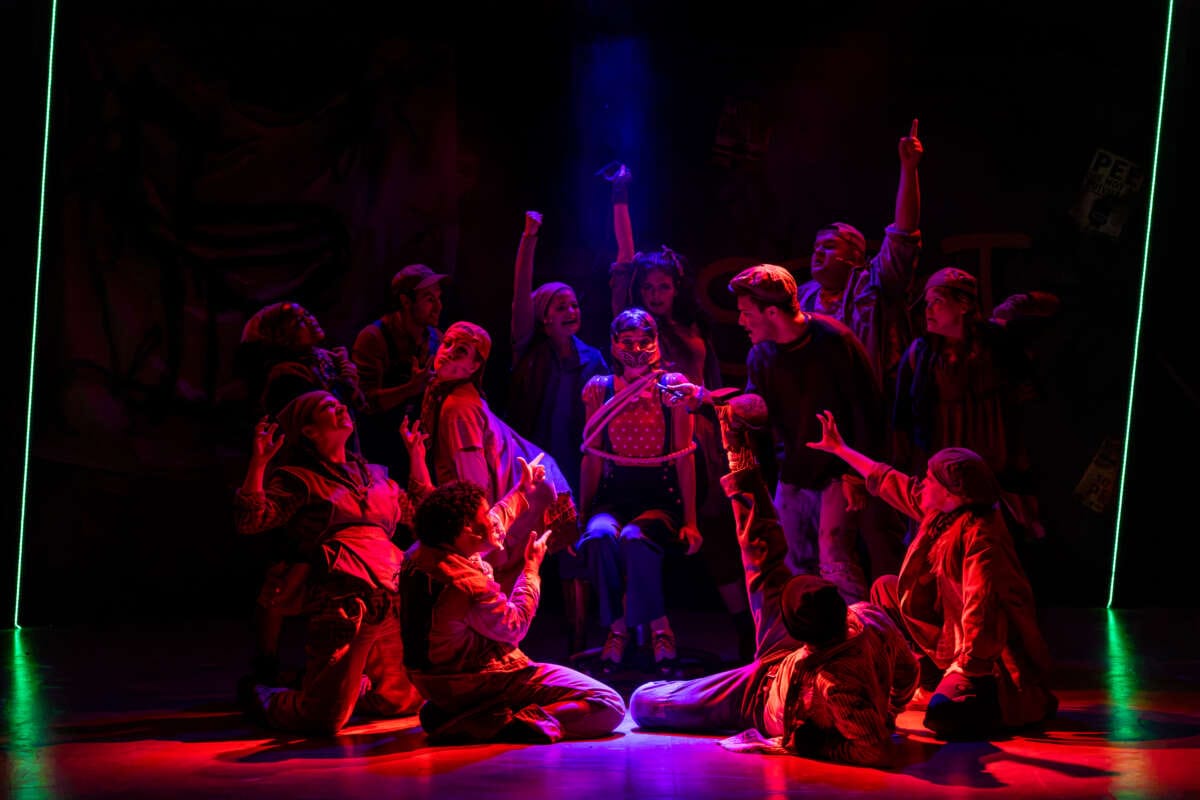
“Don’t Be the Bunny” builds Cladwell’s predatory lesson into clever physical gags involving Cladwell’s evil entourage. “Snuff That Girl” turns a plan for murder into a tightly controlled musical-comedy movement. And “Run, Freedom, Run” expands into an exuberant parody of revival meetings and revolutionary anthems.
The design similarly gives the satire a strong visual framework. Tucker Topel’s scenic design shifts smoothly between the grimy public amenity and Cladwell’s polished corporate world, with the Urine Good Company name looming above the action. Lindsay McDonald’s costumes sharpen the divide between the desperate poor and the moneyed ruling class.
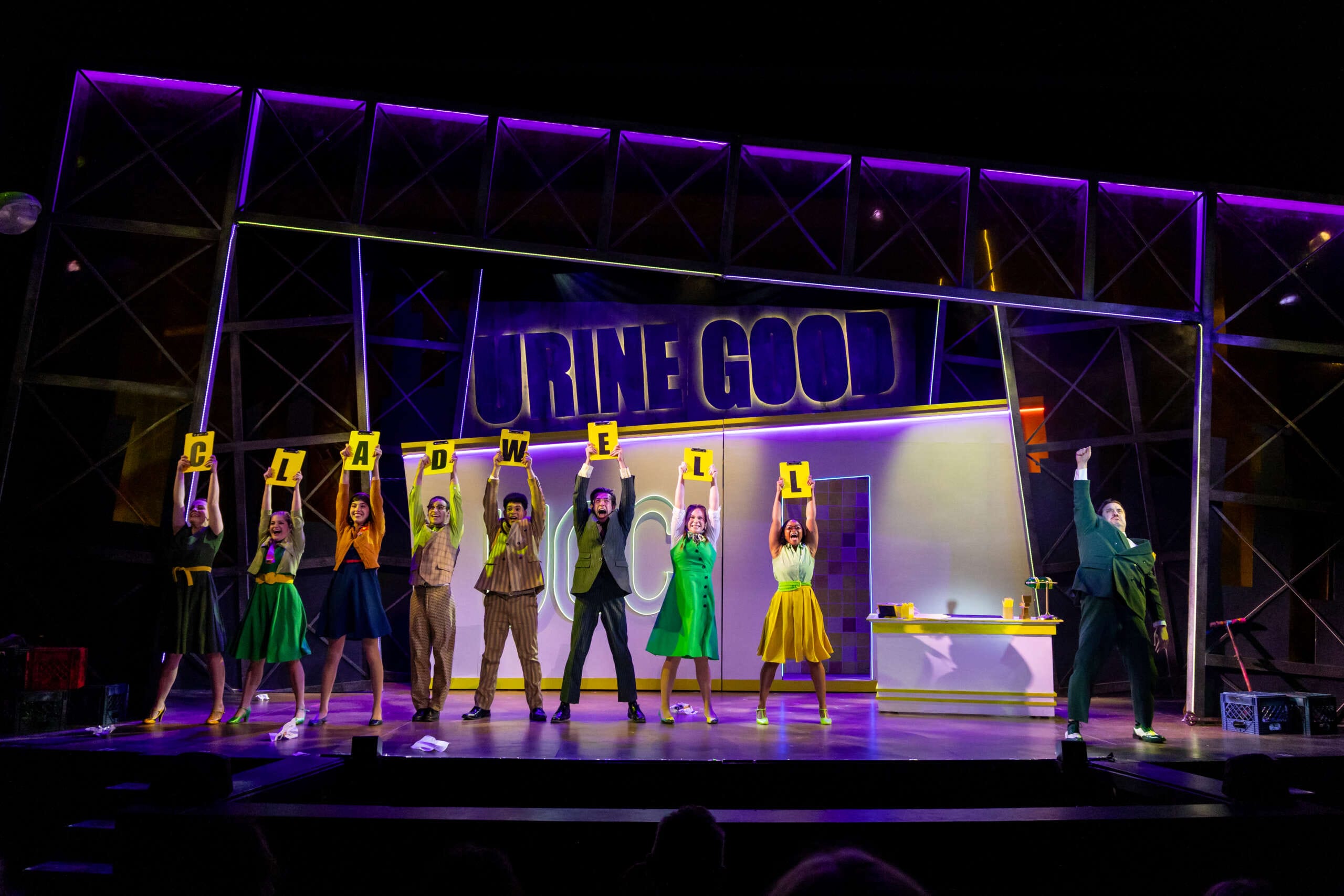
Urinetown at Rocky Mountain Repertory Theatre. | Photo: RDGPhotography
Rocky Mountain Rep has therefore assembled most of what Urinetown requires: strong singers, an eager ensemble, polished design and choreography. What it lacks is commitment to the ugliness underneath the jokes.
Urinetown has endured since its 2001 Broadway premiere because its final joke is crueler than its title. Kotis and Hollmann do not merely mock greedy corporations or celebrate people rising against oppression. They are skeptical of everybody — executives who monetize scarcity, revolutionaries who mistake good intentions for workable policy and musical theatre itself for teaching us to expect righteous rebels to sing loudly enough to solve complicated problems.
That skepticism feels especially potent in Colorado in 2026.
A production staged amid an actual statewide drought has the chance to make Urinetown’s absurd premise feel alarmingly plausible. Rocky Mountain Rep keeps assuring us that none of it should be taken too seriously.
That is a problem for a musical whose best joke is that, eventually, we have to.

An award-winning Colorado arts and culture reporter originally from Mineola, Texas. Tresca is the chief theatre critic for OnStage Colorado and managing editor of OnScreen Colorado. He’s the editor of Bucket List Community News, a contributor to Denver Westword and Estes Valley Voice, a resident storyteller for the Bonfils-Stanton Foundation and the co-host of the OnStage Colorado Podcast.

Whoa – sounds like a personal vendetta against the director to me.