
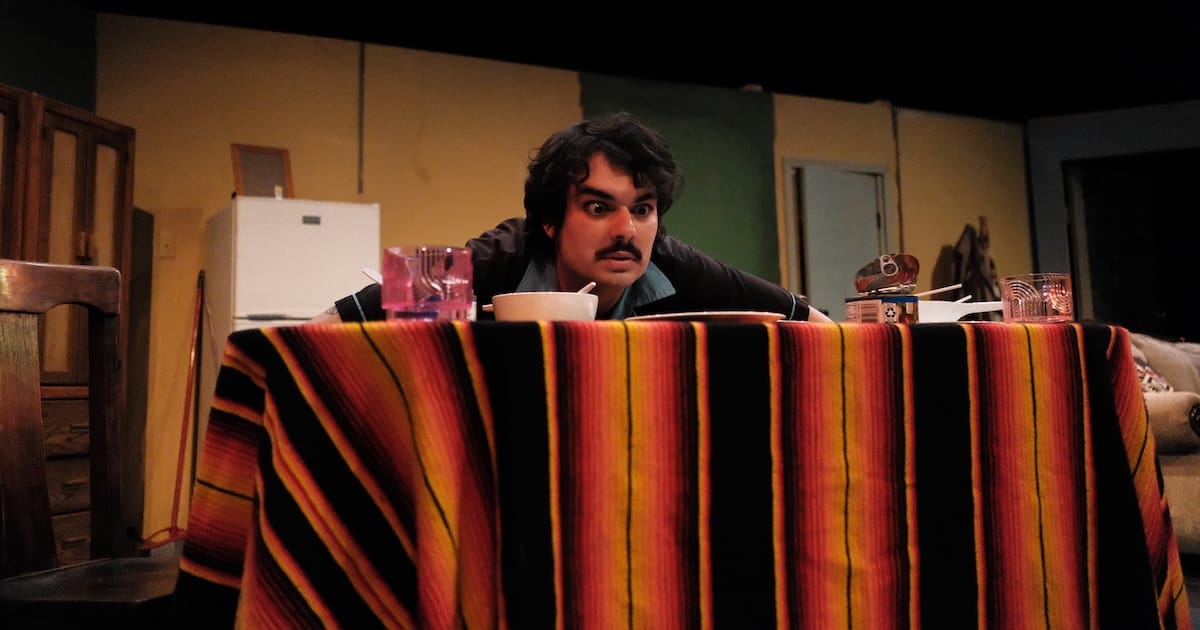
Su Teatro turns affordability concerns into a zany, timely farce about working-class survival.
“We’ve had it! Ya basta! This time, we’re setting the prices.”
In Su Teatro’s No Se Paga, No Se Paga, that rallying cry arrives through Antonia, a working-class Denver woman who comes home from the supermarket with armloads of groceries she cannot afford and a story she can barely tell fast enough. She had gone shopping without enough money, walked into a crowd of women furious over another price hike and watched the manager blame “the free market” while everyone else stared down shelves full of food they could no longer buy.
Then one woman in the crowd says what everyone is thinking. If the store can keep raising prices beyond reason, the shoppers can set them back. Pay what groceries cost last month. Or the month before. Or, if the people in charge still refuse to listen, pay nothing at all. That is the spark that sends Dario Fo’s farce racing.

Adapted by Su Teatro for a Denver barrio in the spring of 1978, No Se Paga, No Se Paga (‘Cant Pay, Won’t Pay’) begins with economic panic and turns it into comic revolt. Directed by Micaela Garcia de Benavidez and Paola Miranda Rodriguez, the production is raucous, deeply silly and sharply relevant, especially when it trusts Fo’s farcical machinery: slamming doors, frantic excuses, mistaken pregnancies, suspicious cops and working-class exhaustion that finally boils over into rebellion.
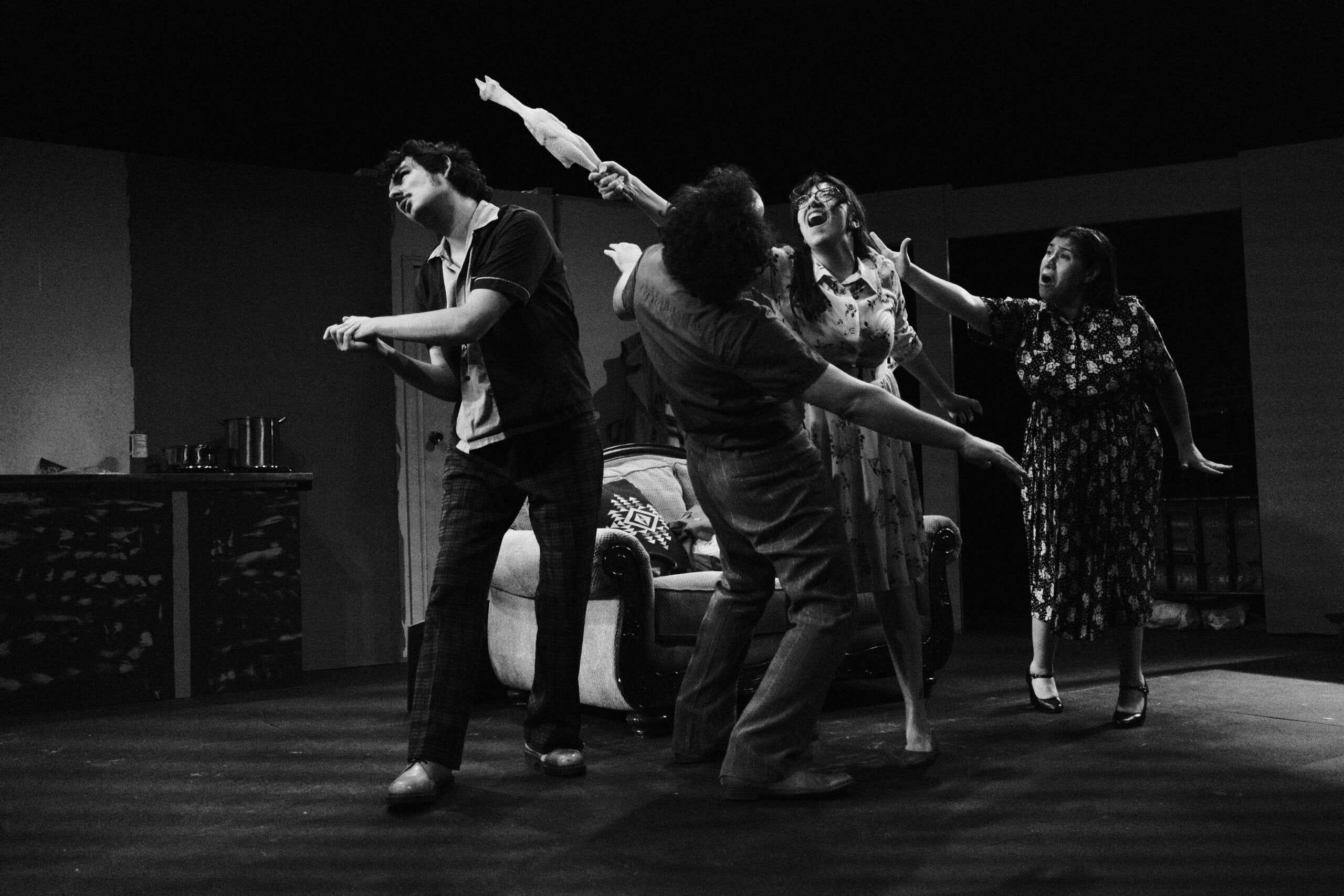
A silly, slow motion fight scene in No Se Paga, No Se Paga. | Photo: Juan Fuentes
A comedy with a lot of doors
Before the action begins, Garcia de Benavidez steps out to warm up the audience and offer a little context. “You have our permission to laugh,” she tells the crowd, explaining that this version blends several versions of the play together, including Su Teatro’s earlier production in the 1990s, with new jokes and local references. Or, as she puts it, “we mixed it all together.”
That spirit of adaptation is key to the production’s success. Rather than treating Fo’s play as a museum piece, Su Teatro turns it into a living, breathing barrio comedy rooted in the company’s long Chicano theater tradition. The cast opens with music, and Kinari, credited as Street Musico, remains visible throughout the evening, perched to the side of the action like a neighborhood witness who occasionally joins the chaos when opportunity presents itself.
Arnold King’s set, which he also designed and lights, gives the production the essential ingredient of farce: entrances. Antonia and Juan’s home sits at the center, complete with a kitchen, refrigerator, closet and enough doors to make everyone’s lies both possible and dangerous. The staging spills beyond the main playing area, with actors racing through the audience, appearing from the back of the theater and making use of a thrust that extends the disorder into the house. A rolling window becomes one of the production’s best devices, allowing characters to spy on escalating police activity outside while keeping the comedy physically nimble.
The plot begins after Antonia (Lucinda Lazo) has already joined the grocery-store uprising. She is not some hardened revolutionary, but after watching the shoppers refuse to accept prices that seem to change by the day, she joins in and returns home with a bounty she cannot explain. That includes useful staples, yes, but also dog food, birdseed and frozen rabbit heads grabbed in the confusion.
Her husband, Juan (Jared Ramirez), is exactly the wrong person to understand any of this. He is poor, hungry and angry, but he still believes in rules that have done nothing to protect him. To hide the evidence, Antonia enlists her friend Margarita (Joelle Montoya), who stuffs groceries under her coat and accidentally appears pregnant. Juan sees the fake belly and wants answers. Margarita’s husband and Juan’s good friend, Luis (Andrew Catterall), has said nothing about a baby. Antonia, thinking faster than anyone should have to think, explains it away; however, the more she talks, the further everyone sinks.
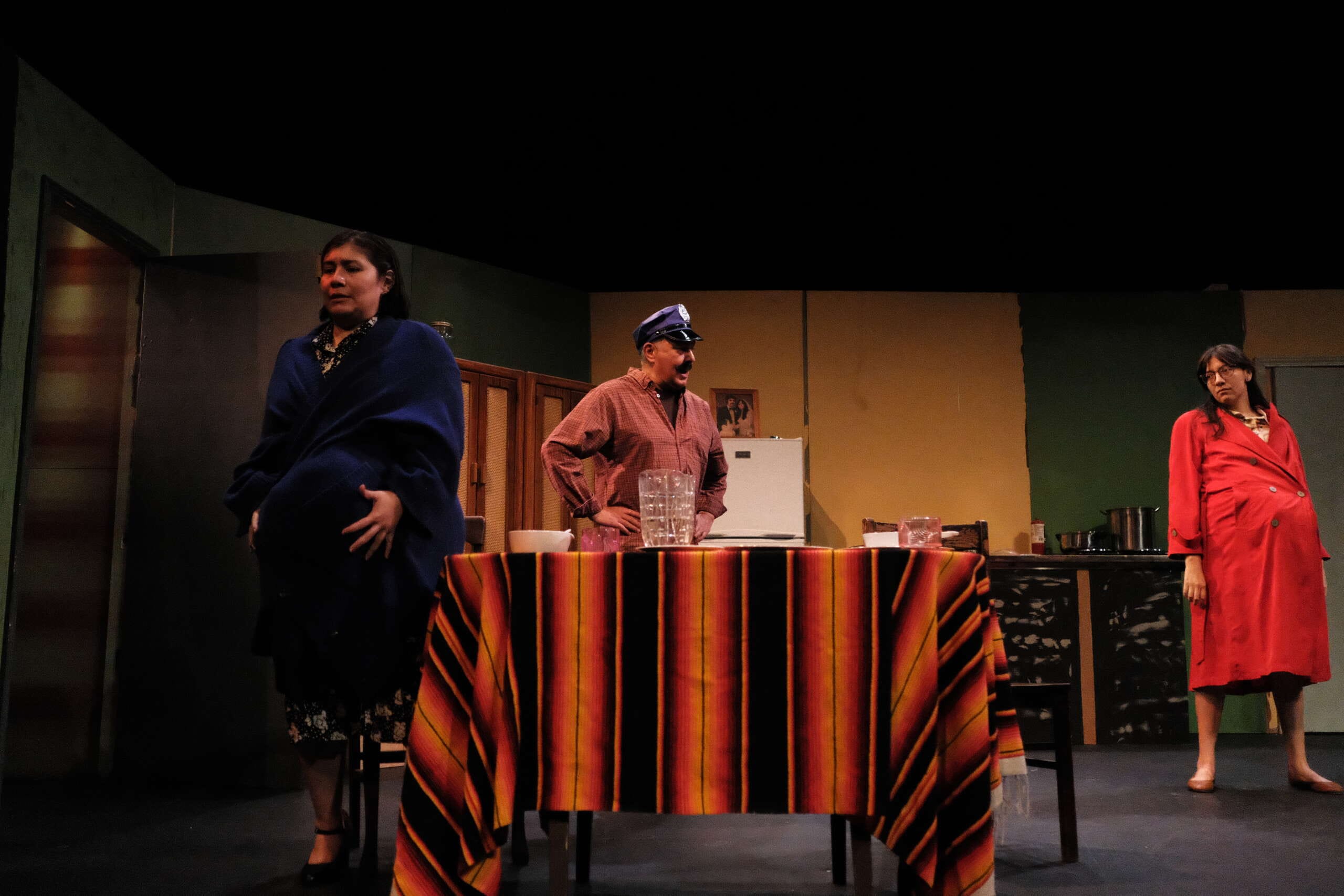
Joelle Montoya, Paul A. Zamora and Lucinda Lazo in No Se Paga, No Se Paga. | Photo: Juan Fuentes
Jalapeños, babies and bad authority
Lazo is terrific as Antonia, the woman at the center of the storm. She is the production’s comic engine, playing Antonia as someone whose intelligence has been honed by necessity. Antonia can talk her way out of any situation, which means she can talk her way into three worse ones before anyone else has a chance to breathe. Lazo’s face registers every new disaster as it arrives, but her body keeps moving, improvising, hiding and redirecting.
Ramirez makes Juan a wonderfully gullible foil. He is not cruel, exactly, but he is infuriatingly committed to respecting authority figures who have done nothing to earn that respect. When the world becomes too complicated, he who would rather retreat into a closet with Dante’s Inferno than confront the injustice unfolding in his own kitchen. Ramirez gives him a sweet, bumbling sincerity, which makes his refusal to see reality even funnier.
Montoya is also a delight as Margarita, especially as Antonia’s lies have an increasing impact on her. Her panic builds beautifully, and the production’s funniest extended sequence arrives when a jar of pickled jalapeños leaks under her coat, convincing everyone that her water has broken. It is dumb in the most sophisticated way. When Juan finds jalapeños on the floor, he accepts them as part of childbirth without questioning the premise.
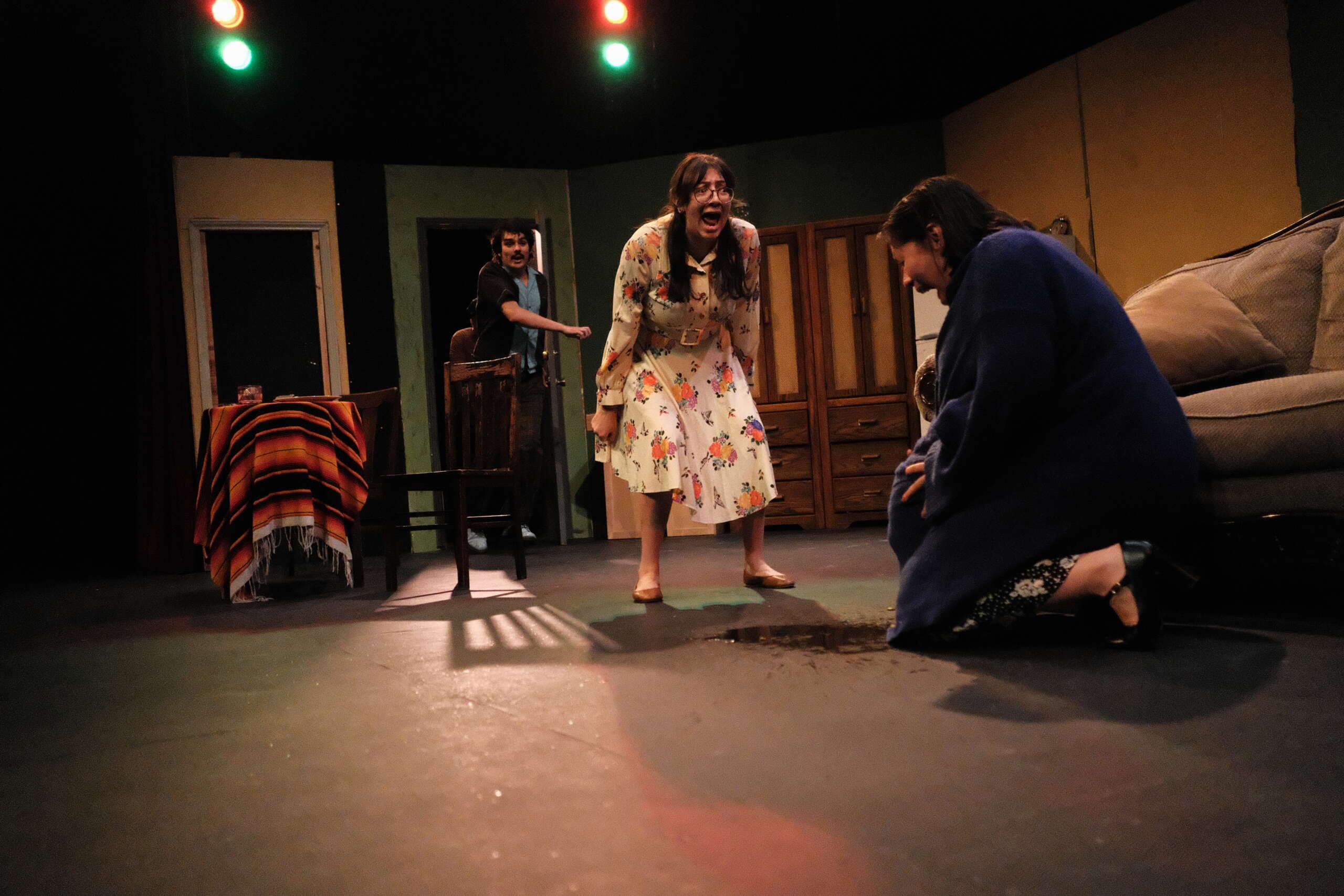
Jared Ramirez, Lucinda Lazo and Joelle Montoya in No Se Paga, No Se Paga. | Photo: Juan Fuentes
The madness continues when Juan tries to explain to Luis where Margarita may have gone. Unable to locate the right hospital, he lands on the “vagynecological clinic,” a malapropism that sounds like an entire OB-GYN department being smuggled through a clown car. The joke works because the cast has fully committed to the show’s internal insanity. By the time Juan starts explaining premature baby transfers and Luis tries to make sense of this medical fantasy, the audience has been trained to accept that one bad lie will always give birth to a worse one.
Shyan Rivera and Paul A. Zamora provide strong support in a series of authority figures, cops and other intruders. Rivera is especially funny as a mustachioed, philosophizing officer whose exhaustion with the system slows the room down in the strangest possible way. Zamora, by contrast, brings a gruff, power-tripping intensity to his roles, making the machinery of authority look both dangerous and deeply stupid.
Catterall’s Luis is less consistent. The character is meant to be both macho and rebellious, and while Catterall nails the broad strokes, some line readings shift the performance into a cartoonish register that feels less grounded than the surrounding chaos.
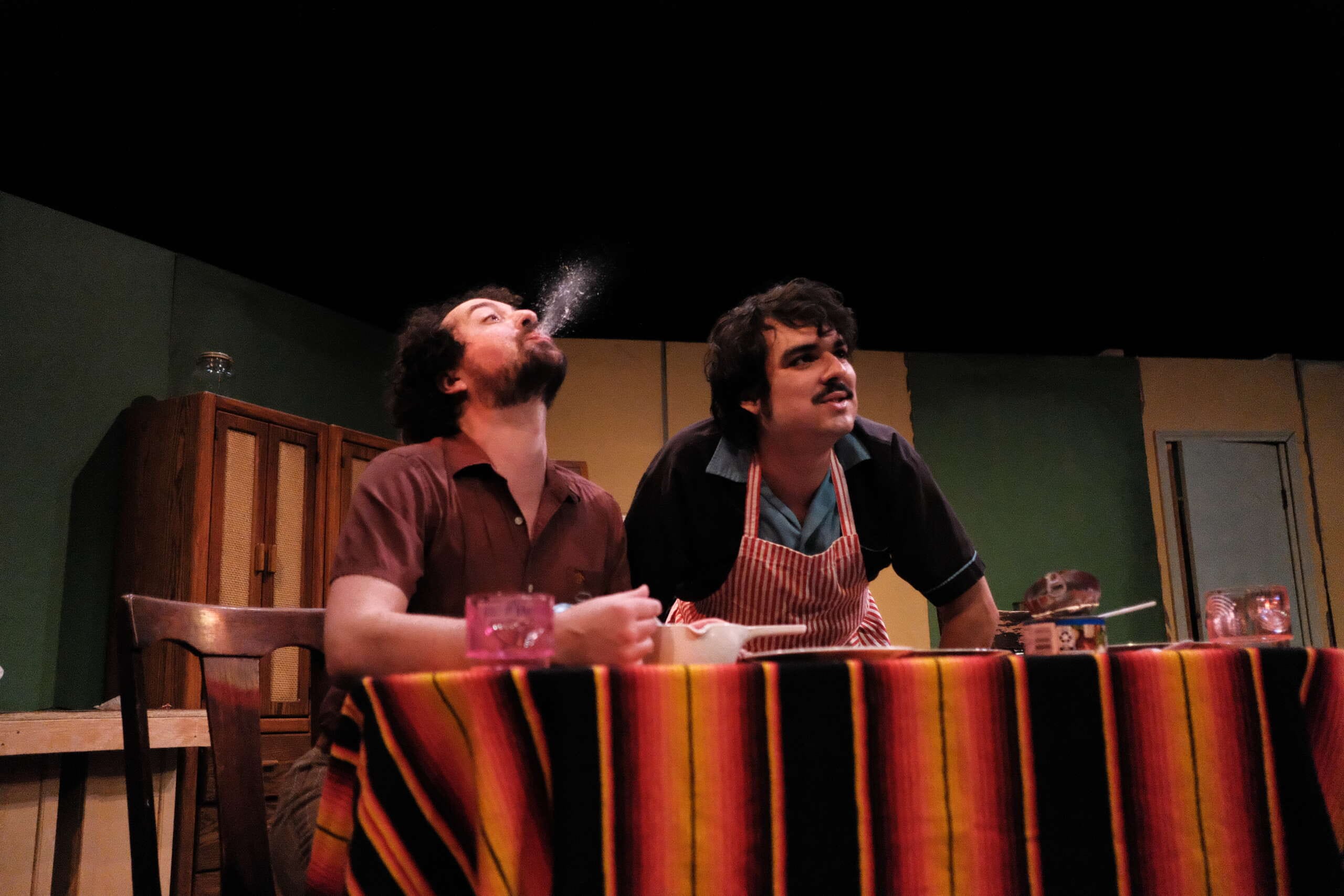
Andrew Catterall and Jared Ramirez in No Se Paga, No Se Paga. | Photo: Juan Fuentes
The joke is already clear
For most of its two-hour-and-20-minute runtime, No Se Paga, No Se Paga moves with admirable comic momentum. Garcia de Benavidez and Miranda Rodriguez embrace direct address, meta-theatrical asides and broad physical comedy without losing the play’s class anger.
The final stretch is where the production overexplains itself. Nyx Garcia Meiring’s video work helps connect the 1978 setting to later political rhetoric and contemporary frustrations, and the cast eventually steps forward to address the audience more directly about revolt and economic injustice.
The impulse makes sense, especially in a moment when the play’s concerns feel painfully legible. Still, the satire has already done the work. We understand who is being squeezed. We understand who benefits. We understand why laughter can become a weapon.
That heavy-handed ending does not undo the pleasure of the evening. Su Teatro has chosen a clever play for a bleak economic climate, and the company delivers it with the kind of communal energy that expertly brings the farcical situations to life. When prices are out of control and the people in charge seem either incompetent or indifferent, sometimes the best you can do is stuff the groceries under your coat, invent a medical condition and keep running.
No Se Paga, No Se Paga cannot solve inflation. But it does provide something nearly as valuable: the freedom to laugh at the absurdity rather than scream about it.

A Colorado-based arts reporter originally from Mineola, Texas, who writes about the changing world of theater and culture, with a focus on the financial realities of art production, emerging forms and arts leadership. He’s the Managing Editor of Bucket List Community News, a contributor to Denver Westword and Estes Valley Voice, resident storyteller for the Bonfils-Stanton Foundation and co-host of the OnStage Colorado Podcast. A member of the American Association of Theatre Critics, he holds an MBA and an MA in Theatre & Performance Studies from CU Boulder.


Leave A Comment