
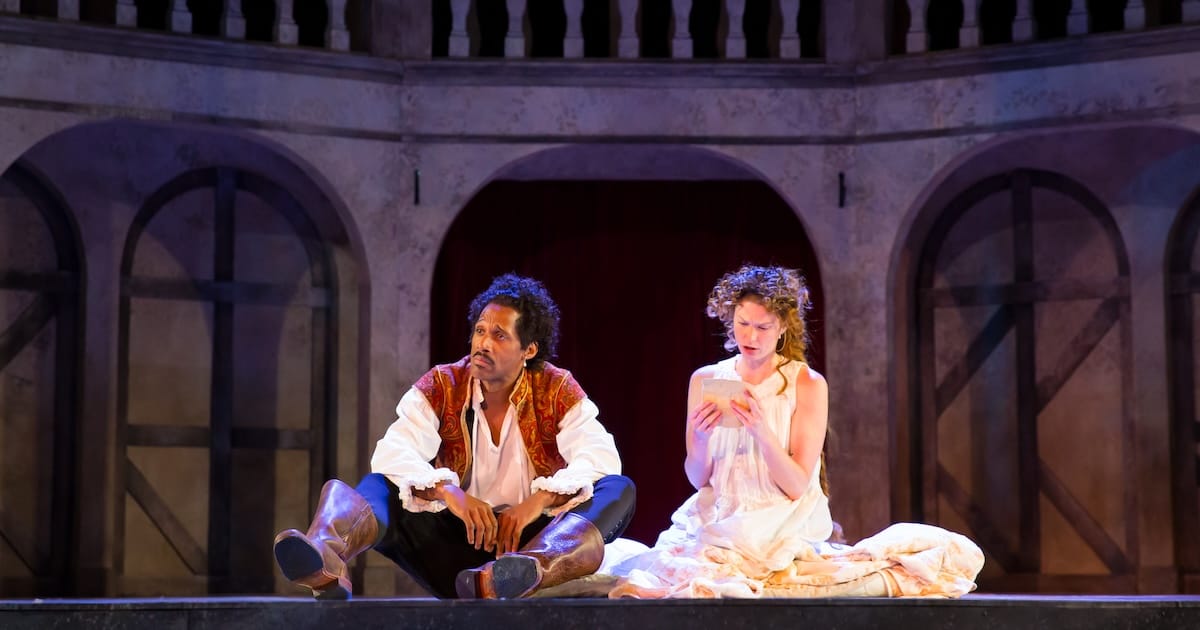
At the newly renovated Mary Rippon Outdoor Theatre, a stacked cast and sharp direction make for a midsummer triumph.
With most of the biographical details of William Shakespeare’s life shrouded in mystery, he yet remains an endlessly fascinating historical figure. Shakespeare in Love takes that nearly blank slate and paints a picture of a chaotic life in the theatre as the young bard struggles to write the script for Romeo and Juliet.
Now onstage in a short run at the Colorado Shakespeare Festival, this comedy soars with a magnificent cast, a brilliant lineup of technical attributes and a director firmly in control of the fast-moving action.
Based on the 1998 film written by Tom Stoppard and Marc Norman, Lee Hall’s 2014 adaptation for the stage hews closely to the screenplay with a few exceptions. For one, the character of Kit Marlowe (Nathaniel Cushing) is elevated as a benevolent frenemy to the up-and-coming Shakespeare (Brandon Carter). Also notable is how Hall’s script incorporates much more of the poetry and elevated language we might expect from the English-speaking world’s greatest playwright and his associate. With a two-and-a-half-hour runtime, there’s plenty of room to slow down in places to surface some of that — a win for an audience of Shakespeare aficionados.
Mostly, though, if you’ve seen the film you’ll easily pick up the plot revolving around starving actors and playwrights, frantic theatre operators and a “real” set of star-crossed lovers at the center of it all.
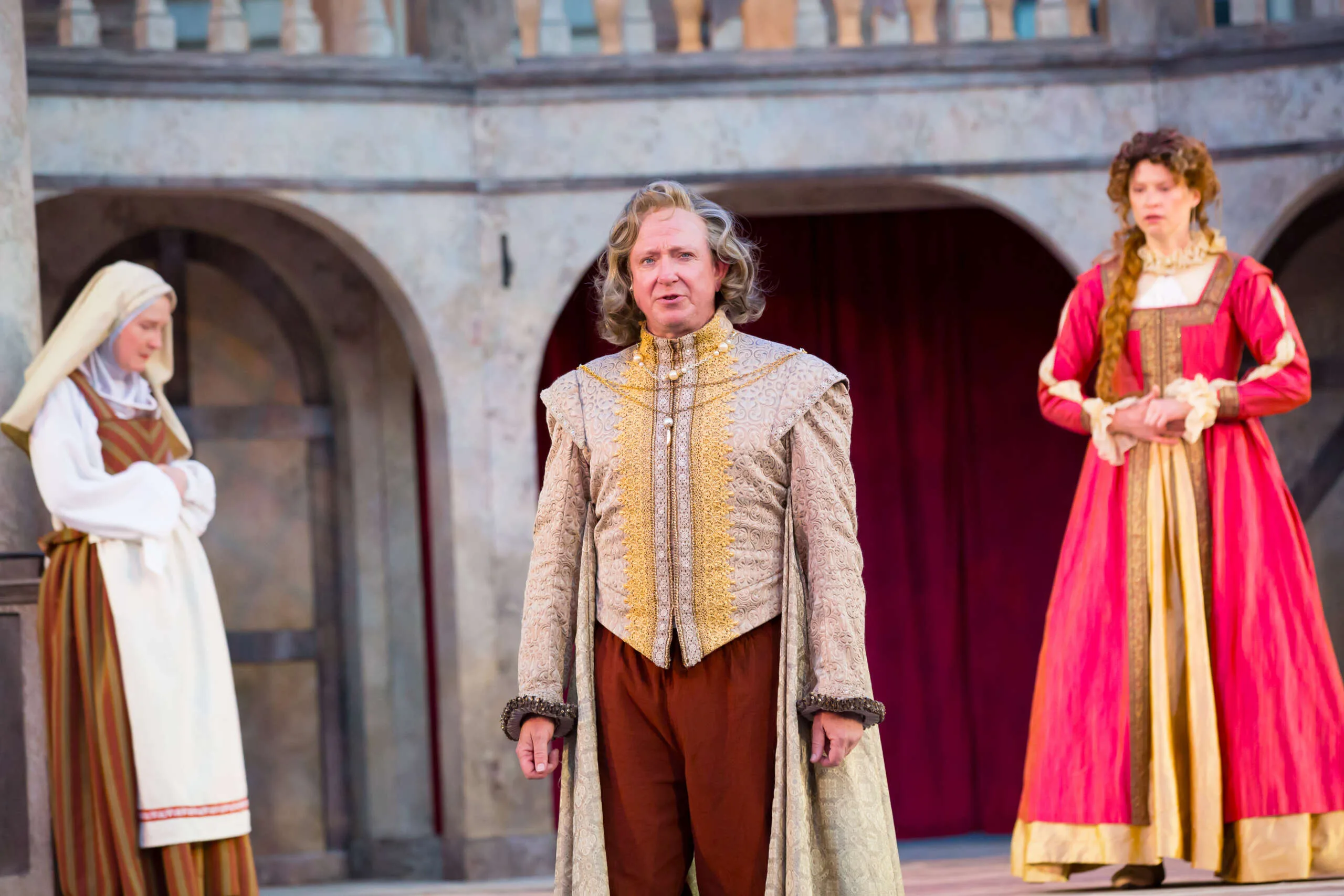
From left: Nisi Sturgis (Nurse) Matthew Schneck (Wessex) and Meg Rodgers (Viola) in ‘Shakespeare in Love. | Photo: Jennifer Koskinen
A perfect show for a midsummer’s night
Shakespeare is the second production to be featured on the stage of the newly refurbished Mary Rippon Outdoor Theatre on the campus of the University of Colorado – Boulder. (Twelfth Night, which figures later in the plot of this one, is the other.) At the July 10 performance I saw, it was an absolutely perfect night weather-wise — always an important factor for outdoor shows.
The story pulls in a number of real persons and tosses them into a comedy that’s equal parts silly and serious as the fictional Viola — high-born yet a big fan of the stage — winds up with Shakespeare wrapped around her finger. Meanwhile, she faces an unwanted marriage to the unpleasant Lord Wessex (CSF regular Matthew Schneck in an inspired performance).
Newcomer Meg Rodgers nails the starry-eyed earnestness and noble carriage of Viola. The actor is simply a delight to watch as she portrays a young woman in utter turmoil yet still looking to realize her dream of being onstage despite the costs.
Borrowing from a familiar element from Shakespeare’s comedies, she is of course going to dress as a boy (“Thomas Kent”) and jump into the acting scene while Will is simultaneously falling for Viola. Compared to how Joseph Fiennes played him in the film, Carter’s Will is a bit less cocky and sure of himself. While he still sees Marlowe as more adversary than friend (indeed, he throws him under the bus completely in Act 2), his willingness to listen to the older playwright’s advice is almost touching in places.
As Marlowe, Nathaniel Cushing invests the character with a swashbuckling persona — the playwright as celebrity gadfly, fixer, confidante and mentor. He has his own ends to focus on, but he nonetheless has time to insert himself in key moments in Will’s life. Impeccably dressed and sporting vivid red hair and mustache, Cushing plays the kind of character whose appearances on stage you always look forward to.
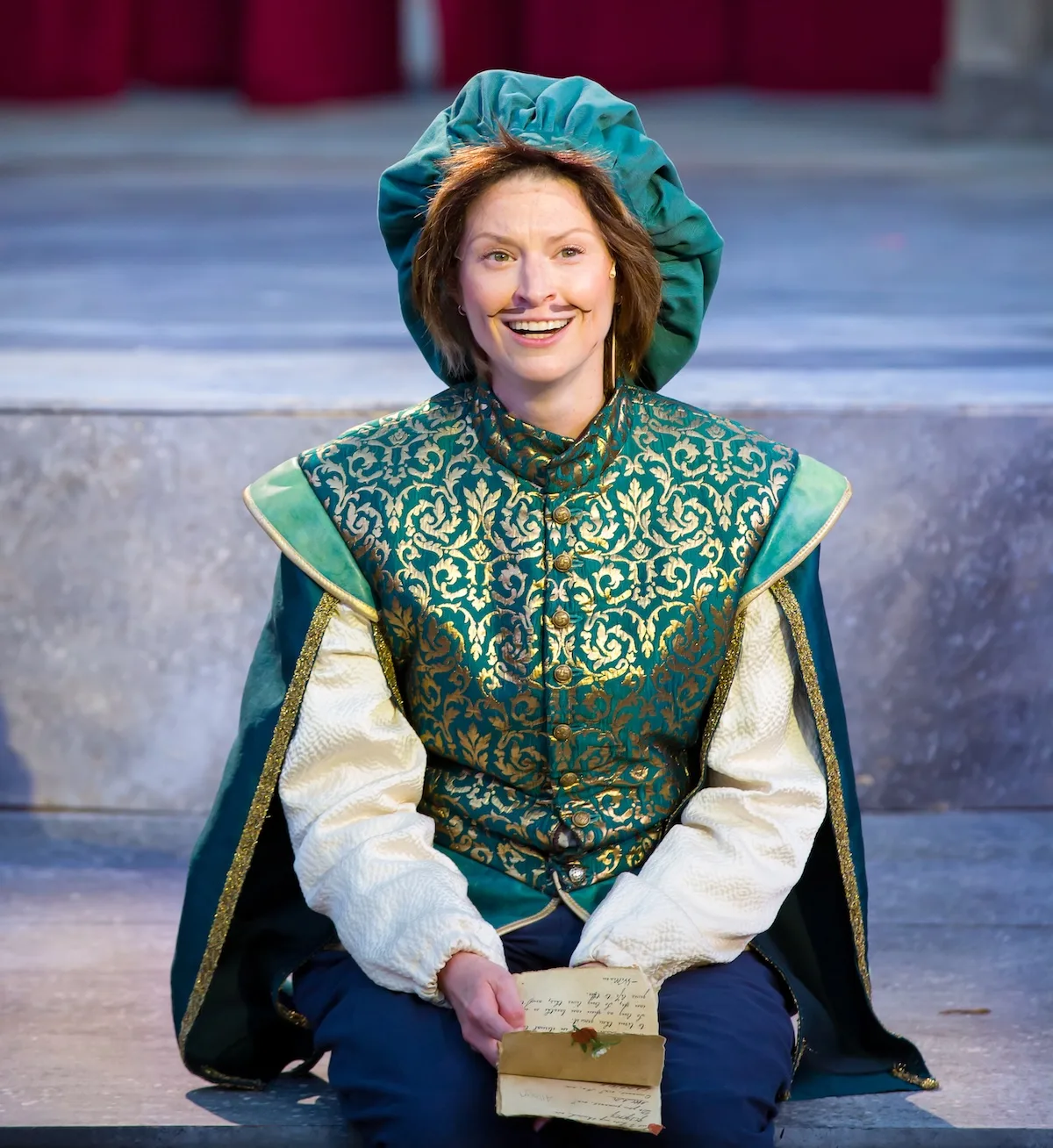
Meg Rodgers as Thomas Kent in ‘Shakespeare in Love.’ | Photo: Jennifer Koskinen
Pirates and profits
While Will labors to produce pages — any pages — for the play, he’s also wrestling with the demands of the owner of the Rose Theatre, Henslowe. To portray the frenetic character more focused on butts in seats than artistic merit, the obvious choice was another familiar CSF face, Sean Scrutchins. Seemingly able to make every line funny, Scrutchins plays Henslowe as a man always on the edge of disaster, yet always hopeful things will work out in the end.
His belief is that Will is writing something with pirates (and a dog!) called Romeo and Ethel, the Pirate’s Daughter.
Henslowe is offset by Fennyman, the money guy, depicted with philistine brio by Brik Berkes. Accompanied by his arm-twisting henchmen Frees (Jordan Pettis) and Lambert (Kenny Fedorko), Fennyman agrees to finance the show in hopes of getting Henslowe’s debt to him satisfied. To the chagrin of the company, he takes a keen interest in the rehearsal process, disrupting the proceedings until Will tosses him a crumb by offering him the tiny role as the apothecary.
While Viola tears about London cross-dressing, rehearsing lines, being wooed by Will and Wessex and lying her ass off in the most charming manner, she’s abetted by her nurse, played by an excellent Nisi Sturgis. Whether it’s facilitating the “plucking” of Viola by Will or staving off a stampeding Wessex, Sturgis is a ton of fun to watch in this role.
So, too, is Tara Falk as Queen Elizabeth. Her first entrance is a banger, highlighted by an extraordinary take on regal clothing by Costume Designer Meghan Anderson Doyle. With a dress and bustle the size of a Buick and an enormous “flying ruff” towering behind her head, Falk as the queen glowers at all around her while assessing Viola’s suitability as a match for Wessex.
Doyle’s designs are stellar throughout, from Viola’s many looks and Wessex’s lordly getup to the simpler dress of the players and tavern whores and the Beefeater costume for Sam Sandoe as the Lord Chamberlain. Praise also goes here for Wig and Makeup Designer Dennis Milam Bensie, whose work throughout the production perfects this highly stylized look of Elizabethan England.
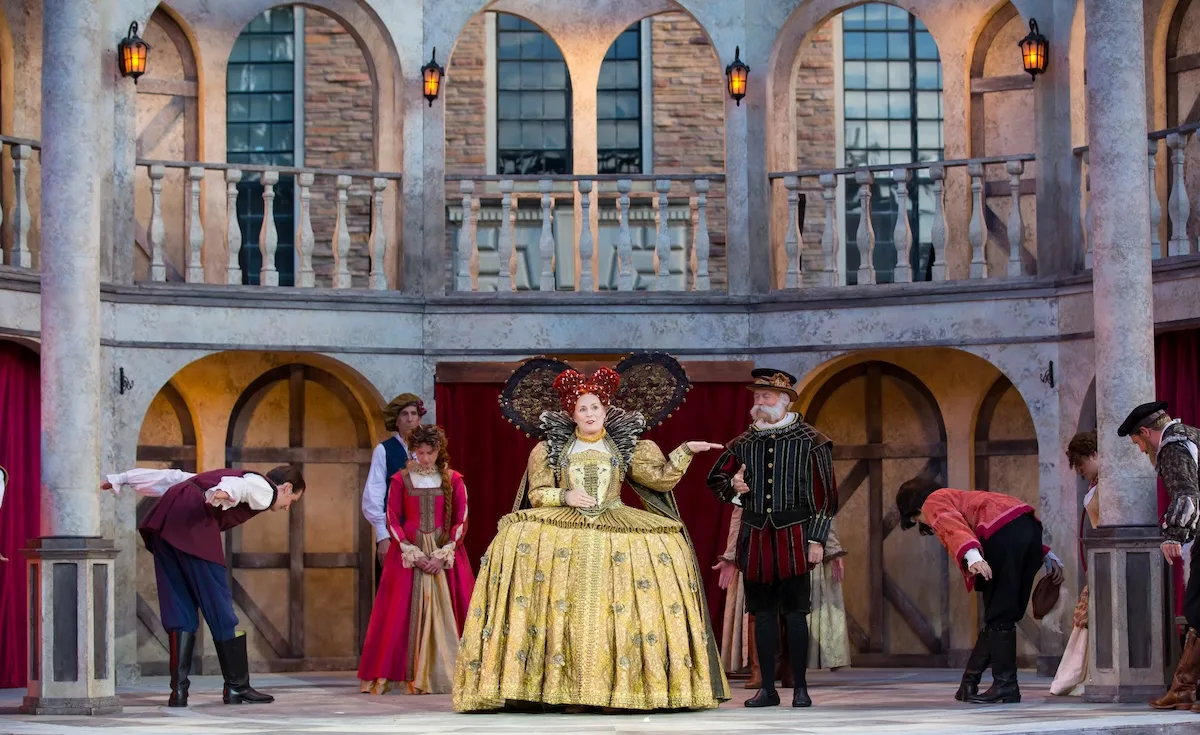
From left: Meg Rodgers as Viola, Tara Falk as Queen Elizabeth I and Sam Sandoe as Tilney in ‘Shakespeare in Love.’ | Photo: Jennifer Koskinen
One neat package
With a 20-person cast (plus dog!), a great many scene and costume changes and dozens of entrances and exits, Shakespeare in Love is a busy show in every way. Director McMahon manages it all with flying colors while adding a number of nice touches. One is seen at the top of the show and throughout as the ensemble flocks to where the action is like a school of fish. Rather than have them try to look busy in the background, they’re in on everything, creating a sense of a true community while making use of all the talent onstage.
Another is a quick set change where white scrims and four poles instantly convert the main room in Viola’s house into her boudoir. As she and Will undress inside, the action is cleverly depicted in shadow with the scene ending as the two unwind the strips that bound her breasts.
Lighting Designer Shannon McKinney has her hands full with this one, starting with the transition from day to night as the sun set in Boulder. With a big lighting update as part of the recent renovation, McKinney takes full advantage — bathing the set in a host of different looks changing much more frequently than they likely would have with the old rig.
Set Designer Matthew S. Crane created a beautiful, classical look at the Rippon for this show (also used with modifications for Twelfth Night). The set’s rounded profile neatly fits into the stage’s outline, while columns and stone rails highlight the two-level, double staircase set. Topping off the tech is Max Silverman’s sound design, balancing a variety of musical stings and interstitials complementing the period music by Paddy Cunneen.
While it’s not a musical, Shakespeare incorporates a good deal of music and dance. Cunneen’s bits are rooted in the sounds of Elizabethan times, with some of the ensemble playing (or at least appearing to play) lutes, lyres and flutes. Choreographer Marla A. Schulz creates the kind of courtly dance you’d expect to see from the time, nicely mixed in with the action. (Schulz also handled the intimacy and movement choreography.)
All told, every element of the production clicks into place in a highly professional manner, serving up an extremely entertaining script for a perfect night under the stars in Boulder.
Although it clocks in at two and a half hours with intermission, the show doesn’t seem overlong. A romantic comedy at heart, Shakespeare in Love also explores behind-the-scenes drama that’s fun to watch. It also treats the act of writing as a blessed thing — something that can take place in public as a bit of performance. Unlikely thought that is in Shakespeare’s time or any other, it underscores the importance of the script at the core of any theatrical piece, however much the promoters and producers may wish to minimize it.
This play-within-a-play-within-a-play represents the kind of complex, comedy-of-ideas business Tom Stoppard was so good at. Others were involved in this script, but that’s his legacy. Lighter than much of his other work, this one is a romp with a mission, and it sends you off into a warm Boulder night remembering exactly why we keep coming back to live theatre.
More reviews from the Colorado Shakespeare Festival 2026 season:

Alex Miller is editor and publisher of OnStage Colorado. He has a long background in journalism, including stints as the top editor at the Vail Daily, Summit Daily News, Summit County Journal, Vail Trail and others. He’s also been an actor, director, playwright, artistic director and theatre board member and has been covering theatre in Colorado since 1995.

Leave A Comment